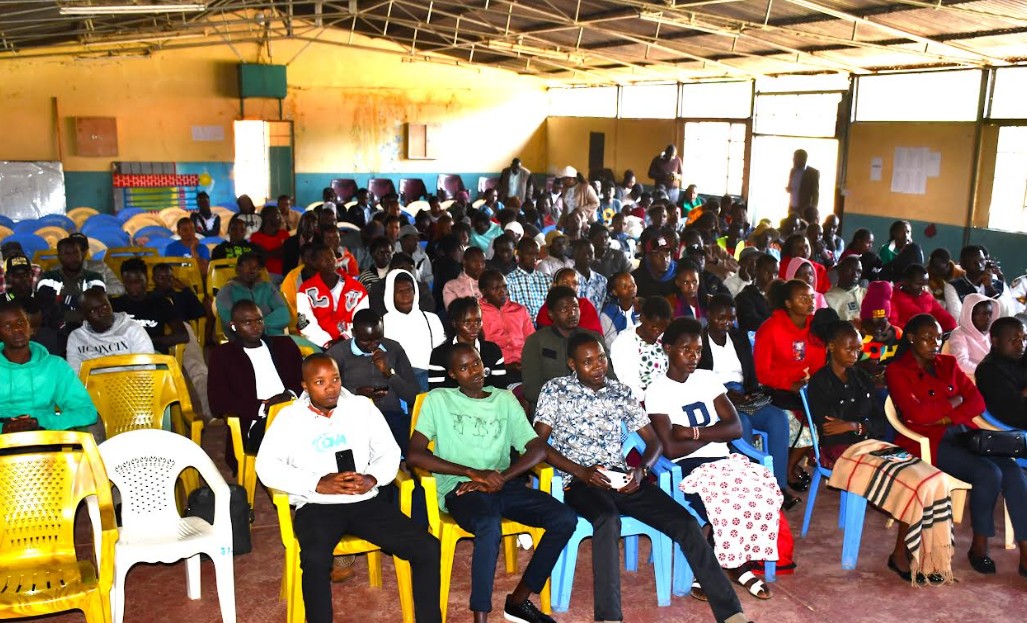
The national government today began training 2,037 youth in Kericho County under the On-the-Job Experience component of the National Youth Opportunities Towards Advancement (NYOTA) Programme.
The beneficiaries reported to various accredited centres for the first day of structured workplace skills placement, marking the official start of the programme in the county.
The On-the-Job Experience programme focuses on providing workplace exposure, socio-emotional skills, and practical hands-on training.
It forms part of the NYOTA initiative, which is designed to improve youth employability and provide access to decent work opportunities nationwide.The launch was held at Kericho Teachers Training College, where Kericho East Sub-County Deputy County Commissioner Dr. Kibe Maguta read a speech on behalf of Principal Secretary Fikirini Jacobs from the State Department for Youth Affairs and Creative Economy.
The PS emphasised the government’s deliberate investment in youth skills development and the smooth transition of young people into gainful employment.
“The On-the-Job Experience component begins with Socio-Emotional Skills Development (SESD), which equips youth with discipline, work readiness, communication, and teamwork skills before they are placed with master craftsmen and employers for hands-on learning,” Dr.Maguta said.
The Principal Secretary highlighted that, nationally, the On-the-Job Experience programme is set to benefit more than 90,000 youth, with over 14,000 already engaged in the current phase.
He described the initiative as one of the largest practical skills and youth employment interventions undertaken by the government in recent years.
After completing the socio-emotional training, beneficiaries will transition into structured workplace placements, gaining practical exposure and mentorship from experienced master craftsmen.
The programme allows trainees to build confidence through real production and service delivery experiences.
“This blended approach of life skills and technical training is designed to improve long-term employability, promote self-reliance, and ensure young people become productive contributors to their communities and the national economy,” he added.
County Director of Youth, Mr. Ratemo Joash, said the distribution of beneficiaries across all six sub-counties was deliberately structured to ensure equitable access to opportunities.
Belgut hosts 475 trainees, Ainamoi 400, Bureti 342, Kipkelion East 274, Kipkelion West 273, and Soin/Sigowet 273.
He noted that this reflects the government’s commitment to inclusive youth empowerment and balanced regional development within Kericho County.
Mr Ratemo explained that the government had contracted service providers to implement the training.
The firms are responsible for curriculum delivery, coordination of Trainers of Trainers, and overall facilitation, while county and sub-county youth officers supervise implementation to ensure compliance, accountability, and quality assurance.
He further disclosed that 82 Trainers of Trainers had been deployed across the county to conduct hands-on training and mentorship. Belgut engages 19 trainers, Ainamoi 16, Bureti 14, and Kipkelion East, Kipkelion West, and Soin/Sigowet 11 each.
“This ensures effective coverage, close supervision of youth, and consistent training standards across all sub-counties,” he said.
Upon completion of the one-month theoretical and socio-emotional skills training, beneficiaries will transition into five months of intensive practical attachment under approved master craftsmen and employers.
Trainees will apply their acquired knowledge in real work settings while receiving mentorship to sharpen technical competencies and workplace discipline.
“The youth will be trained in hairdressing, electrical engineering, tailoring, plumbing, masonry, mechanics, welding, carpentry, hospitality and catering, landscaping, ICT, horticulture, barbering, baking, fashion design, refrigeration and air conditioning, customer service, and entrepreneurial skills, gaining hands-on experience under master craftsmen,” Mr. Ratemo said.
He assured that upon completion, beneficiaries will be assessed and certified, providing national recognition of their skills and facilitating their transition into sustainable economic activities.
The NYOTA Project, financed by the Government of Kenya with support from the World Bank, is structured around four key interventions: on-the-job training and work experience, entrepreneurship support, certification through Recognition of Prior Learning, and strengthened access to labour markets.
By Kibe Mburu