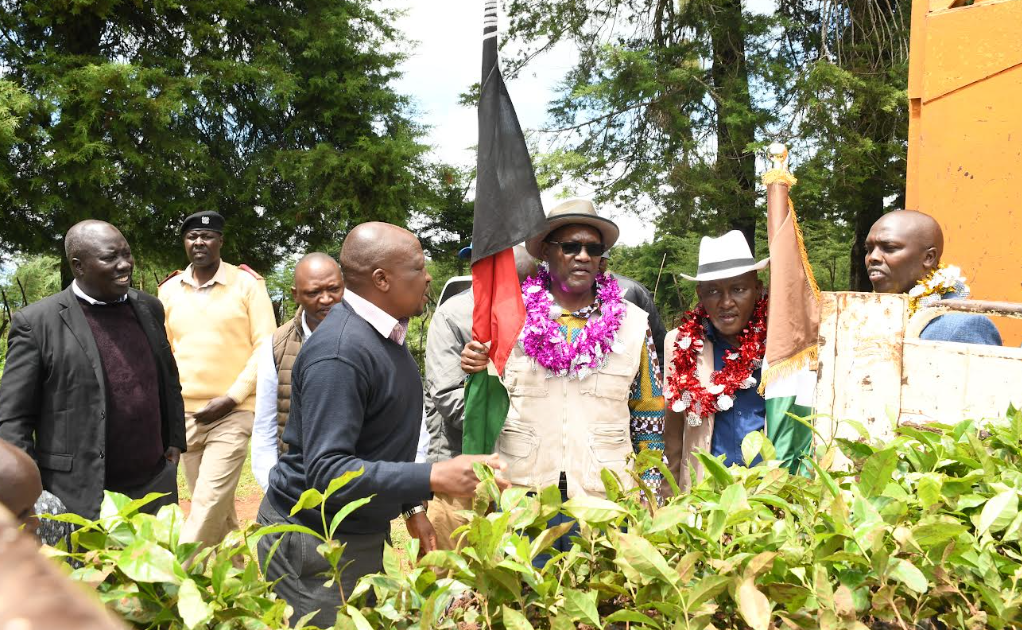
The government, under the Kaptagat Integrated and Livelihood Improvement programme, has distributed 120,000 tea seedlings to farmers in the Keiyo highlands to encourage them to venture into agroforestry.
The Principal Secretary State Department for Irrigation Ephantus Kimotho said farmers would also get 5,000 avocado tree seedlings saying the two crops which do well in the highlands would not only help in conserving the environment but also ensure farmers get money.
Speaking at Kapkoi primary school where he was hosted by his Treasury counterpart Dr. Chris Kiptoo, Kimotho said the country’s economy had started to stabilize due to increased exports citing tea and avocado as part of what the country exports.
The PS called on farmers to form cooperative societies to benefit fully from the programme saying they would be trained on how to take care of tea including being taken for benchmarking to tea growing areas like Nandi Hills to ensure they attain maximum production.
“These benefits will be hard to get as an individual but are easily accessible as a group,” the PS said.
Kimotho said if well managed, one tea bush could produce up to 60kgs per month and therefore with one acre which can accommodate approximately 1,000 bushes, a farmer could earn Sh60,000 per month which, minus the expenses, could come to Sh40,000 per month.
He added that an avocado tree could earn a farmer Sh600,000 per year and that both tea and avocado have ready markets.
The PS said the Kaptagat programme which was started 8 years ago by PS Kiptoo had seen 2,700 hectares of Kaptagat forest restored and was now targeting agro forestry in a bid to encourage farmers to grow trees in their farms.
PS Kiptoo said the programme would see tea and avocado planted in the highlands, coffee along the hanging valley, while mangoes would be planted in the Kerio Valley thereby ensuring that the environment is conserved across the county.
The Treasury PS said the programme has four components which include provision of clean energy through the use of solar and biogas, provision of clean water both for domestic use and irrigation, conservation and livelihood improvement.
Dr. Kiptoo said the event was part of the buildup activities in preparation for the 9th edition of the Kaptagat restoration exercise which would be held in July this year.
The Irrigation PS said his department would sink a borehole at the Kapkoi primary school which would also serve the secondary school and a nearby church
The borehole which would use solar to pump water, would have a storage tank, and it would come with a micro irrigation project which would enable students to use it to plant trees within the compound as part of the environmental conservation exercise, he noted.
“The head teacher has assured me that they will start a 4K club so that each student can plant a tree and water it to ensure it grows,” he said.
By Alice Wanjiru