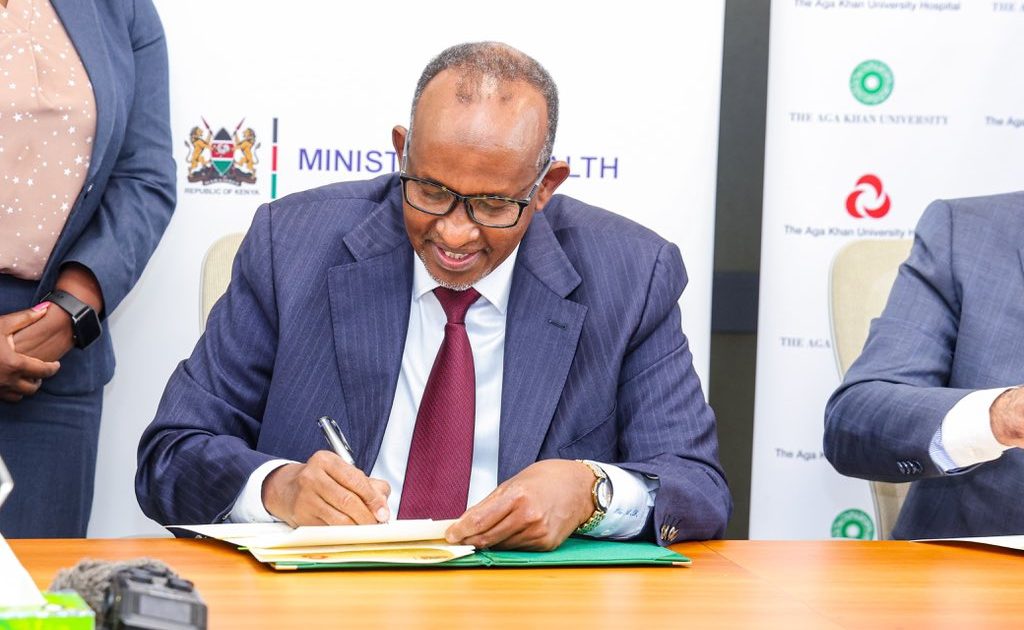
The Ministry of Health, through the Social Health Authority (SHA) Wednesday entered into a partnership with Aga Khan University Hospital (AKUH) at Aga Khan University’s Nairobi campus.
The partnership will provide financial support for Kenyans requiring life-saving kidney transplants and cardiac surgeries, procedures often out of reach for many due to high costs.
The deal was formalized by Health Cabinet Secretary (CS) Aden Duale together with the Principal Secretary for Public Health and Professional Standards Ms. Mary Muthoni, and AKUH CEO Rashid Khalani, in the presence of Dr. Sulaiman Shahabuddin, Vice Chancellor of the University.
According to Duale, the hospital will cover costs exceeding the SHA’s allocation cap of Sh700,000 for kidney transplants and selected cardiac surgeries, including coronary artery bypass grafting (CABG) and valve replacements, for those who demonstrate both medical and financial eligibility.
“Many of the treatments sought overseas are available locally, as this partnership seeks to restore confidence in our local health system by making advanced care more affordable,” Duale stated.
Under the agreement, AKUH will offer subsidized kidney transplants and cardiac surgeries, including coronary artery bypass grafting (CABG) and valve replacements, to patients who meet medical and financial eligibility criteria.
“This collaboration ensures that life-saving procedures are not just a privilege for the few but a right accessible to all Kenyans, regardless of economic backgrounds,” said Duale.
The initiative is grounded in the framework of the Social Health Insurance Act, 2023, which was enacted to actualize Article 43 of the Constitution of Kenya, guaranteeing every citizen the right to the highest attainable standard of health.
The act established three health funds: the Primary Healthcare Fund, the Social Health Insurance Fund, and the Emergency, Chronic, and Critical Illness Fund.
The ministry noted that Kenya’s out-of-pocket health spending stood at 24.3 percent in 2022, with the rising cost of treating non-communicable diseases (NCDs) like heart disease and kidney failure contributing heavily.
NCDs not only affect health but also devastate household incomes, causing up to a 28.6 percent reduction compared to 13.6 percent for other illnesses.
Duale also criticized the country’s dependency on foreign medical treatment, terming it as medical tourism, whereby over 11,000 Kenyans travel abroad annually for treatment, spending an estimated Sh14.7 billion in 2024 alone.
“This trend of medical tourism is based more on perception than reality. With partnerships like this, we are proving that world-class care is possible right here at home,” he said.
Duale urged other healthcare providers public, private, and faith-based to emulate the AKUH partnership and fully implement the SHA Tariff and Benefits Package. He further called on AKUH to generate data on the program’s impact to inform future policy and scale-up efforts.
“This is more than a contract. It is a national commitment to equity, dignity, and the right to health,” Duale said.
Khalani described the initiative as continuation of AKUH’s mission to advance healthcare equity.
“We are honored to work with the Social Health Authority in the national effort to expand access to life-saving surgeries. This collaboration reflects our commitment to giving back to society while upholding world-class medical standards,” said Khalani.
The Ministry of Health affirmed its readiness to support similar collaborations to ensure that no Kenyan is denied essential treatment due to financial hardships.
The ministry expressed gratitude to AKUH for the collaboration and reiterated its readiness to support similar initiatives.
By Daniel Kamau and Victor Kiplagat