Burning of charcoal, overgrazing and clearing of vegetation to create land for cultivation of crops along the Kerio escarpment are just some of the human activities that have resulted in the destruction of the environment, leading to devastating consequences in the Kerio Valley.
These activities have led to not only loss of life and property as a result of landslides when it rains but also formation of deep gulleys which often cut off roads, disrupting economic activities.
As residents strive to create more land for agriculture, their very action results in reduced productivity as the top soils are washed away, leaving the land bare.
This is the situation that Dominic Kemboi, a resident from Kerio Valley working with the NGO Restore Africa Programme, is seeking to reverse by adopting the Farmer Managed Natural Regeneration (FMNR) system, a farmer-driven land restoration initiative.
The Restore Africa Program is a project under the Global Evergreen Alliance (GEA), which is working with other partners, with World Vision being the main coordinator.
Kemboi, having experienced the land degradation and its consequences, was eager to make a change in his area and therefore easily embraced the initiative and volunteered to become a lead farmer who will, in turn, educate other farmers on FMNR.
He says for the two years since the programme started in the county, he has seen great changes and is optimistic that in the next 5 years, as they reach more farmers, Kerio Valley will never be the same.
Kemboi says the benefits of regeneration through the planting of indigenous trees and the growing of vegetation like grass have started to be felt in the area as they hold the soil and therefore stop soil erosion.
I wish the project would have come earlier; this area would be different.” He said.
The farmer added that the grass, apart from providing cover, provides pasture to animals, adding that the growing of indigenous trees does not only provide them with pasture for their livestock during drought but also provides shade in addition to giving them fuel and assisting in fencing their shambas.
“The Ng’swet tree, which grows naturally in this area, is evergreen even during drought and we have always used its leaves to feed our livestock when it gets dry,” he said.
Kemboi says they have also embraced the planting of mangoes, which do well in the area and therefore become a source of income which will not only start giving them money in the next three years once they mature but also qualify them to get paid carbon credits.
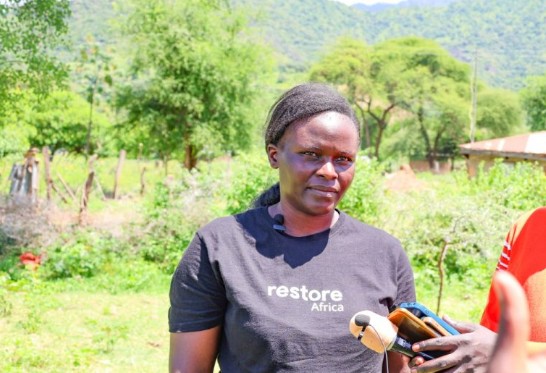
Elizabeth Nyagoha, the Natural Resource Management officer from World Vision, says FMNR is a system where a farmer mostly relies on the farm to regenerate trees through the natural process.
She said all a farmer does is to clear the area where the tree is growing, ensure there is no disturbance and prune the tree as it grows. The farmer then fences using the same prunings using tools such as a panga, which can be found at home.
“This is a cheap way to restore the environment, as all a farmer needs to do is to isolate a place where regeneration occurs and then ensure the tree that regenerates is well managed,” she said.
Nyagoha added that the clearing of the area where the tree is growing ensures that it provides other benefits to the farmer, as he/she can plant pasture for livestock and even crops for domestic use.
“Our aim is not to create another forest within the farm but to ensure that there is interaction with other economic activities within the farm which ensures that farmers earn from the restoration activities,” she said.
She added they also support planting of indigenous trees apart from natural regeneration. The organisation, she said, works with the Kenya Forest Service, who advise on which tree species is suitable for a specific area.
She, however, noted that it was hard to get seedlings for indigenous trees, as most Kenyans prefer exotic trees, which grow faster, though the indigenous were more friendly to the environment.
She therefore said Restore Africa is working with local residents by providing them with the technical skills and tools to establish indigenous tree nurseries, which they will later buy for distribution to farmers, saying their target is to plant 12 million indigenous and fruit trees in the county.
“This is a business opportunity that the youth and women can engage in as we are ready to buy the seedlings,” she said.
By Alice Wanjiru