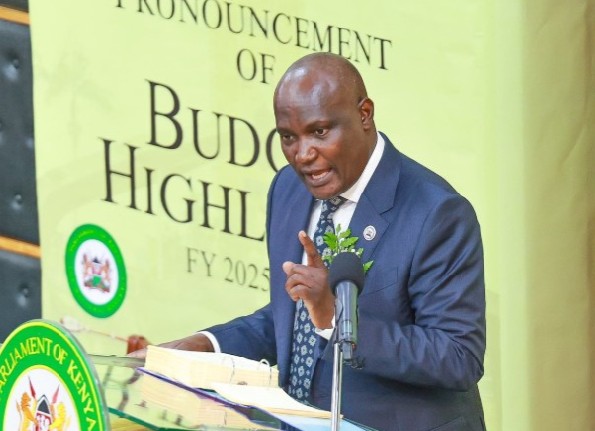
Cabinet Secretary for The National Treasury and Economic Planning, John Mbadi, has unveiled a Sh4.29 trillion government Budget for the 2025/26 Financial Year.
While presenting the Budget Policy highlights and revenue-raising measures for the Financial Year 2025/26 at the National Assembly Chambers, Mbadi said the Budget focuses on stimulating economic recovery and creating jobs under the Bottom-Up Economic Transformation Agenda (BETA).
Looking at Agriculture, the CS proposed an allocation of Sh47.6 billion for various programmes under the sector.
Sh8 billion has been earmarked for the Fertiliser Subsidy Programme, Sh10.2 billion for the National Agricultural Value Chain Development Project, Sh800 million for the Small Scale Irrigation and Value Addition Project, Sh1.2 billion for Food Security and Crop Diversification Project and Sh5.8 billion for the Food Systems Resilience Project.
“The Government will continue to transform the sector by increasing productivity in key value chains, such as fisheries and aquaculture, horticulture, food crops, livestock and rangeland development,” he said.
The CS further said that the government will scale up support to farmers through input financing subsidies and extension services to move the Country from food deficit to food surplus, reduce reliance on food imports and revamp export crops.
In order to promote livestock production, the CS further proposed Sh2.3 billion for the De-Risking, Inclusion and Value Enhancement of Pastoral Economies Programme, Sh1.6 billion for the Kenya Livestock Commercialisation Programme (KeLCoP) and Sh280 million for the Livestock Value Chain Support Project.
He mentioned that under BETA, there will be a roll-out of the fertiliser and seed subsidies to farmers across the country, that has boosted production in key food value chains and revived underperforming or collapsed export crops such as pyrethrum.
Since February 2024, the CS explained that a total of 6.5 million registered farmers have benefited from the Fertilizer Subsidy Programme.
As a result of these initiatives, the cost of fertiliser has declined by 67 per cent, from Sh7,500 in 2022 to Sh2,500 in 2025, while maize production has increased by 38.9 per cent, from 61.7 million bags in 2022 to 85.7 million bags in 2024,” he said.
“This is a clear demonstration of the positive impact of our agricultural reforms towards food security and improved household incomes,” Mbadi said.
In order to secure the uptake of cotton production while providing alternative lint supplies for local apparel manufacturers, the CS said that the Cabinet has approved the revival and commercialisation of Rivatex East Africa Limited by onboarding non-equity strategic partners.
On sugar sector reforms, he noted that the President reaffirmed his commitment to ensure prompt payment of sugarcane farmers.
“The Government has also taken practical steps to deliver its promise to modernise the mills and transform struggling factories into productive, sustainable enterprises,” he noted.
Currently, he said, the four state-owned sugar factories, Chemelil Sugar Company, Muhoroni Sugar Company, Nzoia Sugar Company and South Nyanza Sugar Company (SONY), have been placed under competitive leasing arrangements. This initiative is expected to enhance efficiency.
In order to revitalise and maximise the benefits from cash crops, the CS proposed Sh 2.0 billion for the Coffee Cherry Revolving Fund, Sh 2.0 billion for Coffee Debt Waivers, Sh1.5 billion for sugar sector reforms, Sh120 million for Modernisation and Revitalisation of Cotton Ginneries, and Sh245 million for the Horticultural Produce Compliance Enhancement Project.
To further support local production and processing of edible oils, Mbadi proposed an allocation of Sh300 million for the National Edible Oil Crops Promotion Project.
On milk processing, CS Mbadi proposed an allocation of Sh400 million for excess milk mop-up and Sh150 million for the modernisation of milk processing factories in Runyenjes and Narok.
The CS noted that on custom measures and in order to meet the local demand of rice, Kenya was allowed to extend the stay of application on the EAC Common External Tariff and import rice at the rate of 35 per cent or USD 200 per metric tonne instead of the CET rate of 75 per cent or USD 345 per metric tonne.
Mindful of wheat farmers in Kenya, EAC Ministers also agreed on duty remission of wheat at a rate of 10 per cent instead of the CET rate of 35 per cent, provided the millers who intend to import wheat under the duty remission must first purchase locally produced wheat.
The Total expenditure in the FY 2025/26 budget is projected at Sh4,291.9 billion, equivalent to 22.3 per cent of GDP. Of this, recurrent expenditures will amount to Sh3,134.4 billion, equivalent to 16.3 per cent of GDP.
By Wangari Ndirangu