The Chief of Staff and Head of Public Service (HOPS), Felix Koskei, has challenged African nations to harness technology to enhance product quality, unlock access to global markets, and drive national and regional development.
Speaking in Mombasa during the opening of the 5th Regional Quality Conference organised by the Kenya Bureau of Standards (KEBS) yesterday, Koskei said digital transformation is redefining quality management across industries.
The three-day regional conference is being held under the theme “Future by Design: Shaping Leadership, Technology, and Culture for Regional Resilience.”
The HOPS noted that Artificial Intelligence (AI), advanced analytics, digital traceability systems, and smart manufacturing technologies are enabling organizations to monitor quality in real time, identify risks early, and continuously improve processes.
“The firms that integrate these technologies today will define the industrial leaders of tomorrow,” he stated.
Koskei underscored the need for leaders to design resilient economies capable not only of growth but also of adapting to rapid technological disruption, climate pressures, geopolitical shifts, and evolving global markets.
“The message is clear: in the twenty-first century, nations that succeed will not be those that react to change; they will be those that design systems strong enough to shape it. And if we look carefully at countries that have mastered this art, we discover something interesting: behind every globally competitive economy lies a quiet but powerful foundation- an uncompromising commitment to quality,” he said.
The HOPS explained that South Korea in 1960 was recovering from war, with a GDP per capita of USD 156, and few observers at the time would have predicted that within two generations it would become one of the most technologically advanced economies in the world.
Koskei noted that today, South Korea exports over USD 600 billion worth of goods annually and ranks among global leaders in semiconductors, shipbuilding, and consumer electronics. He linked this rapid transformation to education, industrial policy, and strategic investment.
“But embedded in all these transformations was something less visible but equally powerful: an almost obsessive national commitment to quality. South Korea understood early that in global markets, only excellence earns enduring competitiveness,” he said.
“You do not succeed by simply producing more of the same. You succeed by producing better, measurably, consistently, and verifiably better. Quality, therefore, became more than a technical function,” he added.
On deeper regional integration, the HOPS noted that it requires a shared commitment across borders, with firms, regulators, and institutions operating under consistent standards, certification, and continuous improvement.
“Such a culture fosters trust, competitiveness, and sustainable growth, forming the foundation of regional resilience,” he said.
He affirmed that countries admired globally have deliberately designed their futures through discipline, strong systems, and an unwavering pursuit of excellence.
“No nation ever became first-world by accident. No economy ever achieved global competitiveness by lowering its standards, and no society ever built lasting prosperity on compromise,” he stated.
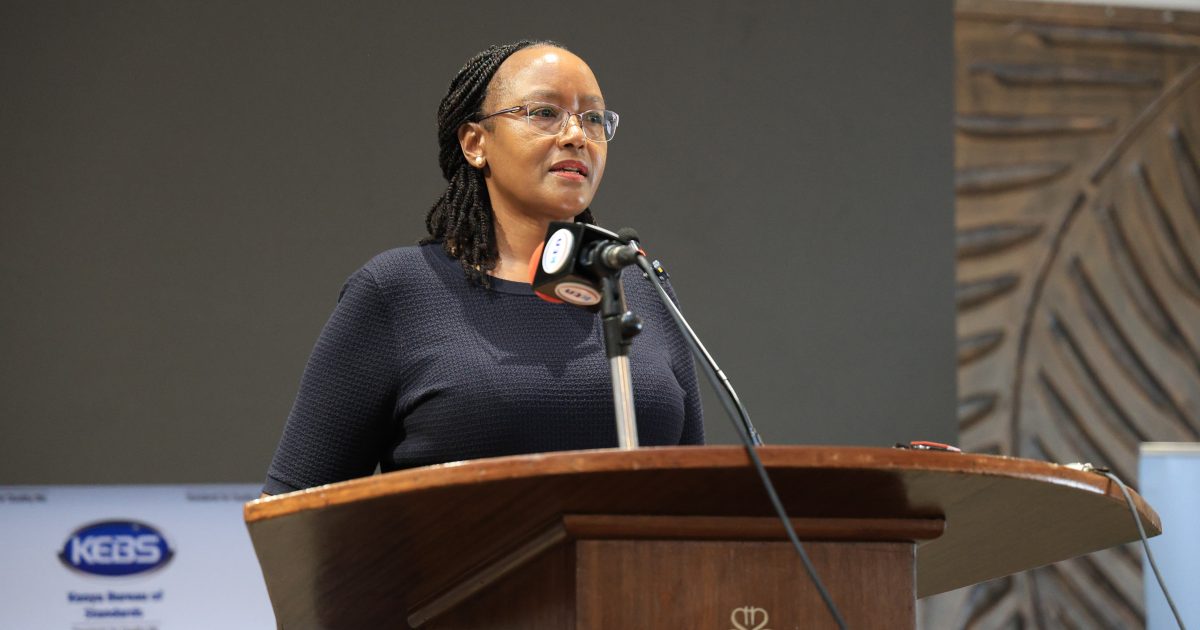
KEBS Managing Director (MD) Esther Ngari echoed the HOPS’s sentiments, noting that the future of quality will not be built on inspection alone, but also on systems, leadership that treats quality as strategy, technology that enables real-time assurance, and a culture that makes excellence habitual rather than exceptional.
KEBS MD emphasised that quality is not delegated but owned, embedded in boardroom decisions, investment choices, and performance metrics. “As leaders, the question is no longer whether we can afford to invest in quality; it is whether we can afford not to,” she said.
She noted that technology is already redefining how organizations monitor compliance, predict risk, and assure consistency.
“At KEBS, we are actively aligning our systems to this shift, modernizing laboratories, digitizing certification processes, and strengthening our capacity to support industry in this transition. Because the standards of tomorrow will be enforced not just through audits, but through data,” she disclosed.
She further called for harmonization of standards across East Africa as regional integration under the East African Community gains momentum.
“A product certified in Nairobi must inspire the same confidence in Kampala, Kigali, Dar es Salaam, and beyond. This is not just a technical requirement; it is an economic imperative. Regional trade does not fail at the border. It fails where trust breaks down. And standards are how we build that trust,” she said.
Principal Secretary for Industry Juma Mukhwana challenged African nations to produce goods that exceed global expectations by building strong institutions that enforce standards and investing in metrology, testing, certification, and accreditation.
“We must support our industries, especially MSMEs, to meet global standards. We must align policies across our countries and private sectors towards one goal: producing world-class goods. Above all, we must shift our mindset from ‘it is good enough’ to ‘it must be world-class,’” he said.
National Standards Council Chairman Chris Wamalwa said KEBS is embracing technology through investments in digital conformity assessment, AI-driven quality assurance, data analytics, and cybersecurity.
By Sadik Hassan