The Federation of East Africa Schools Sports Association (FEASSA) is considering moving future regional games to stadiums to accommodate the growing number of fans attending the tournaments.
FEASSA President Justus Mugisha said the rising standards of school sports have attracted unprecedented crowds, citing Kakamega as a turning point after more than 20,000 fans thronged a football field to watch a single match.
“In previous tournaments, we did not witness such large crowds. What we have seen in Kakamega clearly shows the need for stadium facilities,” Mugisha said.
The push comes after chaos marred the boys’ soccer semifinals between St. Joseph Boys and Musingu High School, which ended prematurely when fans stormed the pitch to celebrate a late equalizer by Musingu before the final whistle.
St. Joseph had been leading 1-0 through a penalty, before Musingu drew level in the 85th minute.
In the other semifinal, Bukedea of Uganda edged out Butere 1-0.
Mugisha urged Tanzania, the host of next year’s games, to prepare stadium venues, noting that the move will eventually be enforced in all participating countries.
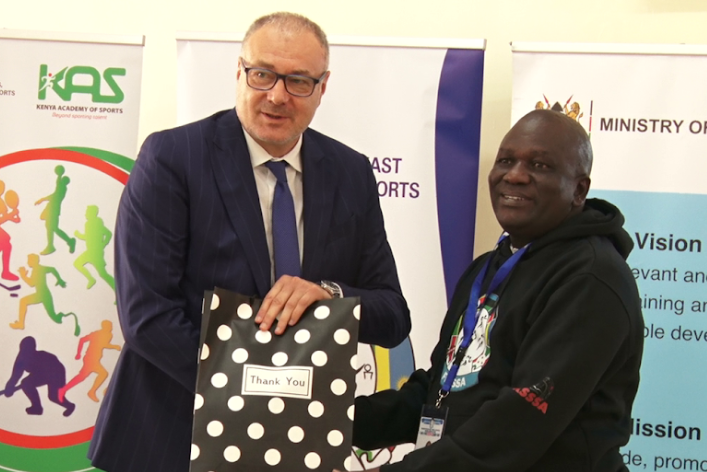
He was speaking during a FEASSA symposium held alongside the East Africa Games, following recommendations by the International School Sports Federation (ISF) to encourage knowledge sharing and development of school sports.
Mugisha emphasized the Federation’s commitment to curbing cheating, stressing that only eligible students should participate. He praised Tanzania for leading the way in enforcing age limits for athletes.
He added that students will gradually take up key responsibilities in the management of the games, under FEASSA supervision.
“We are moving to a point where the games become student-driven, with learners handling officiating, publicity, and other responsibilities, while we provide oversight,” he said.
International School Sports Federation (ISF) President Zeljko Tanaskovic, who attended the closing ceremony in Kakamega, lauded the rapid improvement of school sports in East Africa, saying the region was on track to become a continental powerhouse.
He pledged continued ISF support, noting that the organization works globally to promote education through sports.
Representing Kenya’s Ministry of Education, Simon Muiruri reiterated the government’s support for learners’ skills development through co-curricular activities, citing the Science and Engineering Fair, Drama and Music Festivals, and Sports as examples.
He explained that Kenya dedicates Term One and Term Two of the school calendar to co-curricular activities, while Term Three remains focused on examinations.
“In secondary schools, each learner receives Sh22,000 annually from government capitation, with Sh1,500 earmarked for co-curricular activities such as sports,” Muiruri noted.
The Kakamega symposium ended with renewed commitments from East African states and ISF to strengthen school sports as a key driver of education and youth development.
By Moses Wekesa