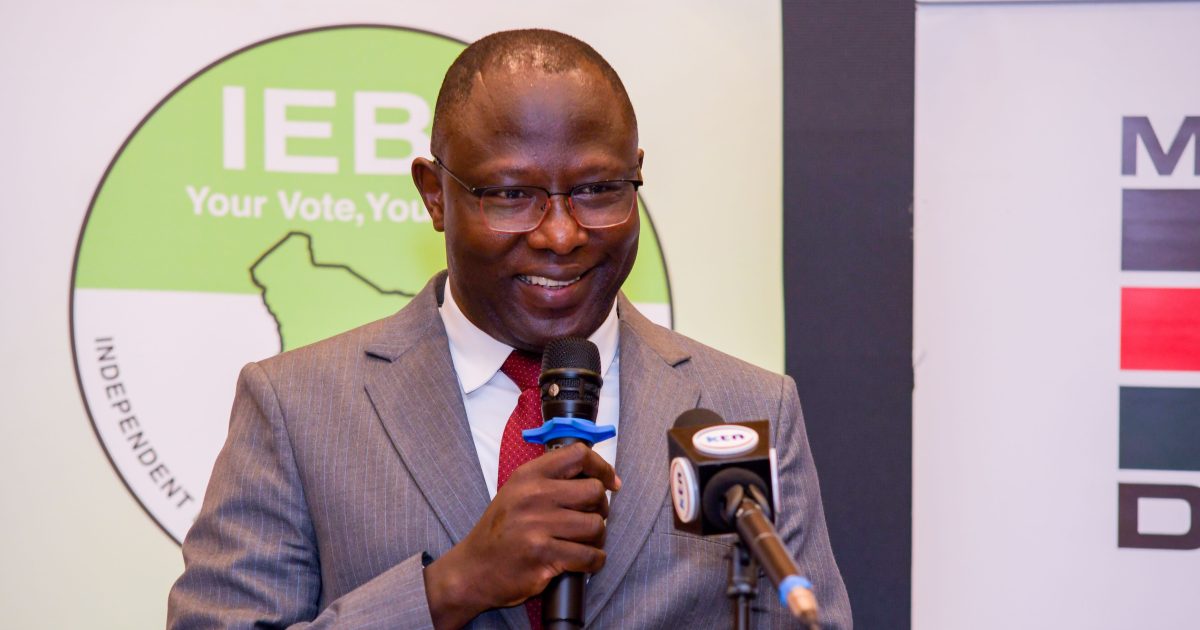
The Chairperson of the Independent Electoral and Boundaries Commission (IEBC), Dr. Erastus Edung Ethekon, has assured Kenyans of the Commission’s commitment to delivering a credible, transparent and peaceful General Election in 2027, while calling for collective responsibility to safeguard the country’s democracy.
Speaking Wednesday during breakfast engagement in Nairobi, Ethekon said the IEBC had adopted a new approach anchored on openness, inclusivity and early engagement with partners including the private sector, civil society and the media.
“This is a new commission with a new philosophy. We believe in being open to Kenyans because there is nothing we are hiding. We will do our job as guided by the Constitution and the law,” he said.
The Chairperson noted that the Commission has already deployed over 12,000 staff across the country to support the ongoing mass voter registration, with commissioners also conducting mobilisation campaigns in various regions.
“We have dispatched ourselves across the country because we believe we must provide leadership to our staff in the field who are registering eligible citizens,” he said.
Ethekon revealed that the Commission had already registered over one million new voters within days of launching the enhanced voter registration exercise and is targeting at least 2.5 million in the First Phase.
He added that the voter register will undergo verification and audit before being gazetted, ahead of the 2027 elections.
The IEBC projects that the Voter Register will grow from 22.1 million in 2022 to approximately 28.5 million by 2027, with polling stations expected to increase from 46,229 to about 55,000.
He emphasized that the integrity of the Voter Register remains non-negotiable, explaining that the Commission has enhanced biometric registration systems to include iris capture in addition to fingerprints.
“The Register is the foundation of any election. We cannot compromise its integrity. That is why we are strengthening biometric identification, to ensure every voter is uniquely captured,” he said.
Reflecting on lessons from the 2007/2008 post-election violence, Ethekon warned against a repeat of the chaos, describing the period as “horrifying” and economically devastating.
“We must pray that the events of 2007 never return. We saw lives lost, property destroyed and the economy collapse. Elections must never again lead to such suffering,” he said.
The IEBC Chair also cited recent by-elections as a learning ground, noting that while the polls were largely successful, cases of violence, voter bribery and political interference were observed.
“We learned valuable lessons. The elections went well and no one accused IEBC of stealing votes, but we witnessed incidents of violence and malpractice that must be addressed collectively,” he said.
He clarified that while IEBC has a mandate to enforce the Electoral Code of Conduct during the official campaign period, other institutions such as security agencies and anti-corruption bodies, must take responsibility for handling offences outside the Commission’s jurisdiction.
“It is time every institution takes responsibility for its mandate so that together we can deliver credible elections,” he added.
On electoral reforms, Ethekon said the Commission is working with the Kenya Law Reform Commission and other stakeholders to fast-track legal amendments aimed at strengthening the electoral framework ahead of 2027.
He further disclosed that IEBC has requested Sh67 billion to conduct the elections but has so far been allocated about Sh41 billion, leaving a significant funding gap.
“Elections are resource-intensive. A large portion of the budget goes to personnel and technology required to ensure transparency and accountability,” he said.
The Chairperson also highlighted plans to expand diaspora voting from 18 to about 54 countries, in line with constitutional provisions to progressively enhance participation of Kenyans abroad.
On technology, Ethekon assured stakeholders that systems to be used in 2027 will undergo thorough testing and simulation to guarantee reliability.
“We will invite experts to interrogate the technology. If it does not work, we repeat the process until it works,” he said.
He urged citizens to avoid misinformation, particularly regarding voter registration and results transmission, noting that election results at polling stations are public and accessible.
“Transparency begins at the polling station. Results are recorded, shared and displayed publicly. Anyone can verify them,” he explained.
Ethekon called for a multi-stakeholder approach involving government agencies, the private sector and citizens to ensure a peaceful electoral environment.
“What concerns us most is the environment in which elections will be held. We must work together to create a peaceful atmosphere that allows Kenyans to exercise their democratic rights,” he said.
by Anita Kariuki and Nyawira Githinji