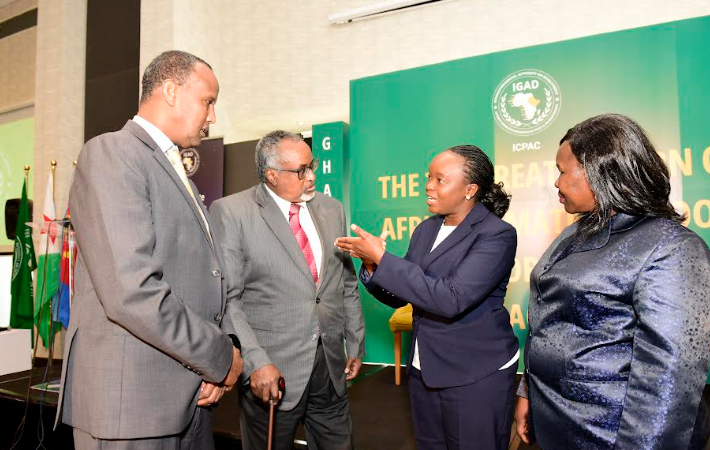
The government of Kenya has urged stronger regional cooperation in climate services to address worsening climate shocks across the Horn of Africa.
Speaking at the official opening of the 71st Greater Horn of Africa Climate Outlook Forum (GHACOF71) in Nairobi, Cabinet Secretary (CS) for Environment, Climate Change and Forestry, Dr. Deborah Barasa, noted that climate extremes such as droughts, floods and erratic rainfall continue to undermine food security and economic growth in the region.
“This year’s theme: Climate Services for Bridging the Early Warning Gap Together, speaks directly to the urgent challenges facing our region, therefore, governments must act collectively to ensure that timely and reliable climate information reaches communities, farmers, and decision-makers across all levels,” urged Dr. Barasa.
The CS disclosed that Kenya has taken deliberate steps to institutionalize climate services by launching its National Framework for Climate Services (NFCS) in March 2025.
She further thanked Intergovernmental Authority on Development (IGAD), Climate Prediction and Applications Centre (ICPAC), and development partners for their continued support and pledged that Kenya would continue championing regional cooperation in climate services.
“With shared commitment and collaboration, we can overcome the climate challenges that confront us,” she assured.
The CS reiterated that the country is committed to making climate services part of government decision-making systems.
“Forecasts must translate into actionable data that support communities to plan and safeguard their livelihoods. The framework also contributes to the implementation of Kenya’s National Adaptation Plans and aligns with Vision 2030,” she stressed.
In addition, Dr. Barasa urged governments and development partners to build on the momentum of the forum stating, “The Regional Framework for Climate Services is not just a policy document. It is a transformative tool for resilience, offering tailored climate services that save lives, drive sustainable development, and ensure a climate-resilient Africa”.
The Principal Secretary (PS) for Environment and Climate Change, Dr. Eng. Festus Ng’eno, disclosed that the NFCS represents Kenya’s determination to narrow the early warning gap by institutionalizing timely, sector-specific climate data delivery.
He noted that this would empower local authorities and communities to act upon forecasts, reducing disaster risks and protecting livelihoods.
“We must ensure that climate information is not confined to research papers and institutions, but is accessible at the grassroots level. Every farmer should be able to make decisions based on credible climate data,” urged Dr. Ng’eno in a speech delivered on his behalf by the Secretary Environment Selly Kimosop.
The PS added that the government has prioritized investments in capacity building, monitoring networks and research to sustain the framework, stressing that these efforts would also contribute to the broader regional agenda of harmonizing climate services.
Speaking at the event, IGAD Deputy Executive Secretary, Mohamed Abdi Ware, commended the Government of Kenya for hosting the forum and for demonstrating leadership in strengthening climate resilience.
He observed that climate shocks do not respect borders and require governments across the Horn of Africa to work in unity.
“Droughts, floods and pests are not confined to one country. They cross borders and affect millions of people across this region. The only way we can effectively confront these challenges is by pooling our knowledge, resources, and technical capacities,” advised Ware.
Additionally, he underscored the role of ICPAC as IGAD’s designated regional climate centre, which has for decades provided scientific analysis, forecasts, and climate information for the region.
“One of the most powerful tools we have is collective knowledge. When it is timely, reliable, and accessible, it saves lives. But when it fails to reach the last mile, the consequences are devastating,” he remarked.
Ware also highlighted the importance of translating climate science into actionable policies that governments can adopt asserting that governments must lead in ensuring climate information is applied where it matters most.
“Climate services must not remain in the hands of experts alone. They must be useful to farmers, pastoralists, business people, and governments at the local and national levels,” argued.
In his remarks, Kenya Meteorological Department (KMD) Acting Director, Edward Maina Muriuki, affirmed that the department is committed to working closely with IGAD and ICPAC to improve the accuracy and timeliness of forecasts.
“Climate change and extreme weather are no longer distant threats but present realities. Governments must be ready to act. Through collaboration with ICPAC, we are improving early warning services so that decision-making is based on accurate forecasts,” voiced Muriuki.
He disclosed that KMD will convene the National Climate Outlook Forum in the coming weeks, with the outcomes cascaded to counties through County Climate Outlook Forums.
These initiatives, he said, bridge the gap between scientists and communities by ensuring climate information reaches those most affected.
Meanwhile, the forum brought together ministers, senior government officials, climate scientists, development partners, and representatives from 11 IGAD member states.
The delegates validated the Regional Framework for Climate Services (RFCS), which will harmonize climate services delivery across the region and provide a roadmap for collective resilience.
Delegates at the forum further noted that Kenya’s NFCS provides a model for other countries in the Horn of Africa seeking to establish similar frameworks.
The discussions also reaffirmed the need for governments to ensure political endorsement of the RFCS to guarantee its implementation.
The framework, developed with the support of the IGAD Climate Prediction and Applications Centre (ICPAC), is designed to strengthen observation networks, improve data sharing, and ensure that climate information is effectively applied in agriculture, water, health, energy and disaster management.
By Naif Rashid