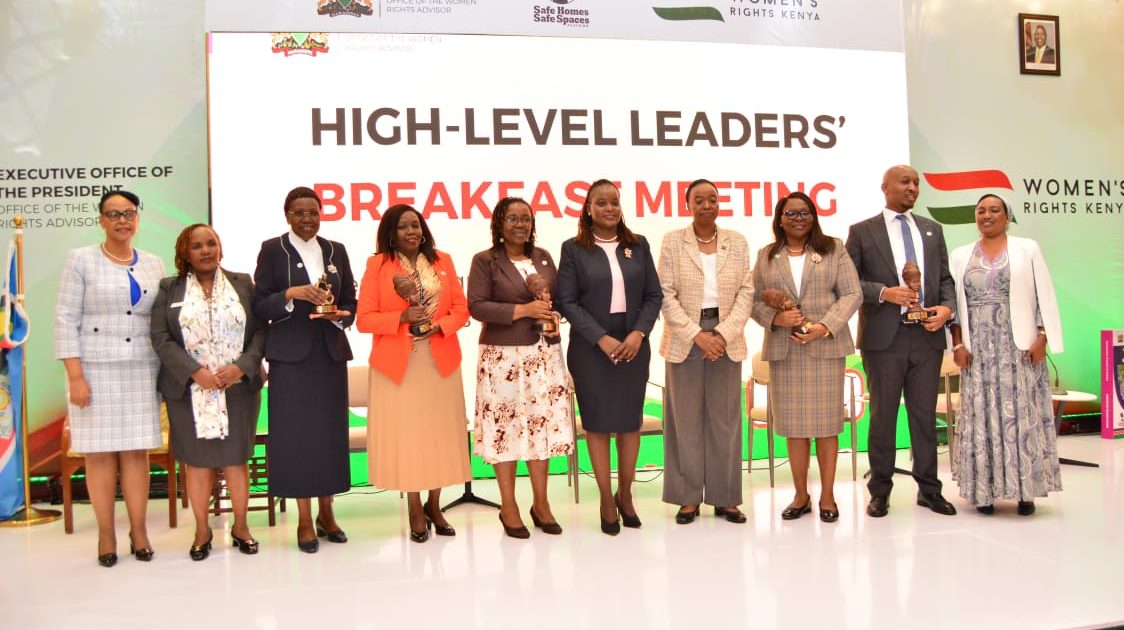
The Government has reaffirmed its commitment to champion women’s empowerment as a central pillar of socio-economic transformation.
During a high-level forum on women’s empowerment held in Nairobi, the National Security Advisor Amb. Dr. Monica Juma, while addressing the meeting said that Kenya’s prosperity and stability depended on unlocking the full potential of women and girls, and assured that the government would continue prioritising their inclusion.
“No country can prosper sustainably when it excludes more than half of its population, women’s empowerment is not just a human right; it is good governance, good security, and the foundation of a healthy society,” she said.
Juma stressed that deliberate action was required to ensure women are fully engaged in new and emerging spaces.
She cautioned that technological disruption, climate change, and financial shifts could erode gains made in gender equality if inclusivity was not secured.
“We must look beyond legacy struggles. The new frontier is technology, artificial intelligence, and financial wellness. Women must not be left behind in these spaces,” she added.
“If you want to go fast, go alone. If you want to go far, go together. Let us choose to go together so that every woman, every girl, and every child in Kenya is protected, valued, and empowered – not just to survive, but to thrive,” Juma said.
The National Security Advisor added that measurable results and bold investments were required to advance women’s empowerment, cautioning that exclusion undermines equality and threatens national security.
Chief Justice Martha Koome underscored the judiciary’s determination to safeguard women’s rights and enhance access to justice.
In a speech read on her behalf by Hellen Omollo, President of the International Association of Women Judges, the Koome highlighted the establishment of gender justice courts to handle sexual and gender-based violence cases, affirmative action in judicial appointments, and the enforcement of anti-harassment policies as important steps in promoting equality.
“Women cannot participate meaningfully in public life if their rights are routinely violated without remedy. Legal guarantees must be matched with enforcement and cultural change,” Koome said.
She added that the judiciary was prioritizing community-based initiatives and outreach programmes to dismantle systemic barriers that prevent women, particularly the vulnerable, from accessing justice.
The Chief Executive Officer of the Kenya Deposit Insurance Corporation Ms. Hellen Chepchumba, underscored the role of financial inclusion in empowering women and strengthening families.
She said the government had strengthened frameworks to protect depositors and enhance stability in the banking sector.
“KDIC provides protection of up to Sh500,000 in the event of bank collapse,” she explained, noting that the scheme currently covers 52 banks.
“Our mandate is to make sure that families and communities do not lose their hard-earned savings,” Chepchumba said.
She observed that although Kenya’s banking sector had previously experienced turbulence, particularly in the 1980s and 1990s, stronger frameworks had since been put in place to enhance resilience and safeguard public confidence.
“When women rise, nations rise with them. KDIC will continue to safeguard investments and stand shoulder-to-shoulder with institutions advancing financial inclusion,” Chepchumba added.
Chief Executive Officer of the National Land Commission Kabale Tache, said strengthened frameworks were necessary to protect women’s rights to land and inheritance, describing access to land as a critical driver of sustainable development.
“Together, we can move beyond isolated initiatives to a cohesive, collaborative approach that secures land rights for women,” she noted.
Tache emphasised that fair and transparent land governance would not only uplift women but also improve food security, family welfare, and national prosperity.
Board Member of Women in Technology and Innovation Africa, Bella Namango, highlighted ongoing projects designed to equip young learners with digital skills.
She said the organisation, in partnership with the Office of the Women’s Rights Advisor, was constructing a SMART library at Mdaimunia Primary School to give pupils access to modern learning resources.
“One child, one computer, one school, one county at a time – that is our mission,” Namango stated.
She appealed for support from government, private sector, and development partners, and revealed that a charity gala will be held on September 26, 2025, to mobilise resources for the expansion of the project.
In her keynote, Juma reiterated that the Women’s Charter unveiled by the Government was not just a policy framework but a covenant between the state and its citizens.
“The Women’s Charter is a promise about the kind of nation we are determined to become. For it to succeed, it must become a Kenyan charter embraced by every citizen,” she said.
The forum issued a collective appeal for unity of purpose in driving Kenya’s gender equality agenda, with participants stressing that inclusive development could only be achieved through strong partnerships across government, judiciary, civil society, and the private sector.
By Lucy Mwende & Darlene Wambui