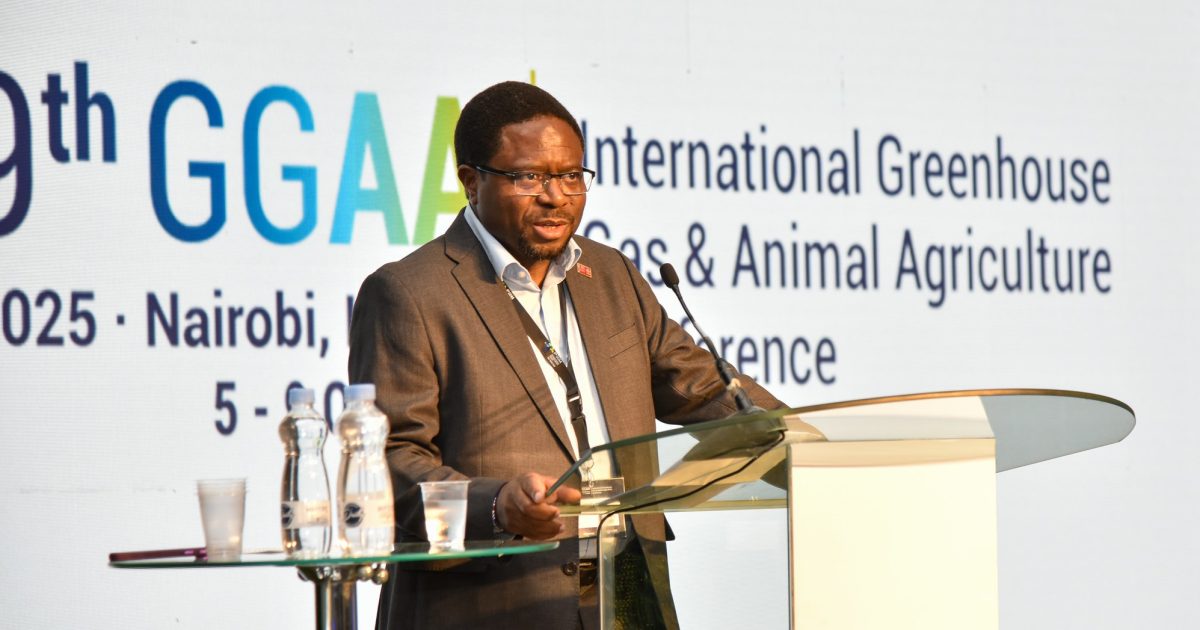
Kenya is hosting the 9th Edition of the International Greenhouse Gas & Animal Agriculture Conference (GGAA) that is being held in the African continent for the first time.
Africa is home to one-third of the world’s livestock, which contributes up to 80 percent of national GDP in some countries and account for nearly 0.8 gigatons of annual emission and according to the meeting, the GGAA 2025 in Nairobi, underscores the continent’s central role in shaping a sustainable future for the sector.
The GGAA2025 has convened over 500 leading scientists, policymakers, industry experts, and civil society representatives to address one of agriculture’s most urgent challenges, reducing greenhouse gas emissions from livestock, while ensuring food security, rural livelihoods, and climate resilience.
“This meeting marks a pivotal shift towards inclusive, globally representative dialogues on mitigating livestock emissions, while bolstering food security and rural economies. At the same time, it amplifies the voice of low- and middle-income countries in global climate discussions, providing a critical platform to address the unique opportunities and constraints faced by the hundreds of millions of smallholder farmers, who form the backbone of livestock production in the region” experts in the meeting said.
The conference is being co-hosted by the International Livestock Research Institute (ILRI) and the Norwegian Institute of Bioeconomy Research (NIBIO).
Professor Appolinaire Djikeng, the Director General of the International Livestock Research Institute (ILRI), said GGAA 2025, should be a springboard for lasting partnerships that ensure solutions are farmer-ready, affordable, and equitable and support resilient livelihoods.
“We do not have to choose between food security and climate mitigation as the priority pathway for both to improve livestock productivity. Farmer-ready solutions are proving it’s possible to do both,” he added.
The goal, Prof. Djikeng said, is to cut emissions, while raising yields and that is the win-win of climate-smart livestock.
The conference underscores that climate-smart livestock is not a future aspiration, but a present-day reality with research showing that that combined strategies in animal nutrition, health, genetics, and manure management, can cut livestock greenhouse gas emissions by 20 to 50percent, while simultaneously boosting productivity and farmer incomes.
Claudia Arndt, Senior Scientist at ILRI and team leader of the Mazingira Centre, said the three-day conference will showcase research from low- and middle-income countries, particularly Africa where 17 countries represented and where all can forge a sustainable future for the global livestock sector, one that is built on context-specific solutions.
“Bringing GGAA to Nairobi is a deliberate and significant move. Low- and middle-income developing country livestock systems have been under-represented in global climate science. GGAA 2025 changes that,” she added.
The event will be unveiling scientific breakthroughs and showcasing scalable technologies, including, breeding low-methane livestock through genomic selection tools, Circular manure systems that reduce emissions by up to 90 percent, while producing renewable energy and organic fertilizer.
Animal health interventions, with new modeling, showing that reducing disease could cut emissions intensity by up to 12percent and also forage innovations that improve productivity and reduce methane emissions.
Others are digital farm tools and carbon accounting systems for tracking and managing emissions and ‘Exhalomics’ cow breath analysis to monitor methane emissions in real time.
The conference agenda is built on the fundamental principle that “one size does not fit all,” and where solutions effective for high-productivity systems in Europe or North American such as feed additives for cows producing 40-50 litres of milk per day, are often not feasible for smallholder systems in Africa, where cows may produce only 5-6 litres.
“For farmers, the most significant emissions reduction opportunities lie in improving animal health, enhancing feed quality, and genetic improvement, to raise productivity and lower emissions intensity”, Arndt said.
Livestock are significant contributors to Kenya’s greenhouse gas (GHG) emissions, mainly through enteric fermentation and manure, with enteric methane from ruminants such as cattle being a key source.
Kenya is actively working to reduce these emissions by implementing climate-smart agricultural practices and improving livestock productivity to align with its low-carbon development goals.
Strategies include enhancing feed efficiency, optimizing feed formulation, better manure management, and improving rangeland management in fragile ecosystems.
By Wangari Ndirangu