The first-ever mini-Kenya Demographic and Health Survey (KDHS) is scheduled to kick off in November this year and is aimed at providing updated and fresher data for evaluation and monitoring of ongoing development projects in the country.
The exercise that will run for 80 days, follows a major Kenya Demographic and Health Survey (KDHS) that was conducted in 2022.
Unlike the comprehensive, seven multi-year Kenya Demographic and Health Surveys (KDHS), that the government had conducted since 1989 at intervals of between 5 and 7 years, the “mini” version is a smaller-scale survey designed to provide up-to-date demographic data.
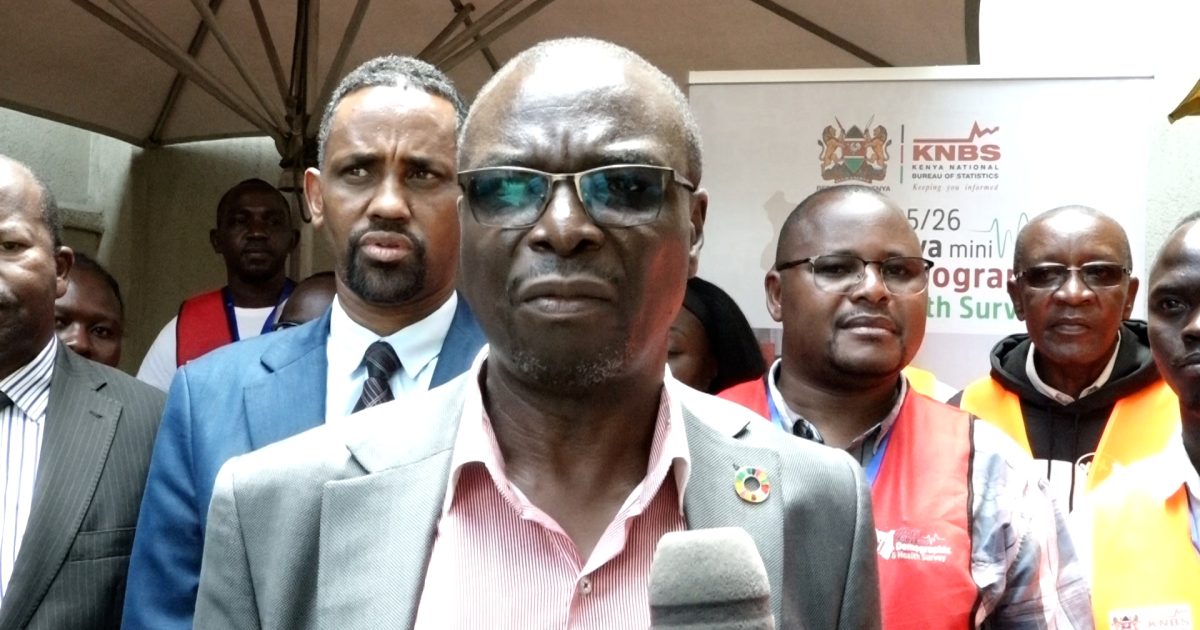
The Kenya National Bureau of Statistics (KNBS) Director General George Obudho said that at least 1,000 personnel had been trained to carry out the exercise in various parts of the country.
Mr Obudho said the exercise will take a break for Christmas and New Year festivities and thereafter resume next year.
Speaking during the launch of the workforce trainings in Nakuru City,the Director General said the survey would be wide and gather data on some of the topics not covered previously.
He explained that the data on the new topics will be clustered on county level to enable county health departments to formulate health policies and strategies aligned to each county’s priorities.
The first Kenya Demographic and Health Survey was held in 1989, with subsequent ones in 1993, 1998, 2003, 2008, 2014 and 2022.
The Mini-KDHS with a targeted sample size of 30,000 respondents will feature household and women questionnaires both in English and Kiswahili and unlike the 2022 KDHS, there will be no interviews for men.
The Director General disclosed that Mini-KDHS will feature a new component on Sexual and Gender Based Violence (SGBV) that will factor in technology-facilitated SGBV taking into account the expanded social media platforms in the country.
Data from the 2022 KDHS revealed that 39 percent of health indicators under Sustainable Development Goal 3 were not tracked, due to missing or outdated data.
The Director General indicated that the mini-KDHS was announced to address these gaps and provide fresher data for evaluation and monitoring of ongoing development projects.
He explained that the exercise will feature a total of 47 teams, each headed by a supervisor and will be spread across the 47 devolved units.
“Waiting for five years and in some cases for over seven years to conduct KDHS may render data stale. The mini-KDHS will help us come up with quality and reliable data,” the official added.
The teams undergoing training include those tasked with doing mobilisation before data collection, data collectors, supervisors, coordinators that will be overseeing the exercise, research assistants and those who will be reviewing collected data to fill in any gaps if necessary.
According to Obudho, data collected in the Mini-KDHS will mainly centre on health of mothers and children, family planning trends, Sexual and Gender Based Violence (SGBV) and they expect the report on the survey to be ready before mid-next year.
Public Health Specialist (Health Systems) at the Ministry of Health Dr David Soti stressed the importance of the survey, saying that besides an updated data bank, it would be a key source of population-based health indicators.
“These indicators are critical in decision-making and determine the direction Kenya takes in implementing health programmes,” he noted.
Dr Soti pointed out that this would provide critical data points to determine the level of progress made in achieving set programmatic targets in the health sector such as Universal Health Care, childhood vaccination coverage, delivery by skilled attendants, contraceptive prevalence rates among others.
The Director General for the National Council for Population and Development (NCPD) Dr Mohammed Abdi Sheikh, said the Mini-KDHS is expected to be nationally representative, with a sample drawn from the Kenya Household Master Sample Frame.
Dr Sheikh said the survey will provide updated statistics on key areas, including: Demographic and socioeconomic characteristics, HIV/AIDS and sexually transmitted infections, female genital mutilation, health expenditures and insurance, nutrition status of children, women, and men and COVID-19 vaccination coverage and related deaths.
The Survey, according to Dr Sheikh, will monitor health outcomes, track key health and demographic indicators to evaluate program effectiveness and identify areas requiring further intervention.
Dr Masini Ichwara, the Director General for Economic Planning at the State Department for Economic Planning said the updated data from the mini-DHS will help inform policy, provide decision-makers with fresh insights to guide planning and resource allocation.
Dr Ichwara noted it will track progress by measuring Kenya’s advancements toward national and international development goals, including Vision 2030 and the SDGs.
“We will build on previous surveys, potentially including new indicators like those on early childhood development and chronic diseases, and focusing on key areas such as maternal and child health, family planning, and nutrition,” Dr Ichwara added.
The data from the mini-survey, according to the official, will help the government and other stakeholders monitor and evaluate health programmes and inform new strategies.
By Esther Mwangi and Dennis Rasto Picture caption