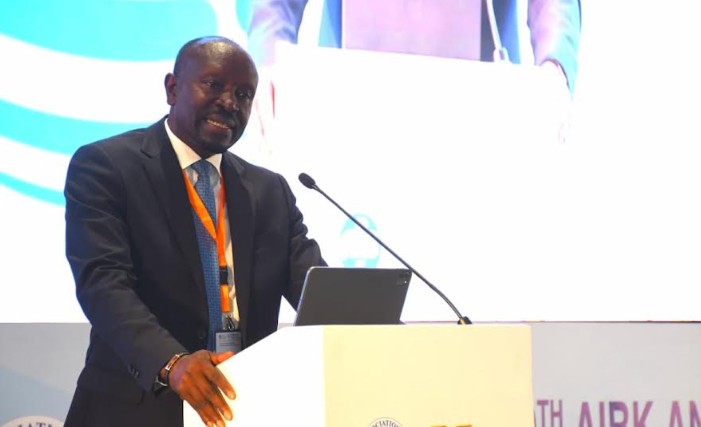
In the wake of rapid technological transformation, insurance brokers have been urged to invest strategically in cybersecurity to curb the risks of money laundering and terrorism financing and to help Kenya exit the Financial Action Task Force (FATF) grey list.
Speaking in Mombasa during the 19th Annual Conference of the Association of Insurance Brokers of Kenya (AIBK), Senior Counsel (SC) Mohammed Nyaoga said that as the industry embraces technology, threats are shifting from physical to digital, requiring enhanced safeguards.
The four-day conference brings more than 500 Insurance Practitioners under the theme ‘The Future of Insurance: Igniting Innovation, Securing Tomorrow’.

“If customers are to have confidence and trust in a digitally driven system, then we must put in place adequate safeguards to guarantee the safety of the systems that hold their data,” he advised.
SC Nyaoga noted there is a growing integration of technology in the insurance sector that has the potential to enhance efficiency and improve customer satisfaction.
He disclosed that over 70 per cent of Insurers in the country are accessible through mobile applications, portals and chatbots, where customers can buy policies, submit and track claims and obtain personalised customer care support from the comfort of their homes.
“The adoption of technology has the potential to increase efficiency and reduce administrative costs through automation of routine tasks. Tasks are performed much faster and at lower costs. This, in turn, leads to improved customer satisfaction,” stated SC Nyaoga.
“Artificial Intelligence and Machine Learning have transformed key aspects of underwriting, risk assessment and fraud detection. Overall, they make it easier to detect fraud more accurately, thereby limiting the exposure that would have resulted from a manual approach,” he explained.
He further asserted that technology has led to innovative products to cover new approaches, such as telemedicine and micro-insurance models including daily or weekly payments, which has lowered the threshold of access to insurance and consequently supported programmes like Universal Health Coverage.
“For insurance sector players to thrive in this digital ecosystem, there is a need to anticipate the challenges and reconfigure our strategies and approaches,” he said, urging Insurers to retool their boards, management and staff for optimal performance
AIBK National Chairman John Lagat acknowledged that the sector stands at a crossroads as the forces of technology, customer expectation, regulatory change, global risks, and local realities are converging, offering both challenge and opportunity.
“One of the most exciting fronts is innovation. In Kenya, the interplay of mobile-money infrastructure, fintech and insurance is yielding new models of inclusive insurance. Pay-as-you-go, peer-to-peer insurance, microinsurance, and embedded insurance are being deployed more widely,” stated Lagat.
He added that insurers are now adopting artificial intelligence, and many are leveraging data analytics to tailor products to specific geographies, customer segments and risks.
“It is worth calling out that individual companies are stepping up. We have strong examples of Kenyan insurers leveraging data, digital partnerships and new distribution models. This not only strengthens their businesses but also the ecosystem as a whole,” said Lagat.
The Chairman also noted that the country’s insurance penetration has remained significantly below global averages, and statistics show penetration levels under three per cent for Kenya, versus global averages of over seven per cent.
“But the good news is that the sector is not static; it is evolving. According to recent industry reports, growth is consistent and across many listed insurance companies; there is positive net income growth,” he said.
He added, “Moreover, the structural foundations are being laid for sustainable growth with digital channels, data analytics, inclusive models and regulatory reform.”
He also raised concerns about the reporting structures and penalties intended to be imposed on brokers who do not comply with the provisions and demands of the Financial Reporting Centre (FRC).
Kenya was placed on the FATF grey list in 2024 due to gaps in its Anti-Money Laundering (AML), Counter-Terrorist Financing (CFT), and Counter-Proliferation Financing (CPF) frameworks.
Insurance Regulatory Authority (IRA) CEO Godfrey Kiptum urged the brokers to lead efforts in ensuring that the country is removed from the grey list, as the country is not off the hook.
“It is not a matter of the IRA or Central Bank; it is for the public good. We want to encourage you to ensure you meet the requirements,” he said, adding that Kenya in East Africa could be the only remaining country on the grey list.
By Sadik Hassan