The global housing crisis is a serious issue, where a significant portion of the world’s population lacks access to adequate, affordable, and safe housing, with estimates from the United Nations Human Settlements Programme (UN-Habitat) suggesting that three (3) billion people will need better housing by 2030.
Key drivers of this global crisis include rapid urbanization outpacing housing development, population growth, and the rising costs of construction due to factors like shortages in land, labor, and materials.
The crisis is most grave in rapidly urbanizing regions and is exacerbated by climate change, with millions living in substandard conditions or facing homelessness.
Scope and impact
Data from UN HABITAT shows that by 2030, an estimated three (3) billion people will need access to adequate housing, which is a demand for 96,000 new affordable housing units per day.
Globally, around 2.8 billion people lack access to adequate housing, secure land, and basic water and sanitation services, with over 1.12 billion living in slums or informal settlements.
Approximately 100 million people worldwide are estimated to be homeless globally. About one in four people live in conditions that are harmful to their health, safety, and prosperity
The crisis is particularly severe in rapidly urbanizing areas like Africa and the Asia-Pacific, where 62 per cent of urban dwellings in Africa and over 500 million people in Asia-Pacific lack access to basic water services. Those in inadequate housing are more vulnerable to extreme heat, severe weather events, and water scarcity.
Rapid urbanization and population explosion are some of the ultimate reasons for the increasing in informal settlements. Factors like shortages in land, access to credits, labour, and construction materials have made housing out of reach for many.
Kenya Situation
Urban towns in Kenya have a high demand for housing, driven by rapid urbanization, with an estimated annual demand of 250,000 new housing units.
This demand has led to a cumulative housing deficit of over 2 million units, a crisis most felt in cities like Nairobi, Mombasa, and Kisumu. To this end, the need for affordable housing in the country is dire now than before.
Consequently, President Dr. William Ruto administration is now focusing on affordable housing project in a bid to address the housing crisis in the country.
The urban population is growing at a significant rate, creating a strain on existing housing stock and increasing demand for both new and affordable homes.
Data shows that the formal housing market supplies far fewer units than are needed, resulting in a growing shortage that exceeds 2 million units.
Kenya’s population growth rate is higher than the global average, further contributing to the demand for housing in urban centers.
The government responded to this through Affordable housing Programme, aiming to deliver up to 200,000 affordable homes annually through public-private partnerships and a housing levy.
Numerous housing projects are underway in major cities like Kisumu, Eldoret among others. While the initiative has created jobs and spurred development, progress remains slow, with affordability and transparency challenges still hindering access for low- and middle-income earner.
In Kisumu County, several massive projects are reshaping the local housing landscape such as the Lumumba Affordable Housing Project which is a mega-project featuring 15 modern blocks delivering 2,348 units (including social and market-rate housing).
It features amenities like Early Childhood Development Education (ECDE) centers, parking, and health facilities.
Located off the Kisumu-Kakamega Highway and being one of the AHP undertakings in the county of Kisumu, this development provides both affordable and market-rate housing with modern amenities such as hospital, kindergarten, and swimming pool.
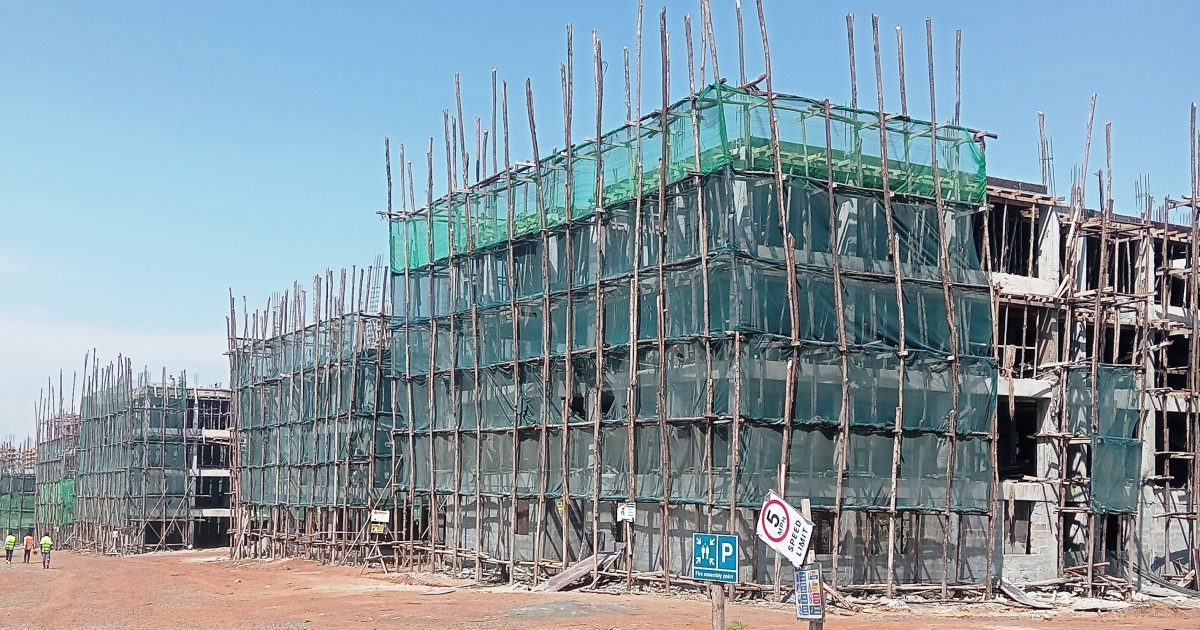
The Affordable Housing Project in Kanyakwar, Kisumu, is steadily transforming the area as construction progresses, and the change is hard to miss.
What was once open land along the Kisumu – Kakamega highway is now taking shape as a modern, planned estate that promises decent homes for hundreds of Kenyan families.
Backed by the national government through the Boma Yangu initiative, Upper Kanyakwar Estate stands as a clear example of the government’s commitment to making quality housing accessible to ordinary Kenyans.
The project includes 2- and 3-bedroom apartments, a clubhouse, and swimming pool, basketball court, and well-paved internal roads, amenities once considered a luxury for many in the region.
For years, rising rents and limited formal housing options have put pressure on families in Kisumu and its outskirts.
This initiative directly responds to that challenge, showing that when policy meets action, real communities benefit.
Residents and commuters passing through Kibos, now see cranes, construction teams, and rising structures on site; a visible sign of progress.
Site engineer and project manager Jackson Mumo says that the development is currently at a “30 framework stage” and has been progressing steadily since work began about a year ago.
He further states that the project employs an average of 500 to 600 workers daily, reflecting the scale of activity on site, and confirms that the expected completion date remains December this year if all goes according to plan.
He however notes that financial constraints may still affect the timeline. Despite these challenges, Eng. Mumo emphasizes that safety has remained a priority with no fatal accidents on the site so far.
Beyond the physical transformation, the project has significantly improved the lives of the workers involved. Many of them, drawn from Kisumu and surrounding areas, have gained steady employment that has allowed them to support their families more reliably than before.
For some, the project has also become a place to learn new technical and construction skills, opening doors to future opportunities in the building industry.
The steady flow of work has created stability for casual laborers who previously depended on unpredictable jobs, though challenges such as long working hours and rising living costs still affect many workers.
The impact goes beyond housing. Local residents and small business operators have already begun to feel the economic ripple effects, with increased activity around the construction site.
Hardware shops are selling more materials, food vendors are serving hundreds of workers daily, and boda boda operators are making more money transporting workers to the site.
This is exactly the kind of economic multiplier effect that has come out of this mega Government project, as the project continues to put money into local pockets while creating jobs and strengthening small businesses in Kisumu West.
On the ground, different stakeholders are already witnessing these changes firsthand. Eng. Mumo says, the project has been running steadily and safely and has transform the area into a modern environment.
Food vendor Rael Kemunto says though she occasionally faces delays in payment from customers, the overall impact of the project on her business has been positive.
However, as construction advances, public conversations are focusing on how to make the project as inclusive and accessible as possible once completed. Key questions being raised include how pricing and payment plans will ensure that teachers, small traders, boda boda riders, and civil servants can qualify, and want measures put in place to prioritize Kisumu residents in allocation.
At a time when many Kenyans are looking for tangible results, Upper Kanyakwar Estate demonstrates that the Affordable Housing Agenda is moving from plans on paper to homes on the ground.
For the people of Kisumu, this project means more than bricks and mortar, it represents dignity, security and the chance to own a home in a growing city.
If delivered as planned, it will stand as one of the most impactful investments in the region and a strong testament to what is possible when government works for its people.