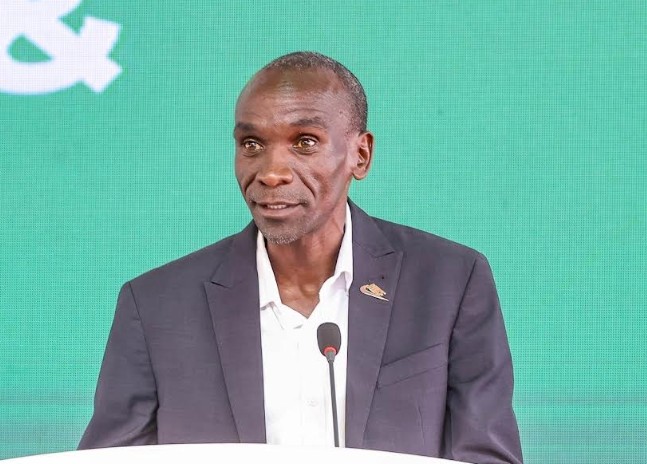
Marathon legend Eliud Kipchoge has called on African nations to embrace Artificial Intelligence (AI), innovation and technology to sustain the continent’s dominance in sport and prepare for a rapidly changing global environment.
Speaking during the Kenya Software and AI Summit 2025 being held at Moi University Annex Campus in Uasin Gishu County, Kipchoge said the world is shifting from fixed systems and predictable playbooks to one driven by adaptation, innovation and data.”
“The question today is not who can run the fastest, but who can adapt the fastest,” he said.
He noted that while technology continues to reshape every sector, sport must equally evolve to remain relevant and resilient.
Kipchoge stressed that the fusion of AI, data and innovation is redefining how athletes train, recover and perform.
“Technology will not replace discipline; it will refine it. It turns effort into insight, preparation into precision and potential into performance,” he noted.
While recognising the impact of climate change on global sporting events, citing his own experience at the Tokyo 2021 Olympics and Paris 2024 Games where rising temperatures affected athletes’ performance, Kipchoge said such challenges highlight the urgent need for smarter and more adaptive systems in sport.
He urged Kenya and the wider African continent to lead in integrating digital solutions into sports, describing it as “not optional, but essential” for competitiveness and sustainability.
Kipchoge further pointed out that by 2030, 42 per cent of the world’s youth will live in Africa, with over 230 million digital jobs expected to be created across the continent in the next decade.
“By connecting Africa’s athletic strength with digital innovation and combining the mindset of Ghana with the skillset of Qatar, we can build one of the most sustainable and inclusive industries in the world,” added Kipchoge.
Addressing young people, the two-time Olympic champion encouraged them to master at least one digital skill and uphold ethics.
“Technology should serve people, not the other way around. Build tools that empower, not exploit. Success without integrity is just speed without direction,” he emphasised.
Kipchoge also urged policymakers to integrate digital and climate literacy into education systems and to invest in solar-powered stadiums, tech-enabled training centers and data-driven facilities to nurture future athletes and innovators.
He emphasised that the world has changed and classrooms must evolve accordingly so that children learn not just how to use technology, but how to create with it.
He also revealed that his upcoming seven-continent tour aims to spread a global message of connection, adaptation and unity through sport.
“This journey is about showing that even as the world changes, the human spirit endures. Africa is not running dry; Africa is setting the pace,” said Kipchoge.
By Fredrick Maritim