The Coast region is banking on the reviewed Kenya Foreign Policy 2024 to unlock its vast blue economy potential and accelerate development across coastal counties.
In 2024, the government reviewed the policy, first published in 2014. The process culminated in Sessional Paper No. 1 of 2025, which reaffirms a people-centered, inclusive, and responsive approach to diplomacy aligned with emerging global realities.
The revised policy expands Kenya’s traditional five pillars to eight focus areas: Peace and Security Diplomacy; Economic and Commercial Diplomacy; Oceans and Blue Diplomacy; Global Governance and Multilateral Diplomacy; Environment and Climate Change Diplomacy; Science, Technology and Innovation Diplomacy; Diaspora Diplomacy; and Socio-Cultural Diplomacy.
The government, through the Ministry of Foreign and Diplomatic Affairs, is conducting a two-day public engagement forum dubbed Kenya Foreign Policy Mashinani– Coast Edition, bringing together participants from Mombasa, Kilifi, Kwale, Tana River, Lamu, and Taita Taveta.
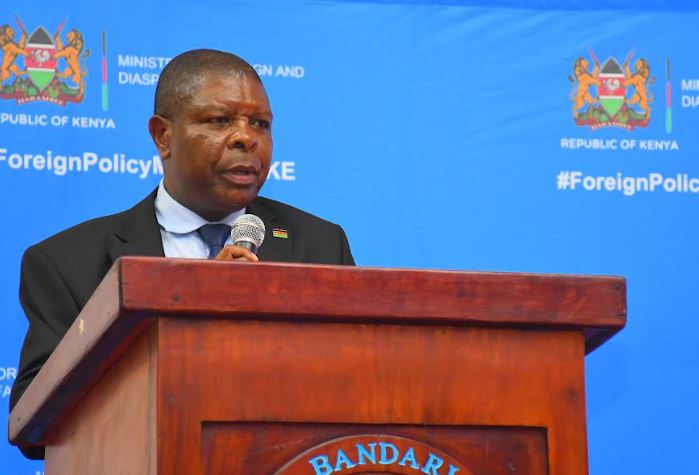
Amb Josphat Maikara, Director General for Political and Diplomatic Affairs, said during the coast edition engagement at the Bandari Maritime Academy in Mombasa that the forums seek to demystify foreign policy by translating global developments into relatable, local benefits and empowering citizens to shape Kenya’s agenda on the international stage.
The ministry also aims to align foreign policy with the Bottom-Up Economic Transformation Agenda (BETA) and Kenya Vision 2030 by linking global partnerships to development priorities such as industrialization, trade, climate resilience, innovation, and enhanced county-level participation as part of a whole-of-society approach to diplomacy.
Amb. Maikara emphasised that Kenya’s foreign policy provides the framework through which the country projects, promotes, and protects its national interests abroad.
“It is the prism through which we identify strategic global opportunities, appreciate challenges and ensure that Kenya’s international engagements advance the prosperity, peace, and wellbeing of our people,” he stated.
“The new architecture reflects a holistic view that diplomacy is no longer premised on the traditional staple of political relations, but assumes a pragmatic approach that encompasses livelihoods, technology, environment, innovation, and culture,” he added.
Traditionally, Amb Maikara noted that foreign policy has been seen as the preserve of diplomats and the national Government. However, globalization has impacted the conduct of diplomacy in such a radical way, where the number of actors have been expanded.
The DG further expounded that the Foreign Policy Mashinani Initiative is anchored on the conviction that the citizenry is not merely a beneficiary of foreign policy, but is a co-creator and co-implementer.
“It gives practical meaning to the constitutional principle that sovereign power belongs to the people of Kenya and foreign policy issues demand active citizen participation,” he said.
He added that the outreach is also a recognition that the impact of global decisions is felt at the grassroots, from the effect of climate change on marine resources within the Indian Ocean, maritime security and the sustainable exploitation of resources within exclusive economic zones, influence on trade negotiations and the opportunities for entrepreneurs.
The policy comes in the wake of rapid changes in the global landscape marked by complex transitions ranging from geopolitical tensions, shifting economic power centers, technological disruption, pandemics, and climate change among others.
“These dynamics compel nations to rethink how diplomacy can effectively safeguard national interests while enhancing resilience,” he stated adding Kenya’s leadership on regional peace processes, global climate action, multilateral reform, and blue economy governance underscores the country’s aspiration to be a credible, solution-oriented actor on the international stage.
Lamu Governor Issa Timamy termed the Mashinani engagements as timely amid global opportunities and challenges.
He said county governments play a three-fold role: localizing national foreign policy objectives to generate county-level development gains; strengthening partnerships with national institutions, the private sector, civil society, and international partners; and providing grassroots insights that enrich Kenya’s global engagement and ensure policies reflect real community needs.
Governor Timamy noted that Lamu sits at the heart of Kenya’s blue economy, trade routes, and regional integration. The county hosts the Port of Lamu, which links Kenya to Ethiopia, South Sudan, and the wider Indian Ocean economy through the Lamu Port–South Sudan–Ethiopia Transport (LAPSSET) Corridor.
“This places Lamu at the centre of Kenya’s economic and commercial diplomacy, maritime security cooperation, and blue diplomacy. Through the 2024 foreign policy, Lamu stands to benefit from expanded foreign investment in the LAPSSET Corridor and its value chains, and enhanced maritime security through regional and international partnerships,” he said.
The historic county also expects strengthened support for climate adaptation, conservation of fragile ecosystems, diaspora linkages, and cultural diplomacy to promote Lamu’s rich Swahili heritage.
On her part, Kilifi Deputy Governor Flora Chibule said county governments will leverage the policy to align local development with Kenyan global aspirations and ensure sustainable exploitation of marine and mining resources.
“As counties, we are key partners in advancing the pillars of the revamped Kenya foreign policy of 2024. The call for greater collaboration, innovation and citizen engagement will resonate deeply in these conversations,” she stated, affirming support for the implementation of the policy.
She further urged county governments to set up county-level foreign affairs desks to coordinate with embassies, and to document investment opportunities and share them with foreign nations.
Director and Head of the Welfare and Rights Division at the State Department for Diaspora Affairs Emmah Gicheha urged county governments to partner with the State Department to engage Kenyans living abroad on the various investment opportunities.
By Sadik Hassan