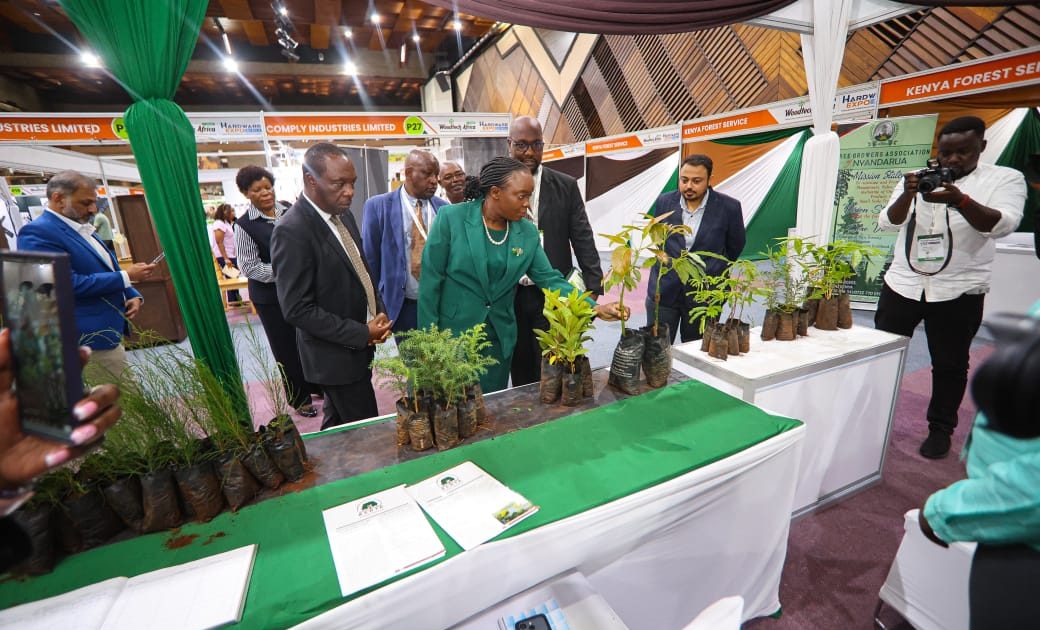
Kenya is setting a bold path for the growth of its industrial wood sector, as government officials, industry players, and international partners convened at the 3rd Woodtech Africa International Exhibition and Conference at the Kenyatta International Convention Centre (KICC).
The event hosted the inaugural Hardware Expo Africa, creating a continental platform for showcasing technology, investment opportunities, and value-chain innovations in wood and construction.
Cabinet Secretary for Environment, Climate Change and Forestry, Dr. Deborah Barasa, officially opened the exhibition, emphasizing the sector’s potential to drive economic growth and environmental sustainability.
“The industrial wood sector contributes around Sh5 billion annually to Kenya’s Gross Domestic Product (GDP), yet it meets less than 10 percent of national demand. This gap presents an opportunity for investment, technology, and policy alignment,” she said.
Dr. Barasa unveiled the Industrial Wood Sector Vision 2050, aimed at transforming Kenya’s forest and wood industry.
“We envision a future where sustainable wood replaces carbon-intensive materials in construction, packaging, and energy. Efficient, well-managed commercial forests will drive rural prosperity, carbon finance, and ecological restoration,” she said.
The Vision sets ambitious targets, including doubling tree cover on farms and plantations to 1.2 million hectares by 2050, increasing wood supply more than fivefold, unlocking Sh137 billion in industrial wood GDP, and creating over 85,000 jobs along the value chain from tree planting to furniture manufacturing. It also supports climate goals by storing more than 140 million tonnes of CO₂ and reducing pressure on natural forests.
Dr. Barasa emphasized the interdependence between commercial forestry and the 15 billion Tree Growing Programme, which aims to increase Kenya’s tree cover to 30 percent by 2032.
“The wood sector cannot thrive without the ecosystems that sustain it, just as the 15 billion Tree Growing Programme cannot succeed without a vibrant, innovative, and well-regulated wood industry that gives economic value to the trees we grow,” she said.
The CS highlighted ongoing regulatory reforms designed to provide clarity and attract investors.
These include finalizing eight regulations under the Forest Conservation and Management Act 2016, establishing clear guidelines for commercial plantation establishment and sustainable harvesting, developing standards for wood-based construction under COP28 commitments, and strengthening traceability systems to curb illegal logging.
“A fair, transparent regulatory environment is the backbone of a strong forest economy,” Dr. Barasa stated.
The Cabinet Secretary encouraged industry stakeholders to actively engage with the exhibition and forge partnerships that drive innovation and competitiveness.
“Furniture manufacturers, interior designers, architects, real estate developers, timber merchants, and all industry players are encouraged to participate, learn, innovate, and form strategic collaborations,” she said.
Sanyal Desai, CEO of Radeecal Communications, which organized the event in partnership with the government, welcomed participants and highlighted Kenya’s growing role as a hub for wood and construction technology.
“What began as a niche platform for wood and woodworking machinery has grown into a continental meeting point. The maiden Hardware Expo Africa elevates this gathering by showcasing the broader construction, manufacturing, and industrial value chain,” he said.
Desai noted that the exhibition provides a platform for investment, networking, and knowledge-sharing, allowing regional and global players to explore partnerships and strengthen supply chains.
“Over the next few days, this forum will enable Africa to advance toward sustainable industrialization, value addition, and skilled job creation,” he said.
Dr. Barasa also commended the State Department for Forestry, FAO, Gatsby Africa, Kenya Forest Service (KFS), Kenya Forestry Research Institute (KEFRI), Architectural Association of Kenya, and other technical partners for supporting the exhibition.
“This platform has become a vital hub for innovation, collaboration, and investment in Africa’s wood industry,” she said.
She stressed that Kenya’s future in the wood sector goes beyond harvesting trees. It is about sustainable management, climate-smart technologies, innovation, and economic transformation.
“The future of Kenya’s wood industry is about vision, innovation, and shared prosperity,” Dr. Barasa said, underlining the role of policymakers, private investors, and innovators in shaping a modern forest economy.
The exhibition brought together industrial wood players, manufacturers, investors, and policymakers from across Africa and beyond, signaling Kenya’s commitment to sustainable industrial development, green manufacturing, and value addition in the forest and construction sectors.
The event featured panel discussions, product demonstrations, and business networking opportunities aimed at strengthening downstream value chains in construction, furniture, and energy.
“Innovation, technology, and partnerships are critical to unlocking the full potential of Kenya’s industrial wood sector,” Dr. Barasa said.
by Naif Rashid