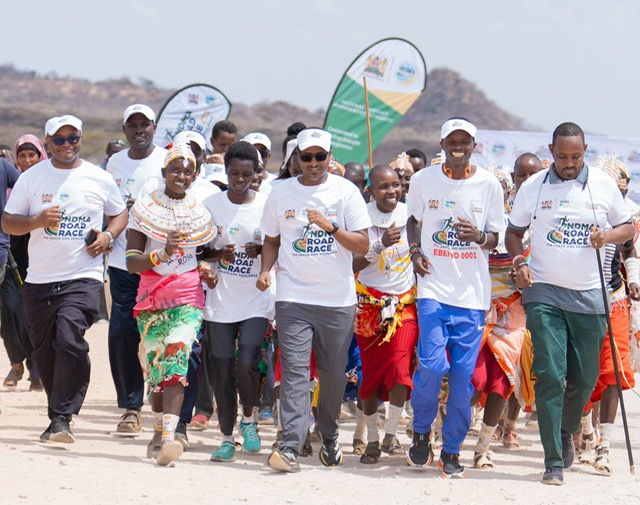
The National Drought Management Authority (NDMA) has unveiled an ambitious road race campaign that targets raising over sh.130.8 million to support drought-stricken counties of Isiolo, Meru, Samburu and Laikipia.
NDMA Chief Executive Officer Rtd Hared Adan, speaking in Archers Post, Isiolo County, said that the authority was keen on addressing disasters before they occur by improving the livelihoods of the people and with this year’s race expected to be held on August 8 this year, over 5,000 households are expected to benefit from the funds raised.
“The funds raised will be used to improve water infrastructures and save women from travelling long distances in search of water. Drought response is a collective responsibility; the government alone can’t manage, we have to partner with all stakeholders, including the community,” said the CEO.
Besides expanding water access points, strengthening climate resilience livelihoods and restoring the degraded lands in the four counties, the race will also champion peace initiatives in the drylands.
“We have had insecurity in this area for many years; the government has restored it and it is now peaceful but we want communities to come together, interact, and exchange ideas and it is only through sports that this happens. By running, we will uphold unity,” said Rtd Adan.
The race, dubbed the NDMA Road Race for Peace and Resilience, entails 10 kilometers, 5 km and 2 km respectively, with seasoned athlete Daniel Simiu Ebenyo as the road race ambassador. He is rallying his community, which has endured years of persistent drought, to participate in the races.
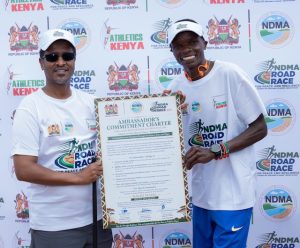
Ebenyo was born and raised in Baragoi, Samburu County; he walked about 24 km to school every day as a child, enduring the scorching sun, insecurity and other hardships, which he said shaped his life, propelling him to the international stage of the athletic arena. He challenged young people not to lose hope.
“Let us run not only for ourselves but for every child who dreams of a better future, run for a mother searching for water, a pastoralist protecting their livelihood, let us run for peace and for Kenya, where no one is left behind,” he said. He called on his fellow athletes, Kenyans and other stakeholders to join him for the 8th August race in Archer’s Post.
Ebenyo highlighted the race will serve as an opportunity to support the area which is often overlooked on development matters.
“Peace enables students to attend school, families to invest in their future and communities to prosper. I therefore encourage every young person to embrace dialogue over division and hence I call upon every Kenyan to support this initiative,” said Ebenyo.
NDMA Board Chairperson Shallow Yahya said that by staying united, they will attract development opportunities and prosper, pointing out that drought and insecurity were the only setback in the pastoral areas.
“If the four counties could maintain peace, we can do great things in our region. We are pastoralists and our major challenges are drought and security, which the road race seeks to address,” said the board chairman
By Muturi Mwangi