A postmortem examination has confirmed that Laura Adhiambo Wesonga a KMTC student from Busia who was killed during a police shootout with criminals, died from a single gunshot wound.
The bullet reportedly entered through her back, ruptured a major blood vessel and exited through her chest before lodging in her thumb.
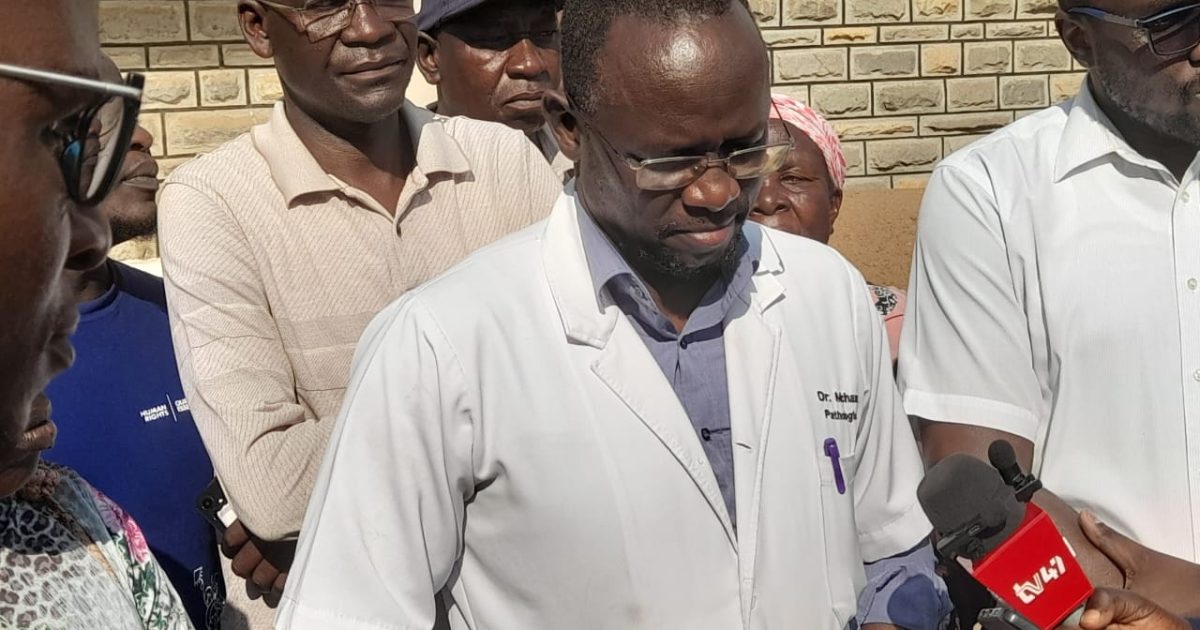
Speaking after the postmortem at St. Francis Funeral Home in Busia, government pathologists Dr. Dickson Mchanah from Kakamega County and Dr. Mike Odhiambo from Busia County said the bullet entered beside the spine before tearing through the chest.
“We can confirm that Laura Adhiambo Wesonga died of a single bullet that was shot from the back beside the spine. The bullet penetrated through the chest and thumb where we found it. We have retrieved it and handed it to the IPOA officer. The bullet ruptured the main blood vessel (aorta), resulting in excessive bleeding,” said Dr. Mchanah.
The deceased’s mother, Euphemia Achieng, appealed to the government to ensure justice is served, saying the family had lost a beloved daughter.
“I am calling on the government to help me because I have confirmed that my daughter died from a bullet shot which I believe belonged to a member of the security forces. This is a big loss to me, and I just want justice to be served,” she said.
Family member Alloyce Oundo said the postmortem findings had confirmed their long-held belief that Laura was killed by a gunshot.
“It has been confirmed that she died from a gunshot fired from the back. As a family, we are calling for justice. We believe IPOA will ensure the person who shot our daughter is arrested. We want thorough investigations to establish who shot her so that the law takes its course,” he said.
Laura’s father, Albert Wesonga, urged police officers to uphold professionalism and the rule of law while on duty to prevent unnecessary loss of life.
“We are devastated as a family, and it is painful to lose a young child. We are calling for justice. I am hopeful because IPOA officers and human rights defenders have stood with us since this happened,” he said.
Raskin Oyugi of Vocal Africa called on IPOA and the Directorate of Criminal Investigations (DCI) to conduct thorough investigations and hold those responsible accountable.
“We observed the entire postmortem process, and the bullet has been recovered. We are asking IPOA and DCI to conduct thorough investigations so that whoever committed this act is apprehended and charged. We have witnessed many cases of people being shot by police that remain unresolved. Police officers must follow the rule of law while on duty,” he said.
Rossah Keya, a monitor with IMLU Busia County, expressed concern over increasing cases of alleged police brutality and urged investigative agencies to ensure justice for victims.
“Many cases have gone unpunished because of lack of evidence and failures by investigative agencies. These matters should be handled with the seriousness they deserve so that families obtain justice. We also call on our leaders to promote peace and unity in the county,” she said.
By Salome Alwanda and Rodgers Omondi