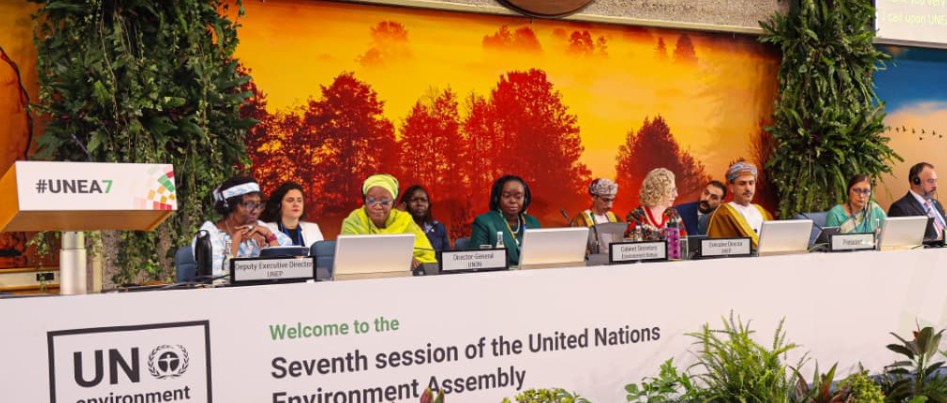
As the Seventh Session of the United Nations Environment Assembly (UNEA-7) opened Monday at the UNEP Headquarters in Nairobi, global leaders were urged to embrace bold, science-backed and inclusive measures to confront the mounting climate, biodiversity and pollution challenges.
Cabinet Secretary (CS) for Environment, Climate Change and Forestry, Dr. Deborah Barasa, said Kenya was honoured to host the world’s premier environmental decision-making forum at a critical time.
She noted that environmental challenges demand unprecedented cooperation and innovation.
“It is truly a great honour and a heartfelt privilege to join you all at the opening of UNEA-7, here in Nairobi, the vibrant city that has become a beacon for our shared environmental future,” Dr. Barasa expressed, extending warm greetings from the Government and people of Kenya.
She reaffirmed Kenya’s commitment to supporting UNEP and Member States in “building a safer, healthier, and more resilient planet for everyone,” she added.
The CS drew attention to the exhibition spaces provided by UNEP for Kenyan institutions, which will remain open throughout UNEA-7.
“These exhibitions offer a unique glimpse into Kenya’s innovations, cultural diversity, and the strengths of our various sectors.
I encourage you to take time to explore them and engage with the ideas, technologies, and partnerships that Kenya proudly presents to the world,” she said.
Dr. Barasa emphasised that the Assembly’s theme, ‘Advancing Sustainable Solutions for a Resilient Planet’, reflects the urgency of the moment.
“The time for small, cautious steps has passed; what we need now is bold, integrated, and inclusive action,” she said, stressing that climate change, biodiversity loss, land degradation, toxic pollution, and unsustainable consumption are deeply intertwined crises that cannot be addressed in isolation.
She said UNEA-7 is expected to approve the Medium-Term Strategy and Programme of Work, guiding UNEP’s strategic direction from 2026 to 2029.
Kenya, she said, would constructively contribute to the process to ensure the strategy incorporates ambition, science-based policy, equity, and opportunities for innovation, especially for developing countries.
Dr. Barasa expressed optimism that delegates would adopt a strong Ministerial Declaration and make critical decisions, including setting the date for UNEA-8.
She noted that Kenya is sponsoring three resolutions and co-sponsoring two others, reflecting emerging global environmental challenges and the potential for innovation, collaboration, and policy leadership.
Dr. Barasa highlighted three key imperatives: scaling sustainable solutions that restore ecosystems, support livelihoods, cut emissions and eliminate waste, and strengthening resilience to move communities from vulnerability to empowerment.
She also emphasised the need to champion inclusive environmental governance that ensures women, youth, Indigenous peoples and marginalized groups have a voice in decision-making.
“Kenya pledges to align national development with the 2030 Sustainable Development Agenda, mobilise finance for nature-based and circular economy solutions, build strong institutions, promote sustainable lifestyles, and foster innovation and knowledge sharing that connects local action with global ambition,” Dr. Barasa said.
“Let us resolve that UNEA-7 will not just talk about the future; it will help create it. Welcome home. Karibuni Nyumbani,” she added.
UNEA President and Head of Oman’s Environment Authority, Abdullah Bin Ali Al-Amri, welcomed delegates, describing Nairobi as “the home of UNEP and the beating heart of global environmental multilateralism.”
He reaffirmed the Assembly’s responsibility to transform determination into tangible results for people, ecosystems, and planetary stability.
“We convene at a decisive moment. Around the world, communities continue to endure the intertwined impacts of climate change, biodiversity loss, land degradation, and pollution – challenges that test not only our economies and societies but also the very trust in our collective will,” Al-Amri said.
He commended UNEP Executive Director Inger Andersen and her team for their leadership in guiding preparatory work for UNEA-7 and emphasised that the Assembly’s success depends on negotiation with “trust, transparency, compromise, and inclusiveness”.
The UNEA President outlined three pillars for success: ambition, because incrementalism is insufficient; solidarity, because resilience is built collectively; and science, as UNEP reports show that challenges, while immense, are surmountable.
He said UNEA-7 will be judged successful if it delivers implementable resolutions, a unifying Ministerial Declaration, a well-resourced UNEP strategy, coherence among Multilateral Environmental Agreements, and equitable access to finance and technology.
The UNEP Executive Director welcomed nearly 6,000 registered participants from over 170 countries, including 79 Ministers and 35 Vice-Ministers.
She underscored that UNEA is the world’s most influential environmental decision-making body, responsible for setting the trajectory for action on the three planetary crises: climate change, nature and biodiversity loss, and pollution and waste.
Andersen warned that global temperatures are likely to exceed 1.5°C within the next decade, ecosystems are rapidly degrading, and pollution remains pervasive.
She urged delegates to maintain focus on consensus despite geopolitical turbulence.
“This Assembly must dig deep because environmental challenges are accelerating. Yet through unity, science, and solidarity, we can deliver sustainable solutions for a resilient planet,” Andersen said.
She cited key achievements in 2025, including the BBNJ Agreement on marine biodiversity, advances at climate talks in Belém, and the launch of the new global science-policy panel on chemicals, waste, and pollution.
She noted that UNEA-7 will consider 15 draft resolutions and two draft decisions addressing issues such as Artificial Intelligence, sustainable use of minerals and metals, antimicrobial resistance, the deep sea, chemicals and waste management, and youth participation.
“This Assembly is more than resolutions and decisions – it is where the world gathers to bring new ideas and momentum to environmental action,” Andersen said.
“We all live on the same planet and face the same challenges. If my neighbour is suffering from climate change, so am I.
Let us summon the Nairobi Spirit and agree on strong resolutions that deliver sustainable solutions for a resilient planet,” she added.
UNEA-7 will run through the week, culminating in the adoption of resolutions, the Ministerial Declaration, and key decisions guiding UNEP’s strategic priorities, reinforcing global cooperation for a sustainable and resilient future.
By Naif Rashid