At least 7000 National Youth Opportunities Towards Advancement (NYOTA) beneficiaries across North Rift Counties got the second tranche of the funs amounting to Sh172 million.
The youth from Uasin Gishu, Nandi and Elgeyo Marakwet counties received both the second and the first tranche disbursements of the Business Development Support (BDS) grants, even as leaders present encouraged the beneficiaries to be strategic in terms of marketing their various ventures through online platforms like social media to attract more customers and earn profit.
The youth were encouraged to invest their funds in viable, income-generating enterprises rather than spending them on non-essential consumption. To ensure long-term growth and success, recipients are urged to adopt financial discipline, actively participate in provided business mentorship, and utilize additional government credit schemes.
Interior Cabinet Secretary Kipchumba Murkomen presided over the disbursement of NYOTA Capital’s 2nd Tranche for Uasin-Gishu, Nandi, and Elgeyo-Marakwet Cluster at Eldoret Sports Club in Eldoret, Uasin Gishu County.
He revealed that Sh 172 million has been disbursed through the NYOTA Programme in Nandi, Uasin Gishu, and Elgeyo Marakwet counties.
The total beneficiaries from the 3 counties were 6914, Uasin Gishu having 2734, followed by Nandi with 2646 and Elgeyo Marakwet with 1534.
Equally, out of the overall 6914, 4693 have received the phase II amount of Sh22000 and an additional 3000 for NSSF savings, while 2221 have received the first-time disbursement. The total funds disbursed in the Nandi, Uasin Gishu, and Elgeyo Marakwet was Sh172,850,000.
“Don’t despise the days of humble beginnings. We have all listened to the testimonies of success made by beneficiaries for the first phase and we hope this will be an inspiring example to the upcoming young business people on the prudent use of this government support,” said Murkomen.
The Interior CS was accompanied by Deputy Head of Public Service Amos Njoroge Gathecha, Principal Secretaries Dr. Belio Kipsang (Immigration), Gitonga Mugambi (Forestry), Julius Bitok (Tourism), John Ololtuaa (Basic Education) and Dr. Chris Kiptoo (Treasury); MPs Phylis Bartoo (Moiben), David Kiplagat (Soy), Julius Ruto (Kesses), Governors Stephen Sang (Nandi) and Wesly Rotich (Elgeyo Marakwet); Uasin Gishu Deputy Governor Evans Kapkea and the Uasin Gishu Women Representative Glady Boss Shollei, among others.
Governor Wesley Rotich called on the youth to take full advantage of the digital space to market their businesses, to attract more customers and grow in profit.
This, he said, was more meaningful rather than using online media for unbeneficial activities like insulting political leaders.
Beneficiaries delivered testimonies of success of how the first phase of the business capital had benefited them as they utilized them across various ventures like poultry farming, retail shops, welding and fabrication among others.
Edwin Kiplagat, a beneficiary of phase I of the NYOTA grant, gave his testimony of how the fund has benefited him.
He said he invested in a chicken farming project where he bought 50 2-day-old chicks at Sh70 each and sold them at Sh300 after a month, earning him a profit of Sh5000 monthly after deductions on all expenses.
“The Nyota fund is of great help to me since it helped me start my business by getting the capital that I didn’t have, and now my business has grown and if I receive today’s fund I will head straight to the market and buy 50 more chicks to my expand my business,” he said.
He decried the challenges he encountered with transportation, market access and costly chicken feed, which in turn reduced his profits.
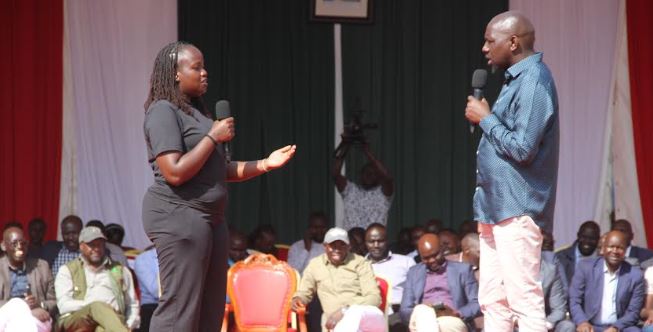
On her part, Sharon Chebet, who was a broker for coffins, gave her testimony, saying that the Nyota fund has really helped her grow as a businesswoman. From the Nyota Fund, she was able to open a coffin shop, which she started with only 5 coffins, and now she makes up to Sh70000 in monthly profit.
“I was a broker connecting clients to coffin sellers and now I run my own coffin business and I am really grateful for the Nyota project because it has really helped me grow; I can now provide for my family with ease and given this Sh22000 for the second phase, I will expand my business,” she said.
The exercise was part of the national event presided over by President Dr. William Ruto at Ulinzi Grounds in Nairobi as the government distributed Sh3.06 billion to 122,203 Kenyans under NYOTA Phase II rollout.
By Ekuwam Sylvester and Shaline Jeruto