The employment gap in Africa has narrowed significantly over the past decade, following years of stagnation in the early 2000s, according to the newly released Global Jobs Index Report.
The report provides the first scientifically based global analysis of how many jobs the world needs, where they are lacking, and where they are likely to emerge in the future.
The International Monetary Fund (IMF) projects that Africa will account for 10 of the world’s 20 fastest-growing economies this year, a promising trend that comes despite rapid population growth and a relatively low starting base.
The report further shows that the number of countries with “extremely alarming” labour market gaps has declined rapidly, dropping by more than half from the year 2000 to 20 countries in 2025.
Despite challenges, the Global Job Index estimates that the overall job gap will peak this year at 170 million missing jobs before beginning to shrink steadily as economic growth and new employment opportunities take hold.
For Kenya, the Index shows that in 2025 the total labour force stands at 26.84 million, with 20.87 million jobs available, leaving a job gap of 5.96 million, equivalent to 22.22 percent of the working-age population.
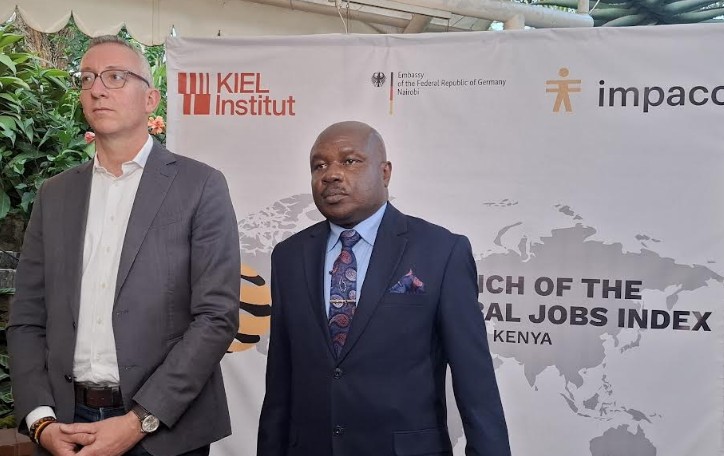
Speaking during the launch of the Global Jobs Index Report by the Kiel Institute and Impacc at the German Ambassador’s Residence in Nairobi, Principal Secretary for Labour and Skills Development, Shadrack Mwadime, said the projections suggest Africa could soon experience higher job creation rates than many other regions.
“The projections from the Index show a likelihood of having more jobs in Africa than even in other regions,” he said, urging young people to seize emerging opportunities.
He added that the government is actively expanding international employment pathways for Kenyans.
“We already signed a bilateral labour agreement with Germany last September. We have had joint implementation committee meetings, comprising both Kenyan and German technocrats, to establish a structured and orderly way for young Kenyans to access jobs in Germany,” Mwadime explained.
The PS praised Kenyan youth for their competence and professionalism, noting that with proper certification, they can compete globally.
“Kenyans are brilliant, disciplined, and highly skilled. With the right qualifications, they can thrive in the international labour market,” he said.
He further emphasised the importance of cultivating a savings culture among young workers.
“It is critical that our youth save from what they earn. An economy that saves more invests more,” he said, highlighting the government’s efforts, such as the Diaspora Bond, to encourage investment by Kenyans working abroad.
Mwadime acknowledged that Western European countries possess more advanced technologies but said that exposure to these environments would enable Kenyan professionals to acquire vital skills and transfer knowledge home.
“Our bright young people working abroad will gain the know-how, strategic capacity, and resources to help drive development when they return,” he said.
He expressed optimism about the continent’s prospects: “The future is bright. The Global Job Index indicates that job opportunities will continue increasing, eventually bringing us to the same level as Western European countries. The policies and incentives in place will help us get there.”
German Ambassador to Kenya, Sebastian Groth, noted that Africa’s economic rise is reshaping global labour dynamics.
“Research shows that of the 100 million jobs projected to be created by 2030, 75 million will be in Africa,” he said.
He described this trend as a positive “twist” to the often-cited “youth bulge”, pointing out that Africa’s young population offers a valuable opportunity for economic transformation.
Groth highlighted the demographic contrast between the two continents: “In Kenya, the average age is about 19 years, representing 42 per cent of the population. In Germany, the median age is 47, which means we have an ageing population and a shortage of skilled labour. This complementarity creates natural cooperation between our countries.”
He encouraged Kenyan youth aspiring to work in Germany to obtain university or TVET-based technical qualifications and to learn the German language—skills that greatly ease entry into the German job market.
“We need skilled labour in the health, care, logistics, and automotive industries—physiotherapists, bus drivers, lorry drivers—and there is a wide range of qualifications currently in demand,” Groth said, adding that Germany faces an annual shortfall of around 250,000 skilled workers.
He revealed that the number of young Kenyans heading to Germany for employment has risen sharply, now representing about 30 per cent of visa applications across various categories.
Groth cited a successful collaboration between Hochschule Koblenz (University of Applied Sciences in Koblenz) and Mount Kenya University (MKU), which trains Kenyan students for paid nursing apprenticeships in Germany.
“The Kenyan school system is solid, and there are currently 57 registered academic partnerships and cooperations between Kenyan universities and German institutions,” he noted.
Dr. Till Wahnbaeck, founder and CEO of Impacc, a venture capital fund investing in African startups, and one of the creators of the Global Job Index, said the research aimed to quantify the gap between available jobs and the people seeking them globally, projecting trends up to 2060.
He explained that while discussions about Africa often focus on population growth, the data show that economic growth is outpacing it, leading to job expansion.
“The gap between those who need a job and those who have a job is getting closer by the day,” Dr. Wahnbaeck said.
“By 2060, the Global Jobs Index estimates that there will hardly be any gap between the labour force and available jobs. But the key is not to wait until then—we must act now.”
He noted that the 100 million new jobs expected by 2030 will largely emerge in the Global South, translating to about 20 million new jobs each year. “This changes the narrative from one of overpopulation to one of opportunity and progress,” he added.
Wahnbaeck also addressed the role of artificial intelligence (AI) in shaping the future of work, saying technological advancement will boost demand for both cognitive and technical skills.
“As AI takes on more cognitive work, we expect many hands-on, manual, and technical jobs to remain, areas where Africa has strong potential,” he said.
He predicted that Africa’s future workforce will be diverse, innovative, and entrepreneurial.
“The future of work in Africa will be driven by start-ups, small ventures growing big and lifting people as they grow,” he remarked.
According to the Global Job Index, while Africa is still at the lower end of the global employment scale, the continent is catching up fast.
The situation remains critical in a few nations, but progress is accelerating. By 2040, only four countries, Madagascar, Burundi, Somalia, and Zambia, are projected to still have an “extremely alarming” employment gap.
The report concludes that Africa’s growing economies, combined with strong youth potential, technological adaptation, and international partnerships, are positioning the continent as a key driver of future global employment growth.
By Wangari Ndirangu