Ministry of Agriculture and Livestock Development, Cabinet Secretary Mutahi Kagwe has called on African countries to act collectively with a unity of purpose if they are to attain food independence and sovereignty.
Kagwe pointed that a collective vision for Africa’s food future should therefore look at four priorities, namely, scaling up agro-processing and trade, mobilizing climate finance, empowering youth and innovation and policy coherence and partnerships.
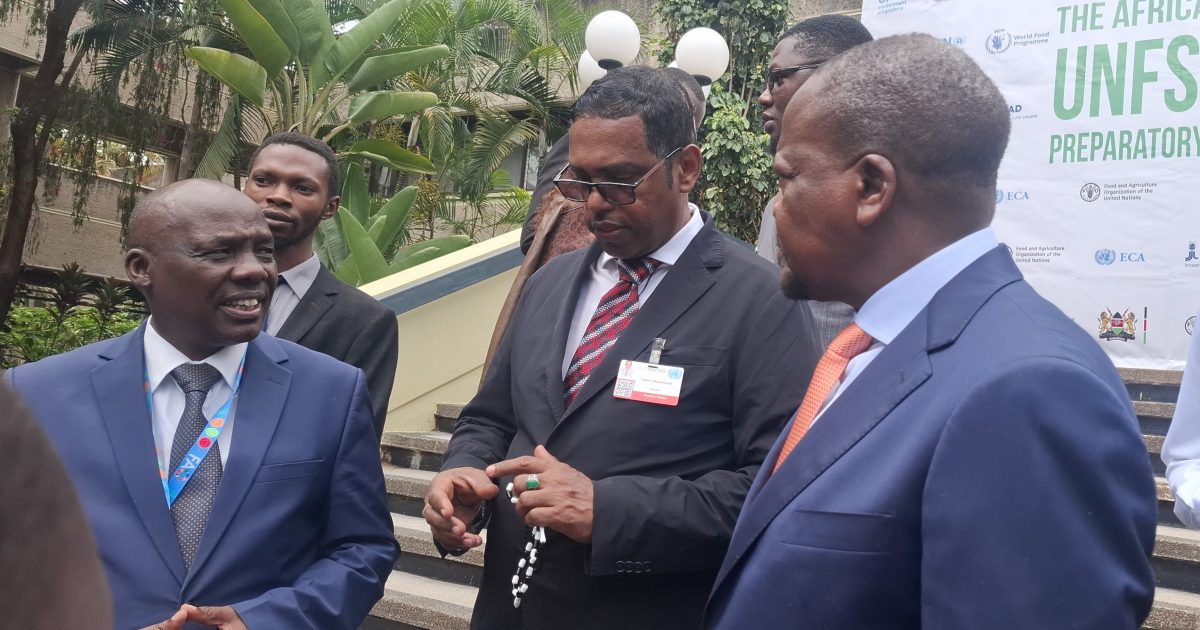
Speaking during the United Nations Food Systems Summit (UNFSS+4) at the United Nations Complex in Nairobi, Kagwe noted that four years ago, the global community came together under the banner of the UNFSS to confront a stark reality: food systems are deeply intertwined with the most pressing challenges of our time climate change, poverty, malnutrition, and inequality.
For Africa, he said that this reality is not just a matter of policy but of survival, adding that despite the continent’s vast agricultural potential, it remains absurdly dependent on food imports, spending billions of scarce foreign exchange resources annually, while smallholder farmers, who produce the majority of what is eaten, struggle with fragmented markets, climate extremes, and systemic inefficiencies across agricultural and livestock value chains.
“The choices we make today will determine whether Africa rises as a global breadbasket or remains trapped in cycles of dependency and scarcity”, the CS told stakeholders and experts from Africa who are gathered to take stock, looking at countries level of progress being made in pursuit of food systems transformation.
The meeting preceded the 2021 UN Secretary-General-convened Food Systems Summit, which aimed at drawing attention to the urgent need to accelerate progress on all 17 Sustainable Development Goals (SDGs) through a food systems approach, and also a follow-up of UN Food Systems Summit Stocktaking Moment (UNFSS+2) held in 2023.
“As we deliberate, let us move beyond rhetoric and commit to actionable, measurable, and inclusive solutions. Let us hold each other accountable, share knowledge freely, and stand in solidarity with the smallholder farmers, women, and youth who are the true heroes of our food systems,” the CS said.
Food and Agriculture Organization (FAO) of the United Nations Interim Representative for Kenya Nyabenyi Tipo said that as a region, Africa is doing its best and that statistics show that by country, the food systems are stable.
“We have a very strong farmer-based organization and stakeholders and also very strong small-scale farmers who are really our backbone of the economy and of agriculture in Africa,” she added.
The meeting today, she noted, is to prepare African countries on how to position themselves and how to take stock of their own progress towards the targets they have set in strengthening their food systems as they prepare for the upcoming UNFSS+4 global meeting that will be held in Ethiopia in the next two months.
In Kenya, the FAO representative said they have supported the country as a co-convener of the food system and supported specific projects along five pathways under the Kenya Integrated Agricultural Management Information System. (KIAMIS)
“One of the pathways is to do with digital agriculture in which FAO is working very closely with the Ministry of Agriculture and also supporting the land governance in registration and demarcating land and this will inform the investment cases of this country in terms of agricultural sector”, said Tipo.
Conversations about transforming food systems, Tipo noted, are nation-specific, saying that some countries in Africa are food self-sufficient at even 100 percent, but she urged the African countries to support their farmers in areas of access to input, reduction of post-harvest losses, and markets, and also at the policy level.
Dr. Khaled Eltaweel, Senior Coordinator of the UN food system, said that globally food security is deteriorating as there is increased hunger, especially in Africa, where one of each five is suffering from hunger and three out of four cannot afford healthy diets.
In addition to hunger and malnutrition, he added that the current food systems are contributing negatively to climate change.
“One-third of greenhouse gas emissions are coming from food systems. 70% of biodiversity loss is happening because of food systems, and almost 80% of freshwater resources are utilized by food systems”, he said.
Dr. Eltaweel said that going into the UNFSS+4 this year, the region has an opportunity to focus on the needs of the African continent to mobilize and agree on a common African position that can be presented in Addis during the global meeting in July.
The meeting was prepared by UNFSS+4, the UN Food Systems Coordination Hub and the UN Economic and Social Commission for Africa (ECA), in partnership with the Kenyan government, the African Union and the African Union Development Agency (AUDA-NEPAD).
By Wangari Ndirangu