Patients with infectious diseases will now receive life-saving diagnosis and treatment faster, thanks to new technology at Aga Khan University Hospital, Nairobi that identifies disease-causing organisms in just 30 minutes- down from 8 to 18 hours previously.
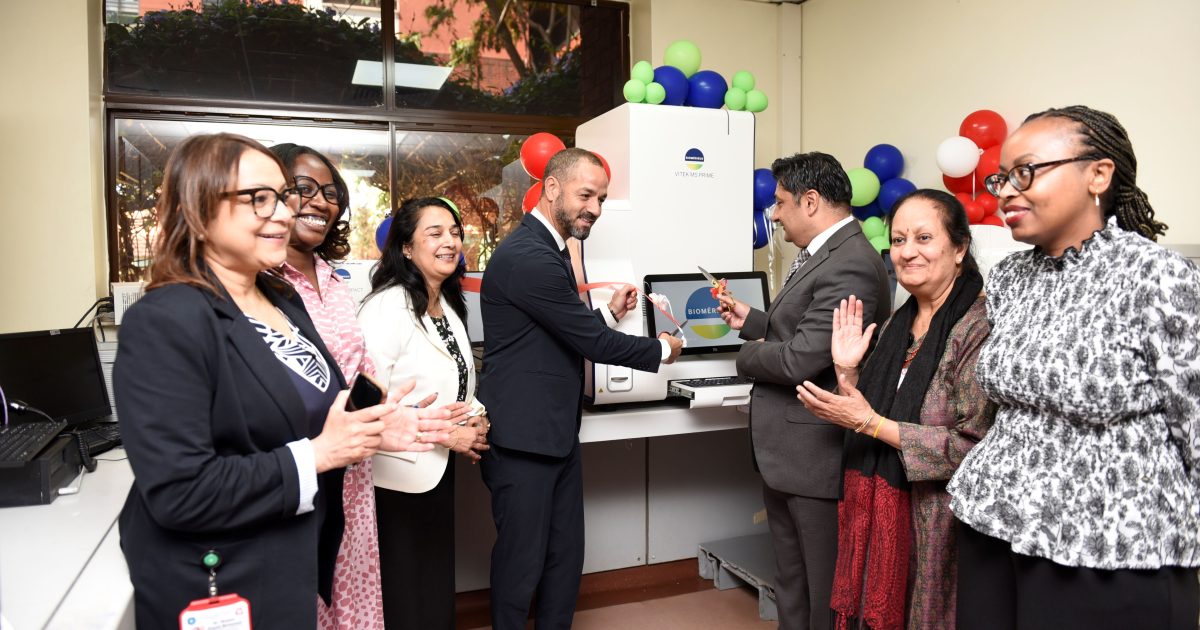
The breakthrough comes with the installation of the Vitek MS Prime, a state-of-the-art diagnostic platform from bioMérieux.
Using MALDI-TOF technology, the machine can rapidly detect a wide range of microorganisms including bacteria, fungi, yeast, and other hard-to-identify pathogens that cause pneumonia, meningitis, gastroenteritis, urinary tract infections, and other diseases.
Unlike its predecessor, which had limited capacity, the Vitek MS Prime can identify a much broader spectrum of disease-causing organisms such as anaerobic bacteria, filamentous fungi, and certain mycobacteria in just minutes.
“Previously, we had to send some samples to Asia, and patients would wait weeks for results. Now, we can do this right here, in our laboratory,” said Dr. Shaheen Sayed, Chair of the Department of Pathology.
In a press statement, Dr. Sayed highlighted that the technology accelerates diagnosis, improves accuracy, and enables timely, targeted treatment, helping curb inappropriate antibiotic use, fight antimicrobial resistance and save patients unnecessary costs.
Notably, Aga Khan is the first hospital in Sub-Saharan Africa to acquire this advanced model, marking a major step forward in the fight against infectious diseases.
The Hospital CEO Rashid Khalani noted that this milestone underscores the facility’s commitment to leveraging on cutting-edge technology and global partnerships to enhance healthcare delivery.
“As we know, antimicrobial resistance is a global health issue. Through this technology and project, we will be able to inform physicians and patients quickly and accurately which will help in faster diagnosis and hence faster and correct interventions,” affirmed Khalani.
The CEO disclosed that BioMérieux is working with 14 Centres of Excellence in Microbiology around the world, only two of which are in Africa, with the first in Morocco for which he expressed the hospital’s pride to be chosen as their 2nd Centre of Excellence in Africa.
“This milestone reflects our patient-centered efforts to address the growing burden of infectious diseases in the country and the region,” he added.
Similarly, the new installation is part of the Centre of Excellence in Microbiology and Antimicrobial Stewardship Project, a collaboration between Aga Khan University Hospital and the bioMérieux Global Academy for Medical Education.
At the same time, Dr. Gunturu Revathi, Head of Clinical Microbiology at the hospital and Principal Investigator of the project, highlighted the broader national impact stating, “Through this initiative, we will work with over 10 public hospitals in Kenya to train multidisciplinary teams on antimicrobial stewardship. The Vitek MS Prime will not only speed up diagnosis and care for our patients but will also strengthen capacity across the public healthcare system”.
In his remarks, Marc Haribou, Vice President for Clinical Operations, Africa at bioMérieux, emphasized the importance of partnerships insisting that they are critical to advancing healthcare and improving patient outcomes.
“At bioMérieux, we remain committed to working with healthcare and research institutions to fight antimicrobial resistance. Reliable and rapid diagnostic solutions are essential to achieving better outcomes across Africa as we strive to make the world a healthier place,” he maintained.
The Aga Khan University Hospital, Nairobi is a regional leader in diagnostics, combining advanced technology with the highest quality standards. Its laboratory is accredited by the College of American Pathologists (CAP), the global gold standard in laboratory excellence.
By Michael Omondi