Agricultural journalists play a crucial role in shaping how Africa understands and embraces innovation in agriculture.
Through their reporting, they translate complex science into stories that farmers, policymakers, and investors will need to act on.
African Agricultural Technology Foundation (AATF) Project Manager Vitumbiko Chinoko said this during the first of its kind World Congress of International Federation of Agricultural Journalists (IFAJ) 2025 held in Nairobi last week.
IFAJ is a global non-profit organization representing over 5,000 agricultural communicators in 60 countries and brings together global journalists who shape conversations around sustainable agriculture, food systems, and environmental stewardship.
“You elevate the voices of farmers, helping them to be heard where decisions are made. You hold institutions accountable, ensuring that progress is both equitable and transparent, but most importantly, you cultivate public dialogue, breaking down misinformation and fostering understanding around biotechnology, sustainability, and climate resilience,” Chinoko added.
Chinoko, who was one of the keynote speakers in the three-day congress, said, “Without the media, many scientific breakthroughs would remain confined in the labs.”
He added that AATF, which acts as a bridge between innovation and impact, has been connecting world-class research to the realities of African smallholder farmers, and through partnerships, has enabled equitable access to climate-smart and biotechnological solutions, improved seeds, and mechanization that are improving and transforming agricultural systems across 24 African countries.
With the media, Chinoko added that these innovations travel across borders, inspire confidence, empower communities, and expand reach to more farmers and countries.
He noted that AATF considers media as a vital partner in accelerating Africa’s agricultural transformation and aims to make media engagement a core component of their strategy by building generous capacity to understand and report on complex scientific and technological advances with accuracy and context.
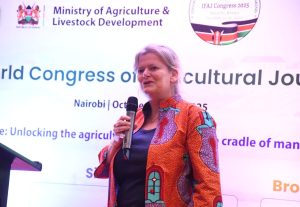
“We endeavor to co-create communication initiatives, from farmer-centered documentaries to policy dialogues and digital storytelling that will amplify Africa’s progress towards food and nutrition security,” Chinoko told the journalists derived from 34 countries across the globe
He further noted that when science meets storytelling, the result is impact that applies far beyond fields and labs, adding that the convergence of technology, media, and farmer innovation offers Africa unprecedented opportunity.
He remained hopeful that the conference would bring out realities of Africa’s agriculture and the role that technology plays in transforming agriculture into an equitable and profitable enterprise.
“At AATF, we are committed to working hand-in-hand with the media to ensure that every discovery finds its audience, every innovation finds its user, and every farmer finds their voice. Together, we can transform our farms and our futures,” Chinoko stressed.
Dr. Catherine Toure, Director of the International Development Research Centre (IDRC) Eastern and Southern Africa office, said they have been supporting some of the members of Media, Environment, Science, Health, and Agriculture (MESHA) in Kenya in interactive science cafes between researchers and journalists to discuss scientific issues.
“We are interested in telling the stories that are translating policy, and in this regard journalists are important research partners. You all ask questions that the public would ask you, ask challenging questions to researchers that we need to hear and that the public also needs to hear, and thus be able to tell the story in relatable ways, even if it has to do with complex phenomena,” she said.
Dr. Toure called upon participants at the congress to come up with new ideas, looking at collaborations and solutions for food nutrition security in Africa and globally through storytelling.
Steve Werblow, the IFAJ president, said the congress will go down in history not just because it is the first in East Africa but also because it will be filled with moments for all, be it a conversation with colleagues that opens eyes to some new angle on agricultural engagement with scientists and farmers who are charting humanity’s course even as the world grapples with a changing climate and ever-growing demand for food, fiber, and fuel.
Aghan Daniel, Congress Director, said that over the years, MESHA has made remarkable strides in advancing science journalism in not only Kenya but also across Africa through media cafés, where it has created spaces for journalists, scientists, and communities to come together not only to foster and understand but also to strengthen credible science reporting.
Kenya’s agriculture sector plays a vital role in the country’s economy, accounting for about 21.3 percent of the nominal GDP. The government has implemented interventions to enhance the performance of priority value chains under the agriculture pillar of the Bottom-up Economic Transformation Agenda (BETA).
by Wangari Ndirangu