While many would have given up hope in fishing and fish farming, Bunyala-based fishermen are riding the wave at Lake Victoria with the new technology of lucrative fish cage farming.
Here at Busembe beach, fish caging is the new method that has taken this little village of Bumbe in Busia County by storm.
Armed with little knowledge obtained from social media platforms and training from the fishery department in Busia, cage farming has drastically reduced cases of insecurity in the lake, where Kenyan fishermen used to lose their lives in the hands of Ugandan police, it has also created employment and minimised overfishing contrary to the rules laid down, as narrated by Victor Bwire, a farmer with 5 cages.
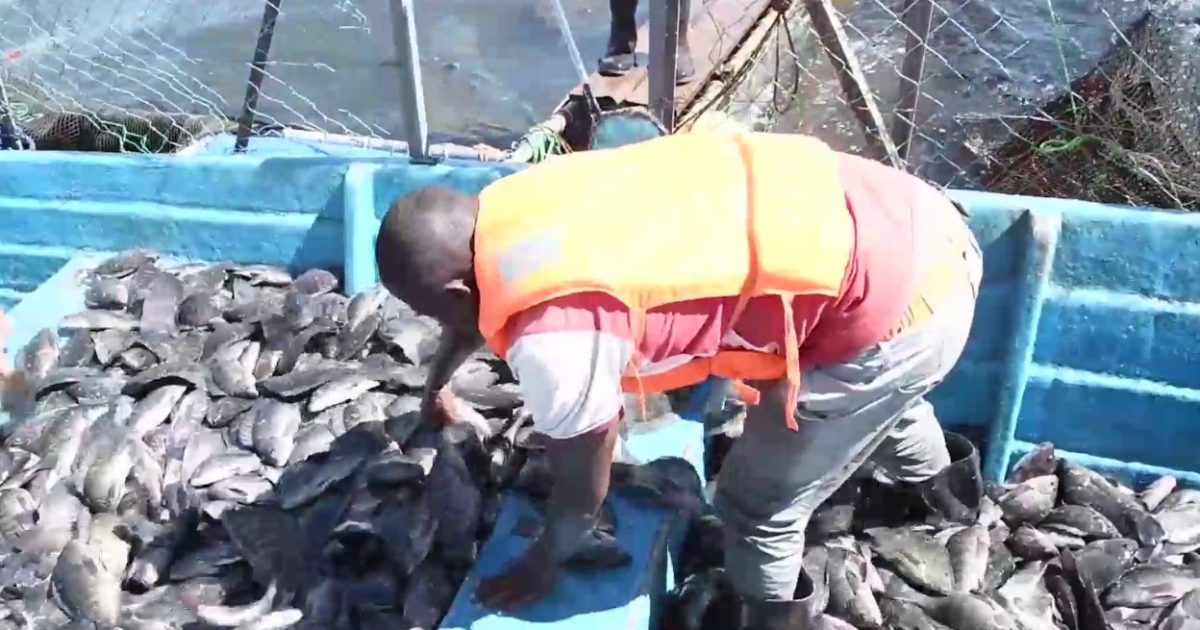
Bwire stares with pride as he supervises the fish harvesting of his four fish cages, which have been an important source of income in these hard economic times.
“Fish cage farming has turned into a thriving business that meets the demand for fresh fish in the local market in the wake of dwindling stocks in the natural waters,” said Bwire.
He added that, “With 70% of people here depending on fishing to earn a living, we ended up overfishing contrary to the laid regulations in the lake, where some even used unauthorised nets to get underage fish, something which led to the arrest of many by Ugandan authorities.”
Bwire narrated how many lives were lost on the lake through harassment by Ugandan army and coast guards forcing families to dispose of their valuable assets like land to bail out their loved ones.
This condition communicated the introduction of cages, which has changed the narrative, as most residents no longer overly rely on fishing alone but rather on improved fish farming.
“Hardly would a week go by before you read or hear the news of a Kenyan fisherman arrested by Ugandan authorities or killed by police for encroaching on their boundary. The narrative is slowly changing as we embrace cage farming,” Bwire noted.
The sentiment was echoed by Calement Nyangweso, Chairman of the Tungane fish cage group, who highlighted the frustrations and nightmare they underwent while fishing in the lake.
“The lake swallowed many lives; it was either boat capsizing, arrest or harassment, including being forced to eat raw fish. Thank God that is behind some of us now,” said Nyangweso.
The industry, which has employed over 4000 people along the lake, is faced with numerous challenges, which residents feel, once addressed, will revitalise the economy.
Despite the huge potential posed by the lake, farmers who have little knowledge obtained from training or online are now struggling with a lack of coolers or fish processing plants, forcing them to sell at retail prices, something that has left more losses to some owing to the fact that fish are perishable.
“We are urging both the county and national government to invest in this industry with processing plants, coolers and hatcheries to boost production and revenue in an industry which has the ability to employ over 10,000 youths in Busia at a go,” said Ouma Benson, a farmer.
Farmers are faced with the challenge of selecting the right fingerling and right standards due to some cartels taking advantage of the demand to supply the wrong quality of fingerlings, which have low weight and are small in size.
The floating fish cage technology was harnessed in 2013 after trials were successfully conducted at Dunga beach, Kisumu County, by the Kenya Marine and Fisheries Research Institute (KMFRI).
Currently, fish cage farming is practised in five riparian counties: Migori, Siaya, Homa Bay, Busia and Kisumu.
Experts, however, observe that, despite fish cages being viewed as an economic empowerment, there is a need to regulate their operation and formulate policies to meet international standards.
Fish cages help to control fish diseases and attacks on fish by monitor lizards and other prey in the lake.
Currently the Lake Victoria Kenyan portion has over 6500 fish cages, according to a report by KMFRI with each cage having the capacity to produce one tonne of fish annually.
According to KMFRI, the current aquaculture capacity in the lake is 60,000 tonnes of fish annually against an annual wild production of fish which stands at 100,000 tonnes.
According to Bwire, with all the risk factors, the cages will end up overtaking the natural fish production, which will alter the entire lake ecosystem.
Statistics by KMFRI show that species like Tilapia have already shrunk by more than 50 per cent in the last decade but the resilient Nile perch shrunk by 23 per cent. The bigger Nile Perch has been resilient because one Nile Perch can produce 17 million eggs compared to Tilapia’s 300 eggs.
Farmers at Busembe beach are appealing to the government to increase the number of coast guards to assure them of the security of their cages despite efforts by privately hired security guards who at times are faced with attacks from neighbouring coast guards.
With changing climatic conditions, increased demand for the fish and a growing population of fishermen, climate-smart agriculture recommends fish cages as the best alternative, which has been proven in most first-class countries like China.
By Absalom Namwalo