Children in Kenya continue to face numerous challenges that threaten their well-being and future opportunities.
Limited access to quality education, inadequate healthcare, and child labor persist as significant issues. At the same time, harmful cultural practices such as female genital mutilation (FGM) and early marriages continue to deprive young girls of their rights.
Rising cases of teenage pregnancies and school dropouts further jeopardize progress made in child protection and education over the past decade.
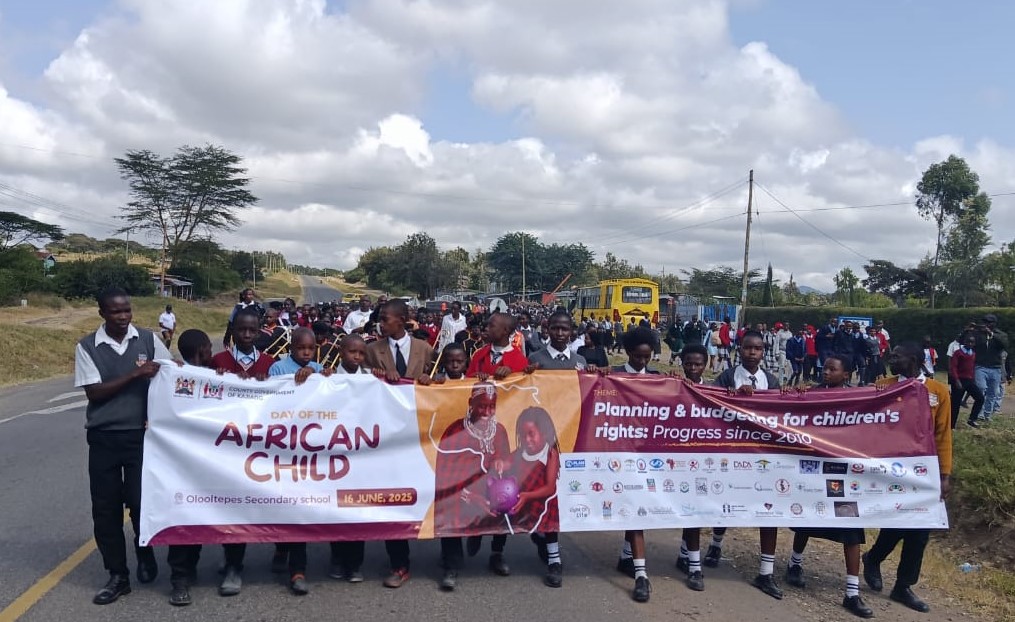
As Kenya joined the rest of Africa in commemorating the Day of the African Child on June 16, discussions centered on the urgent need for sustained investment in children’s rights, with a particular focus on addressing inequalities in underserved communities.
This year’s theme, “Planning and Budgeting for Children’s Rights: Progress Since 2010,” emphasized the need for greater accountability and investment in children’s welfare. It highlighted the progress made since 2010 while urging governments and stakeholders to prioritize education, healthcare, and child protection in national and county budgets.
In Kajiado County, the day was marked at Oltepesi Secondary School in Kiserian, where local leaders, child rights advocates, and government officials gathered to highlight the challenges facing children in the region.
Among the most pressing concerns were Female Genital Mutilation (FGM) and early marriages, which continue to deprive young girls of their rights despite efforts to eliminate the two social vices.
Speaking at the event, Ann Kang’ethe, Kajiado County Coordinator of Children’s Services, noted that while the county had passed an Anti-FGM Policy, eliminating the practice requires a multi-sectoral approach.
“FGM is deeply rooted in culture, making it difficult to eradicate without concerted efforts from the government, community leaders, and families. For us to completely end the practice, a multi-sectoral approach must be employed,” she said.
Access to education was another major focus, particularly for children from disadvantaged backgrounds.
Cosmas Karera, Kajiado West, Children’s Officer, noted that financial constraints remain a significant barrier, preventing many students from continuing with their studies. He emphasized that although bursaries are available, they are insufficient to meet the growing need.
“Eighteen percent of children in Kajiado County did not join Form One this year due to lack of school fees. Without adequate funding, many children are forced to stay home, missing out on the opportunity to secure a better future,” he revealed.
Karera called for greater investment in education, urging both the county and national governments to allocate more funds toward bursaries and financial aid programs. He stressed the need for targeted support to ensure that children from low-income households can continue their studies without disruption.
“We must prioritize education funding so that no child is forced to stay home due to financial constraints. Education is the foundation of a better future,” he stated.
Children from various schools marked the day with poems, songs, and dramatic performances that underscored the challenges they face, including abuse, child labor, and harmful cultural practices. Through their presentations, they called for greater protection, equal access to education, and a nurturing environment where they can grow and thrive.
The Day of the African Child is marked annually on June 16 to honor the memory of the Soweto Uprising in South Africa in 1976. On this day, thousands of black school children protested against the poor quality of education and demanded their right to be taught in their own language. The demonstration was met with brutal force, leading to the deaths of many young students.
Since its establishment by the Organization of African Union (OAU) in 1991, the day has served as a platform to raise awareness about the challenges African children face and to advocate for their rights, particularly in education, health, and protection.
Governments, organizations, and communities use the occasion to reflect on progress made and to push for stronger policies and investments that ensure a better future for children across the continent.
By Rop Janet