Canon Central and North Africa (CCNA) has expanded its environmental conservation initiative into East Africa through partnership with Kenya’s Oceans Alive Foundation.
The collaboration is expected to strengthen science-driven coral restoration, community training and marine storytelling along the country’s coastline by use of its new brand campaign, “Canon’s World Unseen: 2.0-Coral”.
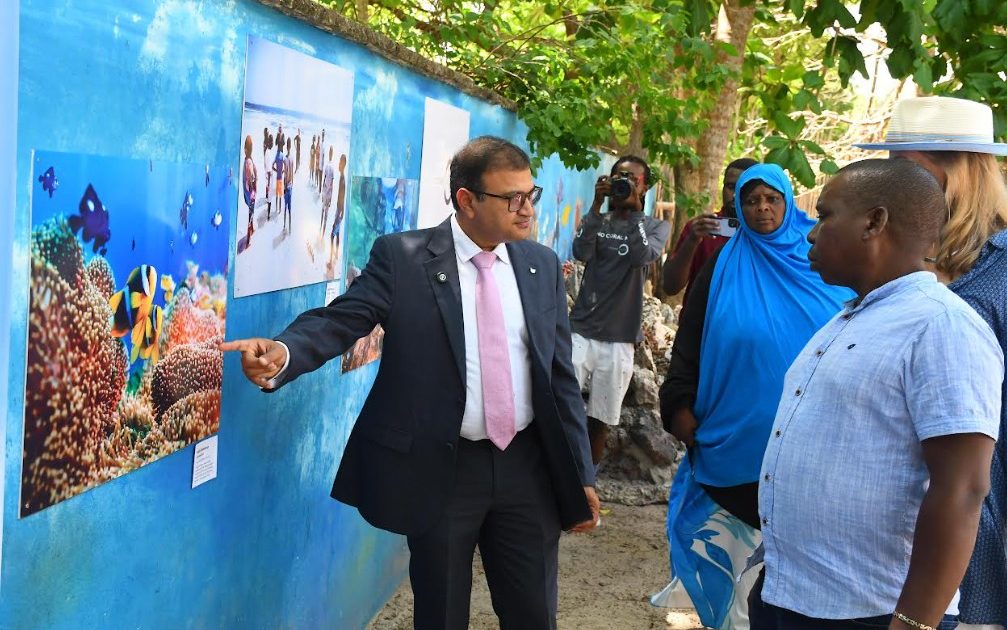
Speaking in Vipingo, Kilifi County, CCNA Managing Director Somesh Adukia said the programme reflects the Company’s commitment to safeguarding coral reef ecosystems that cover less than one per cent of the ocean floor, yet support nearly 25 per cent of all marine life, buffer coastlines, and contribute to food security for millions of people.
He noted that more than half of the world’s coral reefs have disappeared over the last 30 years due to rising sea temperatures, pollution, illegal and excessive fishing, sedimentation and widespread marine disease.
Adukia said the East Africa Chapter will help address the pressures through science-based restoration, advanced imaging technology and local capacity building to enhance long-term reef recovery.
“Our intention is not to start something that lasts a short while and disappears. We want to do something consistent, long-lasting and able to address the real pain points of communities in Africa,” he said.
He noted that CCNA’s research revealed that coral reef conservation affects not only marine ecosystems but also the livelihoods of fishermen and their families who depend on healthy reefs for income and food security.
“Coral reef conservation is not just a programme to restore reefs. There are many communities attached to it; that is the fishermen, their families, their opportunities and their livelihoods depend on it,” he added.
He explained that Kenya was selected as the first African country to roll out World Unseen 2.0 after Canon identified suitable coral ecosystems in Mombasa and Kilifi counties and secured a strong local partner in Oceans Alive Foundation.
“We needed a partner with the necessary infrastructure and one that is engaged in coral restoration regularly. Oceans Alive provided that strong partnership. Here there are necessary coral reefs, you have the beach, and you have a partner like Oceans Alive. That is why we chose Kenya,” he said.
World Unseen 2.0 is part of a broader Europe, Middle East and Africa (EMEA) strategy. CCNA has already launched related activities in the Seychelles and the UAE, and Adukia said similar initiatives will be rolled out across the region.
“This programme is EMEA-wide. You will soon see similar initiatives across Europe, the Middle East and Africa,” he said.
The initiative builds on Canon’s existing collaboration with Nature Seychelles and Coral Spawning International, which established the first coral breeding facility in the Western Indian Ocean.
According to Adukia, the Kenya Chapter strengthens community-led conservation through the Oceans Alive Foundation by expanding restoration work, advancing scientific monitoring and supporting knowledge transfer.
“The World Unseen 2.0 in Kenya reflects our commitment to practical, science-based conservation that empowers communities. Paired with Oceans Alive’s local leadership, Canon’s imaging expertise will enable precise monitoring, credible storytelling and stronger reef recovery efforts,” said Adukia.
Oceans Alive Founder, Des Bowden, said the partnership supports a community-led conservation model that began in Kuruwitu.
“We started in Kuruwitu with a bold belief that communities are the true guardians of the sea. Through this collaboration with Canon, we are making the invisible visible. When people truly see the ocean, they value it. When they value it, they protect it,” said Bowden.
Ocean Alive, established in 2018, works closely with Beach Management Units (BMUs) and supports alternative livelihoods such as ecotourism, aquaculture, and permaculture, especially during the rough-sea months when fishermen cannot access the ocean.
“We help set up kitchen gardens, which have greatly improved nutrition for families, particularly women and children. Many families are now producing leafy greens for home consumption and for sale,” said Bowden.
The Foundation also supports fishmongers by integrating them into coral restoration work for the first time.
“These women traditionally never go into the sea, but now they participate as interns in planting coral. Seeing what is underwater helps them understand the link between coral, fish populations and their livelihoods,” added Bowden.
Coral planting is done using several methods, including installing coral on concrete structures or planting on locally sourced limestone rocks, which were once part of natural reefs.
Under the partnership, Canon will sponsor nursery tables and reef infrastructure to support the propagation and outplanting of thousands more corals. Oceans Alive will continue leading restoration, monitoring and community engagement, supported by rigorous scientific data collection and transparent impact reporting.
Canon is equipping Oceans Alive with advanced imaging tools, including the PowerShot G7 X Mark III, EOS R8 cameras, underwater housings and specialised lighting to document coral growth, bleaching events, fish recruitment and changes in reef structure. The detailed photographic data will support scientists in assessing coral size, survival and overall ecosystem recovery.
Adukia said Canon intends to design a programme that goes beyond underwater photography and focuses on broader support for the journalism sector in Kenya.
“We do not want to launch a programme that only benefits Canon. We want to understand where journalists are lacking compared to the rest of the world and introduce programmes that support them,” he said.
Adukia added that Canon will also offer professional printing systems to help transform research outputs into educational materials for schools, communities and visitors.
As part of the initiative, Canon and Oceans Alive will run underwater photography workshops, youth-led media projects and environmental education sessions through Canon Academy.
The programmes aim to build local skills in digital storytelling, scientific documentation and conservation reporting.
By Chari Suche