The Common Market for Eastern and Southern Africa (COMESA) member states have called for the identification and harmonisation of Non-Tariff Barriers (NTBs) which will go a long way in boosting Intra-Africa Trade.
State Department for Trade Principal Secretary (PS) Ms Regina Ombam said that these NTB’s are especially affecting the horticultural value chain, which plays a critical role in driving regional trade, agricultural productivity, and economic prosperity.
Ms. Ombam said that the horticulture sector in particular remains a pillar of economic growth, supporting farmers, SMEs, and agribusinesses across COMESA and EAC member states.
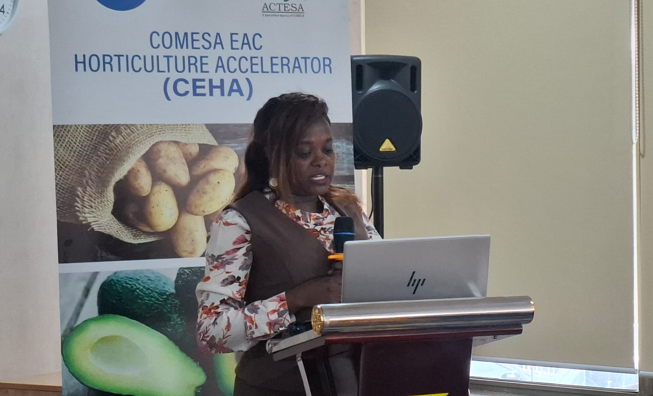
Ms Ombam, in a speech read on her behalf by Ms Caroline Chore- a Senior Trade Development Officer- during the COMESA-EAC Horticulture Accelerator (CEHA) Regional Workshop on Thursday, said that research has consistently shown that the presence of NTBs continues to hinder seamless trade, limiting market access and the movement of fresh and processed fruits and vegetables.
“Unless addressed systematically, such barriers will continue to fragment markets, stifle productivity, and reduce opportunities for regional integration,” said Ms Ombam.
The PS called for the development of a road map for harmonization NTBs affecting CEHA regional value chains.
“This workshop is going to provide a unique platform to map and assess the most pressing NTBs affecting horticulture, identify priority challenges faced by stakeholders across the value chain, and facilitate dialogue and collaboration among policymakers, regulatory agencies, and producers,” said Ms Ombam.
She added that the workshop will also help build capacity to ensure compliance with trade facilitation protocols and agree on a roadmap for harmonizing NTBs to unlock trade potential.
“By fostering cooperation among national and regional stakeholders, we can work towards a harmonized trade environment that enables farmers and agribusinesses to expand their markets. It is through collective commitment, policy coordination, and targeted interventions that we can remove bottlenecks and accelerate horticultural trade across Eastern and Southern Africa,” said the PS.
Alliance for Commodity Trade in Eastern and Southern Africa (ACTESA) Chief Executive Officer (CEO) Dr John Mukuka said that Non‑Tariff Barriers are the hidden forces that delay trucks, inflate costs, and erode farmer incomes.
Dr. Mukuka explained that in 2020, intra-COMESA exports dropped 11%, from USD 10.9 billion to 9.7 billion, and NTBs played a significant role.
“Across EAC, 256 NTBs were reported, and while 95% were resolved by mid-2022, delays and fragmentation continue to stifle trade. In some cases, traders spend between two and 296 hours on compliance,” said Dr. Mukuka.
He disclosed that a mere 10% increase in paperwork time can cut exports by up to 10%. In COMESA, non‑tariff trade costs average a staggering 285% ad valorem, double that of the EAC region
“These are not abstract statistics. They represent real farmers losing income, traders losing markets, and national economies losing growth momentum,” he said.
According to Dr. Mukuka, key challenges include limited digital visibility of NTBs, inefficient border procedures, low ICT adoption among smallholders, inconsistent seed and input standards, and persistent infrastructure bottlenecks.
“These obstacles must be addressed if we are to unlock the full potential of agriculture in our region, and this requires us to be bold, to be practical, and to be creative. Let us propose solutions that harness innovation and foster collaboration,” he said.
The CEO called for the design and roll out of SMS or app-based NTB reporting platforms across all Member States within the next six months, piloting of “Lean Corridors” with ambitious targets such as Nairobi to Kigali with a 48-hour clearance benchmark.
“Let us form multi-stakeholder technical groups to finalize Mutual Recognition Agreements for seed, fertilizer, and Sanitary and Phytosanitary (SPS) regulations, let us digitize our documentation processes; and SPS certificates, Rules of Origin, and phytosanitary documents must go online,” said Dr Mukuka.
He at the same time called for the integration of NTB alerts into the platforms farmers already use like agri-wallets, digital extension tools, and market systems.
“Let us ensure that smallholders, youth, women, and logistics providers have a seat at the table in every national NTB Monitoring Committee, let us incentivize efficient trade by rewarding frictionless shipments with co-funded private sector support,” he said.
Dr Mukuka called for clear timelines, defined responsibilities, realistic budgets and the establishment of a technical task force to follow up with the aim to launch at least two lean corridor initiatives by the first quarter of 2026.
“I am confident that this forum will be a turning point where data drives action, where regulatory harmonization becomes reality, and where cross-border trade becomes predictable, efficient, and inclusive,” said Dr. Mukuka.
By Joseph Ng’ang’a