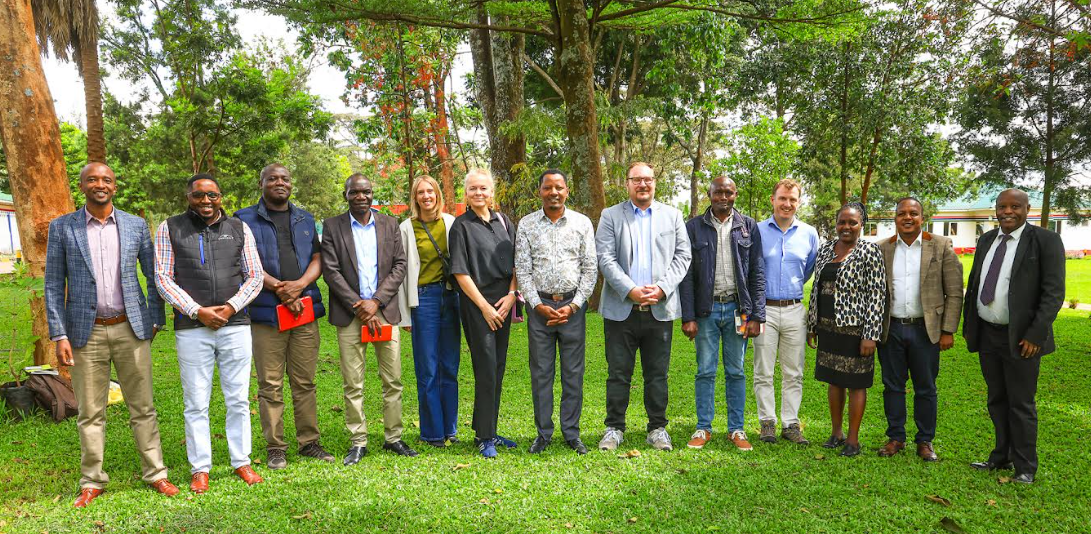
Kiambu County is advancing plans to scale up medium to large-scale biodigester use as part of its clean energy strategy.
The plans follow talks on Thursday between County Executive Committee Member for Environment, Climate Change, Energy and Natural Resources David Kuria, E4Impact and the Deutsche Gesellschaft für International Zusammenarbeit (GIZ).
E4Impact, an entrepreneurship accelerator supporting impact-focused enterprises across Africa, and GIZ, the German International Development Agency, are leading efforts to expand biodigester deployment in Kenya. The discussions in Kiambu strengthened collaboration on waste-to-resource programmes designed to widen access to clean and affordable energy.
The meeting centered on accelerating biodigester adoption for households, institutions and farmers. The technology converts human and organic waste into biogas for cooking and heating while producing nutrient-rich bio slurry used as organic fertilizer.
“The dual output positions biodigesters as a practical solution for both energy access and soil health improvement,” Kuria said.
Participants also examined options to improve market waste management, particularly in urban centers with high volumes of organic waste.
Representatives from E4Impact and GIZ detailed how structured segregation and collection systems could ensure a consistent feedstock supply for biodigester units, supporting circular-economy models within the county.
John Ngugi from E4Impact said the systems “deliver environmental and community benefits by cutting emissions and providing affordable clean energy”.
The meeting further reviewed plans to expand bio slurry use in agriculture, with discussions highlighting the need to raise farmer awareness, establish distribution channels and integrate biogas systems into agricultural extension services to boost uptake and reduce reliance on synthetic fertilizers.
Another key area was the integration of biogas technologies into vocational training programmes to build technical capacity. The partners outlined training approaches for technicians in installation, operation and maintenance, noting that Kiambu’s technical institutions could serve as centres for specialized instruction and support long-term system performance.
The collaboration aligns with the county’s programme to diversify its energy mix, strengthen waste management and advance climate-resilient agriculture.
An official from GIZ said “these can significantly improve soil fertility and reduce dependence on synthetic fertilizers if farmers are supported with training and demonstrations”.
By Grace Naishoo