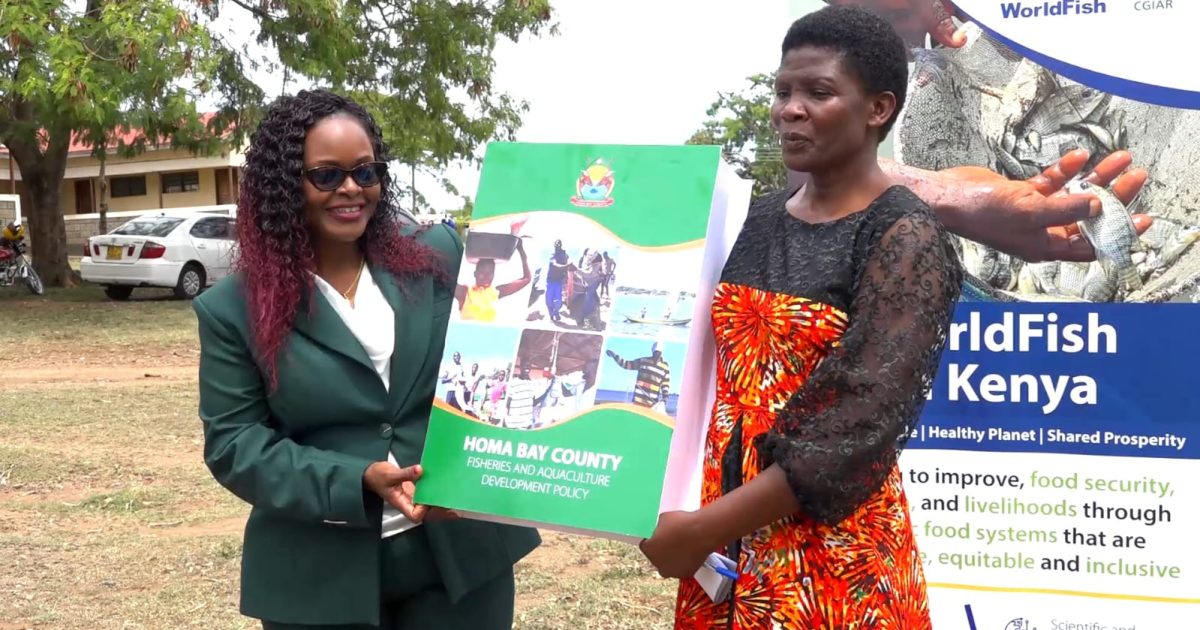
Homa Bay County has launched a comprehensive Fisheries and Aquaculture Development Policy in a sweeping effort to reverse the mounting ecological and economic crisis facing Lake Victoria.
The new policy, crafted in partnership with a global research organisation dubbed WorldFish and the County Assembly, marks one of the most ambitious county-led strategies to rebuild dwindling fish populations while boosting household incomes and job creation across the lake region.
This initiative is not just a response to the ecological decline of Lake Victoria but a broader economic plan to transform fishing communities through modern aquaculture, improved management systems, and stronger governance structures.
County Executive Committee Member for Blue Economy, Fisheries, Mining, and Digital Economy Sarah Malit, who spoke in Mbita Sub County after the launch of the policy, painted a stark picture of dwindling fish stocks and worsening climate-related disruptions.
she also pointed out the widespread illegal fishing and rising territorial conflicts in Lake Victoria, warning that the lake is at a critical point.
“We are facing a serious challenge of climate change and declining fish varieties, mostly caused by illegal fishing gear. We are really working to fight this and teach our people to use legal gears,” she said.
Malit emphasised the need for stricter regulation, research-backed decision-making, and sustainable production methods.
She said that under the new policy, the county aims to increase annual fish production from the current 37,000 metric tonnes to an unprecedented 300,000 metric tonnes by 2050 largely driven by the growth of cage and pond aquaculture.
Homa Bay already leads the region with nearly 980 fish cages installed on the lake and officials say expansion of aquaculture offers the clearest path to stable production, reduced pressure on wild stocks, and new business opportunities for youth and women.
The CEC urged residents to adopt modern practices such as aquaculture and cage culture, noting, “Lake Victoria as a natural resource is ours to maintain and use sustainably. If we cannot protect it, then we will not have a lake to fish in in the future.”
WorldFish Senior Scientist and Global Impact Lead for Social Economic Inclusion Dr. Rahma Adam said the policy is anchored in extensive research conducted since 2022, focusing on climate impacts, species decline, food security, and aquaculture development.
“When we started working in Homa Bay in 2022, our main aim was to understand the impact of climate change on the livelihoods of fisher communities in Lake Victoria,” she said.
“We are proud to have developed this policy together with the county government and multiple stakeholders. It has many pillars, including frameworks for aquaculture, cage fish farming, and pond farming,” she added.
Dr. Adam noted that the policy aims to address persistent cross-border and internal conflicts on Lake Victoria, especially clashes between Kenyan and Ugandan fishermen, by strengthening Beach Management Units (BMUs) to enforce boundaries and protect breeding zones.
She also highlighted the policy’s focus on modernising landing sites, improving processing infrastructure, reducing post-harvest losses, and promoting gender inclusion across the value chain.
Acting County Fisheries Director Michael Omondi said the policy would streamline and organise the fisheries sector, creating a clear roadmap for growth.
“The policy aims at catalysing the development of the sector while ensuring livelihoods are not affected,” Omondi said. “We have a robust plan for marketing, including grading fish and increasing value addition,” he added.
The director reiterated that the county intended to diversify the types of fish entering the market, such as fish from the lake (indigenous), those from the cages, those from ponds and the imported fish.
“The wild-caught fish from the lake will remain indigenous, fish from cages will be improved kienyeji, and pond-raised fish will be produced in a ‘broiler-like’ system. All these varieties will dominate the market,” he informed.
He said aquaculture presents a sustainable pathway for reducing pressure on natural fish stocks in the lake while boosting incomes for local communities and emphasised the need for special mapping of the lake to ensure cage aquaculture is properly organised.
By Sitna Omar