Information, Communication and the Digital Economy Cabinet Secretary (CS) William Kabogo has reaffirmed the government’s commitment to strengthening collaboration with journalists and improving the operating environment for newsrooms.
Kabogo emphasised that the government is keen on addressing long-standing challenges facing the media industry.
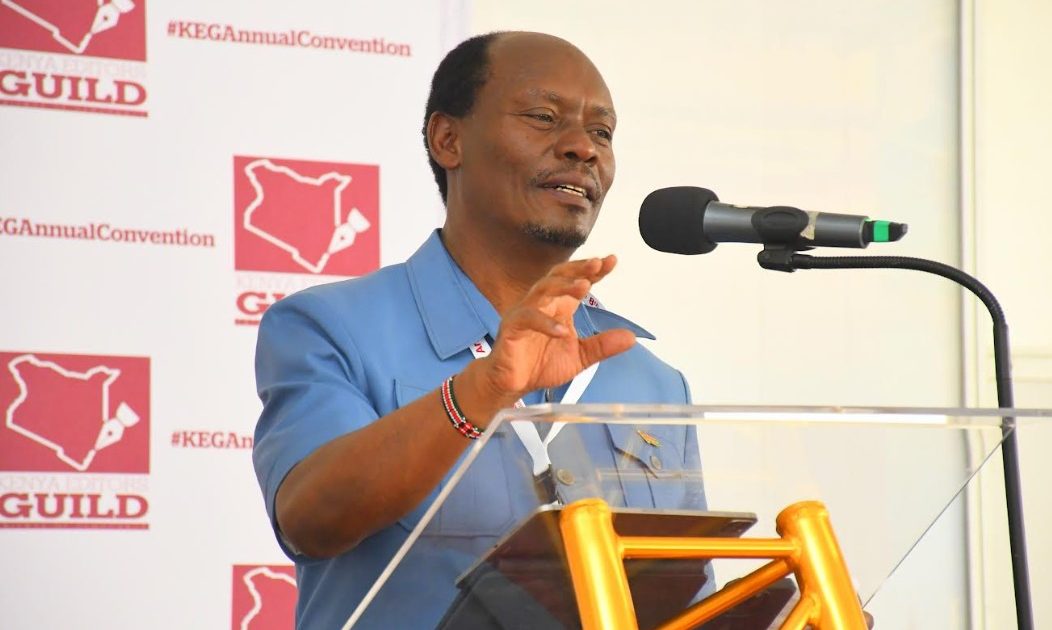
Speaking at the 8th Annual Editor’s Convention in Kilifi, CS Kabogo delivered a candid and personal address, reflecting on his long-standing relationship with the media and urging deeper trust between government and journalists.
“I enjoy working with the media. Journalists have always been my friends,” he said, recalling how reporters earlier in the day had expressed concern for his well-being. “My doors remain open. Bring your issues to me so they become part of the solutions we are planning.”

Kabogo emphasised the government’s focus on modernising the Kenya Broadcasting Corporation (KBC), describing it as a vital national institution.
He noted that the broadcaster is undergoing restructuring to reclaim its role as a leading public service media house.
The Kenya News Agency (KNA) and the Directorate of Information, he added, are also being strengthened to enhance transparency and public communication on government programmes.
“When I came into the office, one of my first questions was how many people work at KBC. It took six months to procure equipment due to bureaucratic resistance. But we have made progress. Strengthening KBC remains a priority,” he said.
He added that KBC’s modernisation efforts will support its competitiveness and reinforce its mandate as a public service broadcaster.
While acknowledging the challenges journalists face, including harassment and attacks, the CS encouraged reporters to continue documenting issues affecting the public.
He expressed concern over the safety risks journalists encounter, noting that some have been injured or killed.
He pledged to continue advocating for their protection and urged media practitioners to report incidents promptly so that the government can respond effectively.
Kabogo affirmed that information gathered by journalists is essential for transparency, governance, and public welfare.
He reiterated the government’s intention to work closely with the sector to enhance both safety and the economic well-being of media workers.
Addressing concerns raised by media owners, the CS announced progress in reducing delays in government advertising payments.
“There must be a proper relationship between the government and media houses. I cannot continue giving you advertisements while you are continuously criticising me unfairly, but we can build a fair working relationship,” he said.
He noted that a team has been established to clear pending bills owed to media houses through the Postal Corporation (POSTA) and the Government Advertising Agency (GAA) within 60 days.
On infrastructure, he highlighted the expansion of the digital superhighway, including tens of thousands of kilometres of fibre-optic cable and digital hubs in every village, positioning Kenya to benefit from technological shifts such as Artificial Intelligence.
Kabogo emphasised that the relationship between the media and the government should be rooted in partnership, adding that responsible journalism and responsible governance go hand in hand in strengthening democracy.
He also shared anecdotes from his early career, including working in Mombasa, starting small businesses, and interacting with journalists who jokingly critiqued his fashion choices.
“I like being among journalists. Some of you even told me my trousers were too short,” he said.
He added that such interactions highlight the shared humanity between public officials and reporters.
In his closing remarks, the CS urged the media to embrace innovation, maintain professionalism, and collaborate with the government on national development initiatives.
“This is a partnership. Let us build something better together for journalists, for the government, and for the people of Kenya,” he said.
State Department for Broadcasting and Telecommunications Principal Secretary Stephen Isaboke reaffirmed the government’s commitment to protecting media freedom and strengthening the country’s information ecosystem, even as the sector faces rapid digital transformation and declining revenues.
Speaking during the convention, he noted that the government is implementing key policy and legal reforms aimed at safeguarding journalists’ rights, enhancing access to information, and ensuring a conducive operating environment for media houses.
The PS said media freedom, freedom of expression, and access to information are constitutionally protected rights that the government will continue to uphold as it reviews sectoral laws, including the Kenya Information and Communications Act and the Media Council Act.
He encouraged media practitioners and the public to participate in the review process to ensure regulations reflect evolving industry needs.
Isaboke also expressed concern over the financial challenges facing traditional media as audiences shift to digital platforms, leading to shrinking advertising revenues and newsroom downsizing.
He affirmed the government’s readiness to collaborate with media stakeholders to find sustainable solutions that protect jobs and strengthen journalism.
The PS further emphasised the importance of responsible journalism, urging media houses to invest in fact-checking and digital literacy initiatives to counter the growing threat of misinformation and disinformation.
By Chari Suche