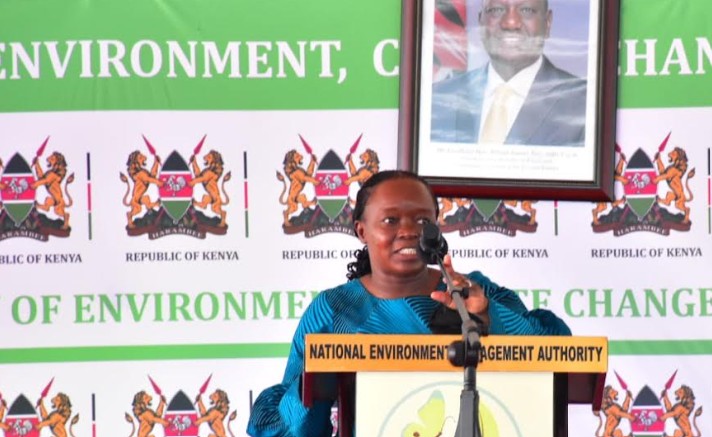
Environment, Forestry and Climate Change Cabinet Secretary (CS) Dr Deborah Barasa yesterday led the country in celebrating this year’s World Environmental Day with a clarion call to Kenyans to reduce plastic leakage into the environment.
She urged citizens to lead by example and to work together to protect the country and the planet at large.
Speaking at Tharaka University in Tharaka Nithi County, where the celebrations were held, Dr Barasa said that plastic pollution remains one of the most urgent global environmental threats with significant impacts on ecosystems, human health, and economic sustainability.
“As the world celebrates world environment Day 2025 under the theme ‘Ending plastic pollution’, Kenya reaffirms its commitment to environmental stewardship,” said the CS.
She noted that globally, more than 430 million tonnes of plastics are produced annually, where two thirds become waste, polluting oceans, degrading land, and threatening biodiversity.
Only nine per cent of plastics ever produced have been recycled.
However, she noted, Kenya has emerged as a leader in plastic pollution control, beginning with its 2017 ban on plastic carrier bags, which achieved more than 80 per cent compliance and significantly reduced litter.

“The national marine litter management action plan (2021-2030) furthers this progress by targeting plastic waste in coastal and freshwater ecosystems through source reduction, clean-ups, awareness and research, complementing policies like the sustainable waste management act.”
“Today, we join the global community to celebrate this day by renewing our shared commitment to face one of the most pressing environmental challenges of our time – plastic pollution,” said the CS.
She added: “Innovative solutions are transforming perceptions of waste, not as a problem, but as a resource. Across Kenya, we are witnessing promising strides in converting plastic waste into valuable products such as eco-friendly building materials, fencing poles, paving blocks, roofing tiles and even furniture.”
She said the innovations are not just reducing pollution but also creating green jobs, especially for youth and women, as well as driving local economic development.
She further said Kenya’s circular economy movement is growing, powered by grassroots innovation, community-based organisations and private sector champions.
Informal waste pickers, often overlooked, she added, are now being recognised and integrated into formal systems through public-private partnerships and county-level waste initiatives.
She called on county governments, businesses, civil societies, and communities to take the lead in waste segregation, sustainable packaging and local recycling solutions.
“I especially want to emphasise the role of local communities in ending plastic pollution from grassroots led by county governments. My Ministry is committed to transitioning the country from a linear to a circular economy.”
“From bold policy, regional leadership and international negotiations to grassroots action and innovation, we are moving as one nation, with one purpose, to protect our environment and our future,” she said.
She added that every Kenyan has a role to play, from business owners reducing plastic packaging to schools teaching sustainability and farmers finding alternatives to agro-plastics in farming.
“Your everyday actions matter: participate in clean-up drives, support recycling centres and say no to single-use plastics,” said Dr Barasa.
She said this year’s theme, “Ending Plastic Pollution”, is a shared call to action, and Governments, policymakers, Small and Medium Enterprises, the plastics industry, financial institutions and communities must all work together to drive change in production, consumption, and waste management.
“Ending plastic pollution is not just a government agenda. It is a call to every Kenyan. To industry: innovate sustainable alternatives. To our youth: lead through action. To all citizens: reduce, reuse and recycle,” she said.
Tharaka Nithi Governor Muthomi Njuki said, “Plastic pollution is not a distant problem – it’s here with us, in our water, our soil and the food we consume. If we are to protect our children’s future, we must act decisively today.”
He said the county is leading by example to respond to environmental issues through progressive policy frameworks such as the county climate change adaptation plan (2023-2028) and the Tharaka Nithi Climate Change Fund Act 2019.
The legal frameworks, he added, enable the county to fund and support localised climate initiatives, including solid waste management programmes, conservation efforts and clean-up campaigns targeting plastic waste.
“Let us remember that climate change and plastic pollution are not future threats – they are present dangers. But with unity, innovation and community engagement, we can turn the tide. Together, we can end plastic pollution. Together we can protect our planet,” said Governor Njuki.
The County Woman Representative Susan Mwindu noted that protection of the environment is no longer a choice but a necessity.
As climate change continues to threaten ecosystems, health, and livelihoods, she added, collective action at all levels is key to securing a sustainable future for generations to come.
National Environmental Management Authority (NEMA) Director General Mamo Boru Mamo said Kenya generates about 22,000 tonnes of solid waste daily, totalling eight million tonnes annually, with only seven per cent of this waste being recycled.
The majority of waste, he said, is either mismanaged or left to pollute the environment, harming ecosystems and waterways.
He said this highlights the urgent need for innovation and investment in waste management solutions that benefit the environment, economy and communities.
He said NEMA has implemented strategic programmes with the National Solid Waste Management Strategy, including licensing for plastic-related activities, inspections and enforcing environmental laws.
“A robust licensing framework has been established to ensure all waste management players adhere to safety standards. NEMA is also promoting innovative solutions such as converting plastic waste into building materials, which offer both environmental and economic benefits,” he said.
He said one of the frameworks includes enacting Extended Producer Responsibility (EPR), where they make sure producers take responsibility for managing the waste that arises from the products they introduce into the country.
“Despite all these frameworks, our country is still facing the menace of plastic pollution due to attitudes towards the environment where everybody wants to pollute the environment and the throwaway culture.”
“We are the waste generators and we must take responsibility for the waste. Let us be eco-friendly by reducing usage of plastic materials and stopping the throw-away culture and instead protect our mother earth, since it is the only planet we have and we must take care of it,” said Mamo.
By Dickson Mwiti