Kenya’s commitment to advancing gender equality and empowering women took centre stage at the 2nd Biannual National Gender Sector Working Group (GSWG) meeting held in Nairobi.
The event brought together key government officials, civil society, development partners, and stakeholders to review progress, confront challenges, and map a strategic way forward in tackling gender disparities, gender-based violence (GBV), and economic exclusion.
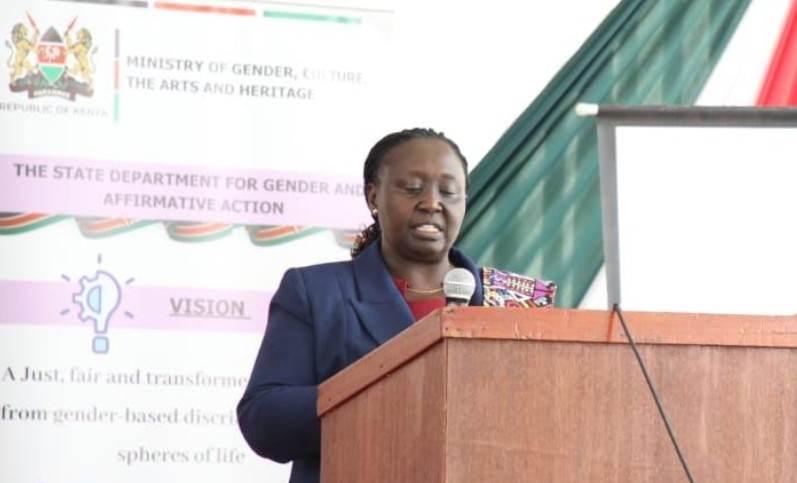
The Cabinet Secretary (CS) for Gender, Culture, Arts and Heritage, Hanna Cheptumo, set a bold tone reaffirming the government’s commitment to gender equality.
“I look forward to engaging constructively as we reflect on our shared progress, challenges, and opportunities and, most importantly, as we chart the way forward with unity and purpose,” implored Cheptumo.
She highlighted the Ministry’s alignment with President William Ruto’s 9-Point Agenda for Women and pledged to mainstream gender across all national development efforts.
According to the CS, among the meeting’s major announcements was the launch of the National Policy on Women’s Economic Empowerment, which has already gotten Cabinet approval.
“If implemented fully, this policy will be a game changer,” she emphasised. “It will shift women from the periphery to the centre of economic decision-making, unlocking their full potential as drivers of national development and action on climate change.”
She also announced significant progress on the National Care Policy, which recognises the value of unpaid care and domestic work—tasks predominantly undertaken by women—and seeks to establish nationwide support systems for caregivers.
On the critical issue of gender-based violence and femicide, Cheptumo praised the work of the Presidential Technical Working Group on GBV, which she chairs.
The taskforce has conducted public forums nationwide and is developing a comprehensive national strategy to enhance prevention, protection, and prosecution mechanisms.
Cheptumo also reaffirmed the government’s commitment to implementing the constitutional two-thirds gender principle and announced the development of a National Male Engagement and Inclusion Strategy aimed at transforming cultural norms involving men and boys in the gender equality journey, urging them to also be part of the driving power to bring in solutions to the menace.
In addition, the CS also launched the Gender Climate Action Plan, which will provide a systematic approach to matters of gender equality while at the same time tackling climate change.
Concurrently, the Chairperson of the Presidential Technical Working Group on Gender-Based Violence, Dr. Nancy Barasa, provided an update on the task force’s progress since its gazettement in January 2025.
“While a comprehensive examination of GBV and femicide in just 90 days is no small feat, I thank God for the progress we have made,” expressed Dr. Barasa.
She praised Kenya as one of the first countries in the region to openly acknowledge the gender-based violence crisis and take proactive measures.
The taskforce, a coalition of 42 representatives from government, civil society, and experts, has gathered extensive data from across the country, revealing sobering insights, that is, 60 per cent of femicides occur within domestic settings, mainly due to prolonged domestic violence.
“Femicide must be recognised as a unique form of homicide driven by gender discrimination within domestic spaces,” demanded the Chairperson, adding that many victims suffer in silence, often at the hands of partners or family members.”
Despite the emotional toll, Dr. Barasa assured the nation that the taskforce is committed to delivering actionable recommendations to the Head of State.
“There is hope because Kenyans are tired of this violence and want solutions,” she said, expressing gratitude to stakeholders for their trust and collaboration.
UN Women Country Representative Antonia N’gabala applauded Kenya’s leadership and recent strides while emphasising the need for stronger coordination and adequate funding to sustain momentum.
“It is a pleasure to be here for this important stock-taking moment in our gender equality journey. UN Women looks forward to working closely with the Ministry to advance the empowerment of women and girls across Kenya,” said N’gabala.
Marking major anniversaries, including 30 years since the Beijing Platform for Action, N’Gabala stressed urgency amid rising backlash against gender equality efforts.
Citing National Police data, she drew attention to the grim reality of femicide, revealing that 5,578 cases were recorded in 2024, with 129 already reported this year.
“These are not just statistics, but lives lost, families broken, and futures stolen,” lamented N’gabala.
However, she commended the government’s establishment of the Presidential Taskforce on GBV and the collaborative social analysis underway with the University of Nairobi to deepen understanding and inform prevention strategies.
Further, N’gabala hailed the National Policy on Women’s Economic Empowerment as a landmark achievement but cautioned, “Policy without adequate funding is hope without action. Countries investing in women see stronger stability and economic growth. We must strengthen gender-responsive budgeting with robust monitoring at all levels.”
She called for persistence and courage and maintained that Gender Equality in Kenya is not just possible but also essential for social stability and economic prosperity.
The meeting underscored Kenya’s renewed commitment to tackle gender inequality through bold policy reforms, strengthened coordination, and inclusive engagement, paving the way for a more equitable and prosperous future for all Kenyans.
By Fride Amiani and George Gerish