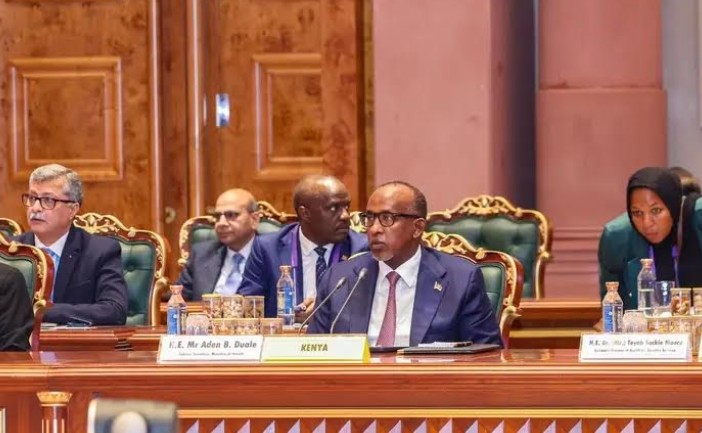
Health Cabinet Secretary (CS) Aden Duale joined fellow ministers from across the world in New Delhi, India, for the Traditional, Complementary and Integrative Medicine (TCIM) Ministerial Roundtable.
The meeting reaffirmed the enduring role of traditional medicine in cultural heritage, community wellbeing, and Kenya’s journey towards Universal Health Coverage (UHC).
Duale expressed Kenya’s strong appreciation for the leadership of the World Health Organization (WHO) and affirmed the country’s full alignment with the Summit’s theme, ‘Restoring Balance: The Science and Practice of Health and Well-Being’.
He noted that the theme closely reflects Kenya’s ongoing health sector reforms, which are firmly anchored on UHC and guided by the Global Traditional Medicine Strategy 2025–2034.
Further, the CS outlined Kenya’s TCIM approach, which prioritises patient safety, scientific evidence, innovation, environmental stewardship, and the respectful integration of indigenous knowledge.
As well, Duale emphasised that Kenya’s Constitution safeguards biodiversity, promotes equitable benefit-sharing, and recognises indigenous knowledge as a cornerstone of sustainable development.
“To operationalise this vision, Kenya has established a comprehensive policy and regulatory framework, including the TCIM Policy, the Traditional Health Practitioners Bill, the National Research Framework, and the Herbalists’ Handbook.
These instruments are designed to professionalise practice, strengthen safety and quality standards, and enhance evidence generation,” he highlighted.
Notably, the CS announced that the regulation of herbal and traditional medicine products is undertaken by the Pharmacy and Poisons Board (PPB) across the full product lifecycle, supported by digital regulatory systems and specialised expert committees.
He added that Kenya is also recognised as a Regional Centre of Regulatory Excellence in Pharmacovigilance, stressing that the adoption of digital technologies and artificial intelligence has further enhanced regulatory efficiency, transparency, and product evaluation.
“Beyond regulation, TCIM is contributing to local manufacturing, innovation, and health sovereignty. This is being advanced through targeted incentives, including reduced regulatory fees, expedited evaluation timelines, and deliberate measures to stimulate domestic production,” stated the CS.
Equally, he reported that Kenya is also strengthening research and innovation through strategic partnerships that leverage artificial intelligence, genomics, and digital platforms to improve standardisation, strengthen evidence, and support the global integration of validated TCIM practices.
Meanwhile, Duale reiterated that the Government remains committed to the structured integration of traditional medicine into primary healthcare through practitioner accreditation, clearly defined referral pathways, expanded research, and potential inclusion within social health insurance benefit packages.
Ultimately, he reaffirmed Kenya’s readiness to work closely with WHO, Africa CDC, fellow Member States, and global partners to unlock the full potential of traditional medicine—ensuring it is safe, well-regulated, evidence-based, and culturally grounded—to strengthen health systems and improve health outcomes across Africa.
By Michael Omondi