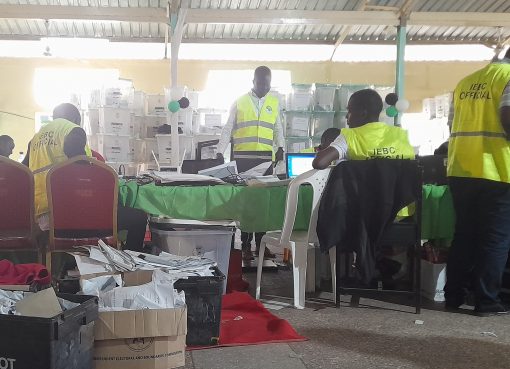
The 2025 Kenya Certificate of Secondary Education (KCSE) examinations commenced smoothly on Monday morning across the country, with 996,078 candidates sitting for the national tests.
Education Cabinet Secretary (CS), Dr. Julius Ogamba, urged candidates to uphold integrity and avoid any form of malpractice during the exams. He warned that exam irregularities, if unchecked, could erode public trust in Kenya’s national qualification system.
Dr. Ogamba assured the nation that the government had put in place tight security measures to safeguard the credibility of the exams.
“We warn of dire consequences including dismissal from service and prosecution in a court of law for any invigilator, supervisor, teacher, or KNEC official caught abetting examination malpractices,” he said.
He emphasized that the ministry’s goal was to ensure fairness and preserve the reputation of Kenya’s national certificates, adding that examinations are a cornerstone of the country’s education system as they uphold fairness, validity, and reliability of results.
The CS noted that invigilators and supervisors play a critical role in safeguarding the integrity of the process by enforcing examination rules.
To ensure all candidates sit their papers without disruption, the Education Ministry has deployed police and military helicopters to airlift exam materials to schools in areas affected by flash floods and mudslides, especially in Elgeyo Marakwet County.
Dr. Ogamba said one KCSE candidate injured in the recent mudslides was sitting for the exam at the Moi Teaching and Referral Hospital, where 28 victims remain hospitalized. “Exams will also be delivered by helicopters in other rain-affected regions such as Trans Nzoia County,” he said, assuring that robust contingency measures were in place to ensure the exams proceed smoothly despite the ongoing heavy rains.
The CS, accompanied by Coast Regional Director of Education (RDE), Ann Kiilu, and Teachers Service Commission (TSC) Regional Director Fredrick Ng’ang’a, officially opened the Kenya National Examinations Council (KNEC) examination container at the Matuga Sub-County Deputy County Commissioner’s Office in Kwale.
He revealed that more than 600 KNEC containers fitted with smart padlocks had been distributed across sub-counties nationwide for the secure storage and dispatch of examination materials.
“The introduction of smart padlocks by KNEC ushers in a new era of digital vigilance and sends a strong message that cheating will not be tolerated. Those caught will face severe sanctions, including dismissal and prosecution,” said Dr. Ogamba.
New KNEC rules for this year’s examinations include a total ban on mobile phones for all exam personnel, mandatory identification for authorized staff, and anonymization of papers to minimize bias. Supervisors will now serve for only one week in a single examination centre to enhance transparency.
Dr. Ogamba stressed that supervisors must ensure they open the correct exam packets for the designated session, while every examination centre must maintain a list of authorized personnel for verification.
During his visit, Dr. Ogamba also toured Kwale High School as part of a nationwide multi-stakeholder monitoring exercise aimed at ensuring the smooth administration of national examinations and assessments.
He reiterated that examination malpractice not only compromises fairness but also tarnishes Kenya’s international image. He cautioned that any individual — whether a candidate, teacher, or official — found engaging in malpractice would face the full force of the law.
“Any individual found engaging in examination malpractice will face the attendant legal consequences,” the CS warned, noting that penalties would be applied to all culpable parties upon verification by KNEC.
This year’s national examinations include the KCSE, the Kenya Primary School Education Assessment (KPSEA), and the Kenya Junior School Education Assessment (KJSEA), alongside school-based assessments for grades 3, 4, and 7.
According to Dr. Ogamba, a total of 3,424,864 learners were registered for the 2025 national examinations, 996,078 for KCSE, 1,298,089 for KPSEA, and 1,130,699 for KJSEA.
He reported that no major incidents had been recorded since the exams began, attributing the success to strong coordination among education stakeholders and security agencies.
The CS noted that the 2025 examination season marks a historic milestone, it features the inaugural KJSEA under the Competency-Based Curriculum (CBC) and one of the final cohorts to sit the KCSE under the 8-4-4 system, which is being gradually phased out.
Meanwhile, Dr. Ogamba appealed to university lecturers currently on strike to suspend industrial action and embrace dialogue through a court-sanctioned conciliatory process.
The lecturers’ strike, now in its 50th day, revolves around three key demands: the release of Sh2.73 billion for phase two of the 2021–2025 Collective Bargaining Agreement (CBA), payment of Sh7.9 billion in arrears from the 2017–2021 CBA, and negotiations for a new 2025–2029 CBA.
Dr. Ogamba reaffirmed the government’s commitment to addressing the lecturers’ concerns through dialogue, urging them to resume teaching in the interest of students.
“The government remains committed to resolving all outstanding issues, including working conditions and staff welfare, to motivate our lecturers and safeguard the academic calendar,” he said.
By Hussein Abdullahi