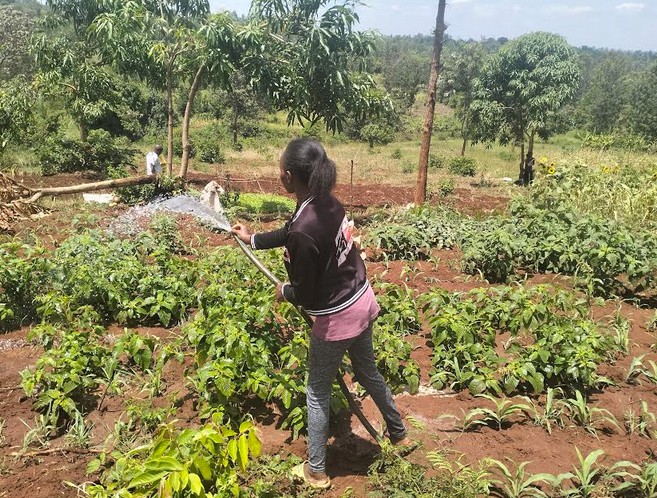
Farmers in Murang’a County are experiencing losses due to the recent depressed rains during the planting season.
The October-December rains have failed to sustain germinating crops, causing a loss of early planters and posing a threat to the region’s food security.
The Kenya Meteorological Department predicted drought in Central Kenya, urging farmers to grow drought-tolerant crops, but many had already planted by the time the rains subsided just two weeks later.
Thus, farmers are now hoping that the rains will resume in the coming weeks to allow them to replant. However, some worry that delayed rains may not support crops to maturity before the end of the season.
However, reduced harvests may not only threaten food security but also increase food prices, further straining household budgets.
Julius Maina, a small-scale farmer from Maragua, says he had planted maize and beans two weeks ago, when the first rains fell.
“The crops germinated and sprouted well, but after a few days the rains disappeared and the young plants dried up, the soil has died up completely and the young crops have withered,” he said.
“We however are hopeful that the rains will return even though it’s a huge loss because I will have to purchase more seeds to re-plant” Now I have to buy new seeds if the rains return,” Maina lamented.
Another farmer, Sarah Njeri from Kiharu, invested in tomatoes and capsicum, hoping to take advantage of the early showers. She says the dry spell has frustrated her efforts.
“Tomatoes require consistent watering, and I solely rely on rainfall. I had spent over Sh30,000 on seedlings, fertilizer, and labour, but nearly everything is drying up,” said Njeri, adding that irrigation is too costly for smallholders.
In Kimorori, David Mwangi, a horticultural farmer, says he planted 500 Rudolph Hass avocado and passion fruit seedlings during Mazingira day as part of a reforestation and agribusiness initiative.
“I invested heavily in seedlings and manure, but almost all are drying up despite my attempts to water them. The sun has been too harsh,” Mwangi said.
Unfortunately, the situation has left many farmers uncertain about replanting, as they weigh the risk of further losses if the rains remain erratic.
Murang’a County Director of Meteorology, Peter Karanja, had confirmed that the region is experiencing below-average rainfall, noting that such conditions could worsen food insecurity if the pattern persists.
Farmers are advised to consult agricultural extension officers for suitable crop varieties, water conservation techniques, and consider short-season crops like sorghum, millet, and green grams.
Meanwhile, agricultural experts warn that the depressed rains could lead to a decline in crop yields, particularly maize, beans, and vegetables, which are the county’s staple foods.
“Many families depend on small farms for daily food supply. When crops fail, people not only lose income but also face nutritional challenges,” said Michael Mwaniki, a local agricultural officer.
Normally, the short rains between October and December are crucial for most farmers in Murang’a and other central counties, sustaining maize, beans, and horticultural crops, before the long rains begin in March.
by Florence Kinyua