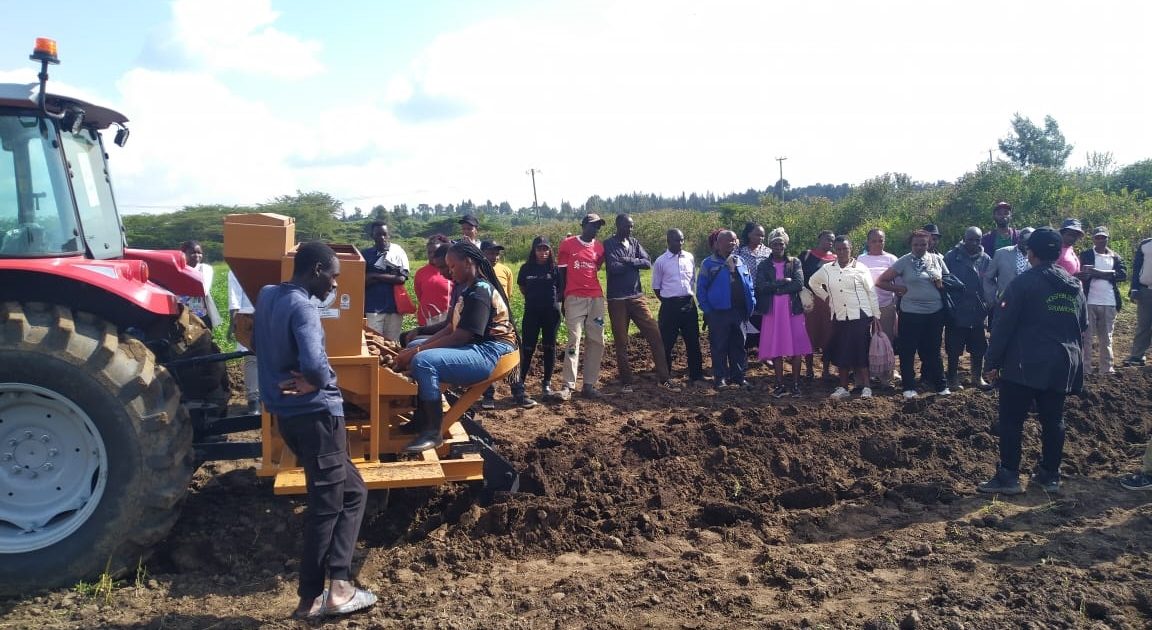
Egerton University has embarked on building the capacity of smallholder farmers in climate-smart farming techniques to ensure food and nutritional security and increased household incomes among farmers in Rift Valley Region.
The initiative is geared towards promoting sustainable agricultural development and enhancing the resilience of rural communities to climate change impacts in agriculture.
An Agronomist from Egerton university’s Crops, Horticulture and Soils Department Prof. Antony Kibe said the initiative would incorporate farmer field days, research, training, and extension services aimed at helping farmers adapt to climate change impacts and also build more resilient agricultural systems.
Prof. Kibe explained that Climate Smart Agriculture (CSA) involves actions that sustainably increase productivity, enhance adaptation, reduce greenhouse emissions to a possible zero and enhance achievement of national food security and development goals.
The don, who is also leading the Kenya Sustainable Potato Initiative (KSPI) project aimed at implementing climate-smart potato farming practices and technologies, stated that the university was encouraging farmers to embrace irrigation and growing of resilient crops such as cassava, sweet potato, finger millet, green grams and sorghum, as part of climate-smart agriculture.
Prof. Kibe made the remarks at the institution’s Agro-Science Park during a farmers’ field day that focused on empowering farmers from the South and Central Rift regions on climate-smart agriculture (CSA) practices.
The event brought together over 500 smallholder farmers, extension officers, and agricultural stakeholders, who were trained on CSA by ecologists, agro-metrologists, agronomists, pedologists (soil scientists) and plant pathologists among other experts drawn from learning and research institutions on practical solutions for farming in a changing climate set up.
Prof. Kibe said the trainings were aimed at promoting Climate Smart Agriculture practices that not only increased productivity but also build resilience and protected the environment adding that the practices were key to food security systems in the face of unpredictable weather patterns, degraded soils, and water scarcity.
The field day offered hands-on experience on growing climate-resilient crops including potato, beans, sweet potato, sunflower, sorghum, and cassava.
While indicating that sustainable farming practices include techniques like agroforestry (integrating trees into farming systems), conservation tillage (reducing soil disturbance), and integrated soil fertility management, Prof. Kibe reiterated that by adopting drought-tolerant crops and water management techniques, farmers could better withstand the impacts of droughts and floods.
He explained that sustainable agriculture was about increasing profitable farm income, protecting the environment, and enhancing quality of life for farming communities and increasing production for human food and fibre needs.
To promote climate smart agriculture uptake, Prof Kibe stated that Egerton University was promoting the development and use of drought and heat tolerant crop varieties, finding use for waste products from harvested crops, training farmers on the costs and benefits of crop insurance and reduction of post-harvest losses through support of agricultural machinery.
The initiative is also supporting adoption of biological pesticides for cereal farmers, conservation of agriculture practices such as zero tillage, and mulching, adoption of a warehouse receipting system and making use of waste material for biogas, the don added.
He explained that for pastoralism, CSA entailed shifts in herd composition from cattle to goats and/or camels, government support for improved mobility to access pasture and water during dry seasons and insuring animals through index-based livestock insurance (Kenya Livestock Insurance programme).
In dairy farming, ensuring animal housing shields cows from excessive heat, providing feed supplementation to increase productivity, providing of adequate water, improving collection systems to reduce spoilage and biogas systems to provide household energy and reduce emissions from manure, elaborated Prof. Kibe.
He further explained that aquaculture entailed development of integrated systems that utilize waste from chickens raised for eggs or meat in fish farming to reduce costs of fertilizer and feed and maximize profits and adopting finger-pond technology through digging ponds in wetlands that are naturally filled with water and stocked with natural fish when lake levels rise.
During the field day, the farmers were taken through a practical chisel ploughing session, which Prof. Kibe said as opposed to disc ploughing, was a cornerstone of conservation agriculture, that helps retain soil moisture, reduce erosion, and enhance carbon sequestration and all critical components of sustainable land management.
“The farmers were also introduced to a solar-powered irrigation system, an energy-efficient innovation offering a lifeline to farmers in arid regions struggling with water scarcity and unreliable power supply,” the don elaborated.
He added that the Egerton University in partnership with Farm to Market Alliance was supporting farmers not only to access better technologies but also receive the training and market connections needed to improve their livelihoods.
“We will go on expanding access to climate smart agriculture innovations through continued field demonstrations and farmer trainings,” Prof. Kibe added.
Experts also showcased rapid seed multiplication techniques, giving farmers tools to generate early seed for planting, thus shortening the time it takes to access quality planting material.
According to the Ministry of Agriculture, economic losses from climatic events could be up to three per cent of the country’s GDP in 2030 and up to five per cent in 2050 if the impact on climate change on Kenya’s food system is not addressed effectively.
Two years ago, players in the agricultural sector curated the launch of the 2022-2026 Climate Smart Agriculture Multi Stakeholder platform strategic plan (CSA-MSP).
Being spearheaded by the Ministry of Agriculture, the five-year strategic plan aims to equip farmers with adaptation practices on climate action, geared to increase food production hence, reducing the food prices.
According to experts, Africa has 60 percent of arable land, which could feed the entire world. Despite this, the continent suffers a food deficit.
It is projected that by 2030, the world’s population will surpass the 9 billion mark. While farm land size is continually shrinking due to population pressure, Prof. Kibe advised that countries must continually innovate to increase food production to feed the growing population.
By Esther Mwangi