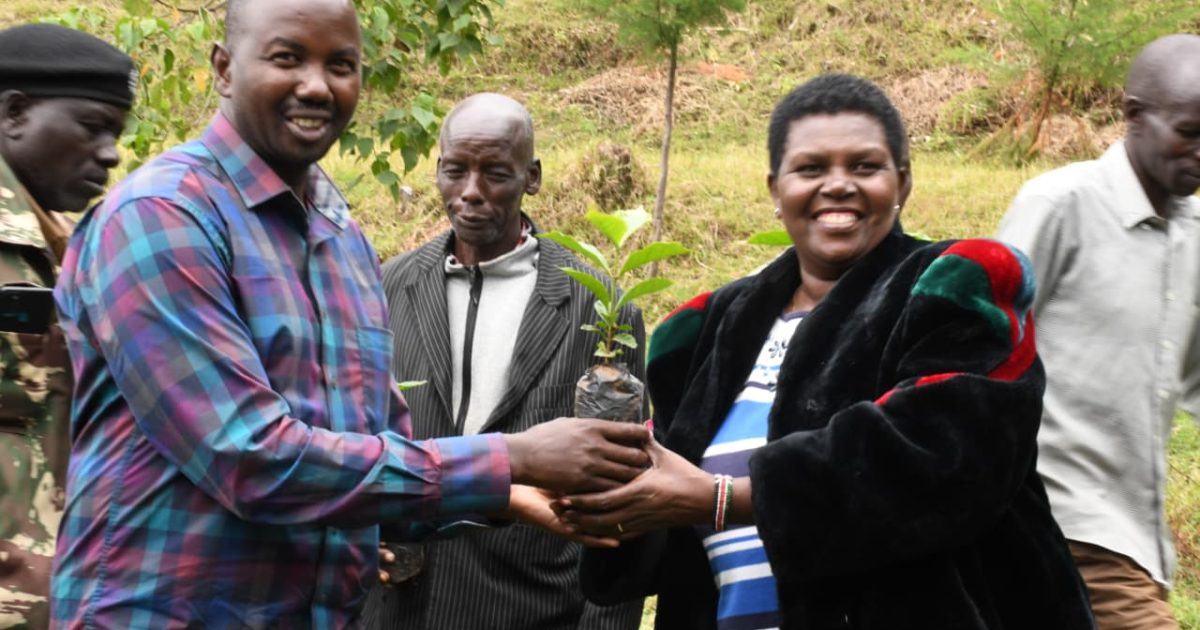
The Elgeyo Marakwet County Government has initiated a targeted coffee production enhancement programme through the distribution of 30,000 Ruiru 11 coffee seedlings to members of the Sambirir Farmers Cooperative Society.
Speaking at the Embo-Kachebii coffee nursery during the launch, County Executive Committee Member (CEC) for Agriculture Edwin Kibor said the initiative aligns with the county’s wealth creation and agricultural diversification strategy.
“We are launching the sale of coffee seedlings at subsidised prices to ensure affordability while maintaining quality,” Kibor stated. “Sambirir Ward possesses agro-ecological conditions that are optimal for coffee cultivation, and we have deliberately established a local nursery to produce clean, disease-free planting material at reduced cost to farmers.”
The CEC explained that in previous years, externally sourced seedlings often underperformed due to environmental incompatibility and untimely planting. “By producing seedlings locally, we not only guarantee varietal purity and site-specific adaptation but also ensure that farmers are ready for immediate transplanting,” he said.
The Ruiru 11 variety, developed for disease resistance and high yield potential, was selected for its suitability to the mid-altitude zones of Sambirir. The nursery, established with seed sourced directly from the Kenya Coffee Research Institute, can cover 30 acres in the current distribution phase.
Kibor noted that the distribution is being conducted in collaboration with the Sambirir Farmers Cooperative to ensure only prepared and committed farmers participate. “Selling at a nominal Sh 20 per seedling acts as a commitment filter. Farmers must have land prepared before purchase, verified by cooperative officials and agricultural extension officers,” he emphasised.
The county government also plans to facilitate benchmarking tours for farmers to observe best practices in coffee husbandry, post-harvest handling, and value addition in established coffee-growing regions.
Sambirir Ward MCA Paul Suter said the subsidised sale model replaced the previous free distribution system after it was observed that many seedlings were neglected and left to perish.
This year, 40 kilogrammes of seed were propagated into seedlings, and our goal is to reach 100 kilogrammes annually. Within five years, we will achieve full coffee coverage in Sambirir Ward,” Suter said.
He further encouraged youth to consider coffee agribusiness as a viable livelihood option, noting that formal employment opportunities are diminishing. “Coffee is a perennial cash crop with strong market demand. With proper agronomic management, it offers better returns than most other enterprises,” he remarked.
Nahashon Biwott, Farm Manager of the Sambirir Farmers’ Cooperative Society, said the coffee development programme began last year to strengthen members’ economic resilience.
“Coffee has a favourable profit-to-cost ratio. Seedlings are being allocated strictly to registered members to promote accountability and collective benefit,” Biwott said.
He added that unsold seedlings will be established on the cooperative’s demonstration farm for farmer training on optimal agronomic practices. “Our objective is to ensure every distributed seedling is planted, managed correctly, and brought to bearing for maximum economic impact,” he concluded.
The initiative is expected to significantly expand coffee acreage in Sambirir Ward, improve farmer incomes, and strengthen the region’s position in the national coffee value chain.
By Rennish Okong’o