Women in Kenya constitute an estimated 80 percent of the agricultural labour force and play a vital role in food production, food security, and the economy.
They are central to ensuring food security at both the household and national levels, often responsible for the majority of food grown for domestic consumption and, at the community level, managing seed banks.
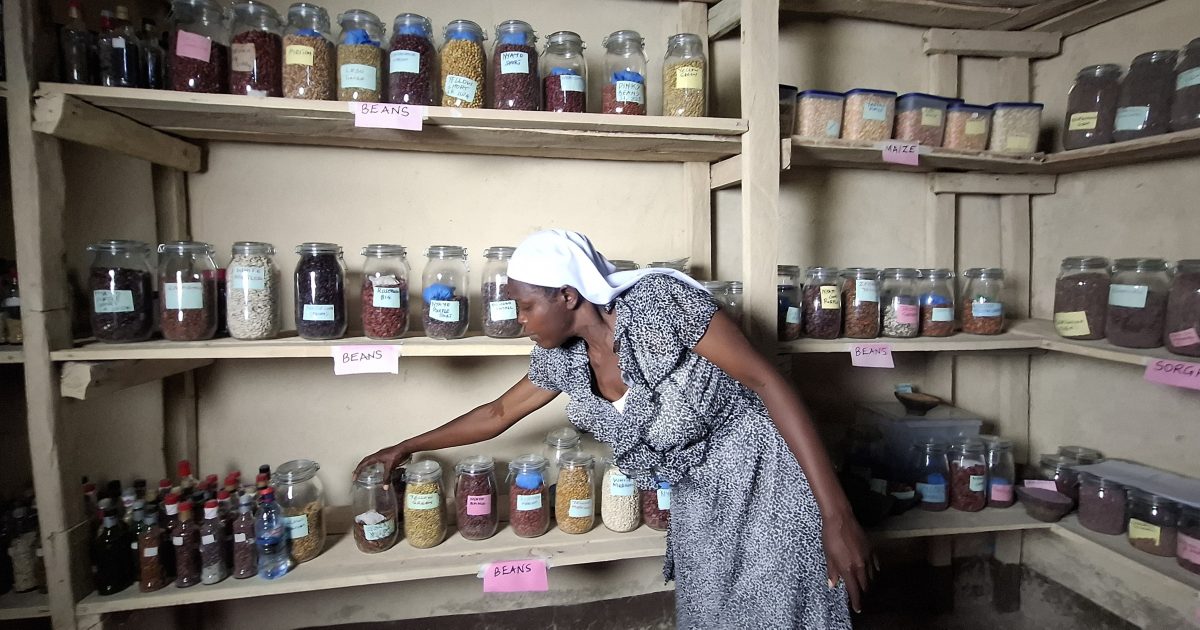
Kabudi-Agoro Seed Bank group managed by Women in Nyakach area, Kisumu County, is one of the local initiatives that helps smallholder farmers preserve and access indigenous, climate-adapted seeds.
Evelyn Adhiambo Okoth, chairlady of the 25-member group, says their main aim of starting a seed bank was to conserve traditional crops, diversify plant species, and restore the indigenous food crops.
“We realized that traditional seed varieties were being lost as time passed, and hence the only way for smallholder farmers to access seeds that are affordable was through seed banking,” she said.
Okoth explained that the Kabudi-Agoro Community Seed Bank was started in 2020 and launched in 2021 with the support of the Alliance of Bioversity International-CIAT with the intention of conserving indigenous seeds.
“Apart from seed conservation, we also do value addition for our various crops and have over eight different varieties of maize, 18 sorghum varieties, seven finger millet varieties, 69 bean varieties, nuts, and also over 15 different varieties of different traditional leafy vegetables,” Okoth said.
The Kabudi-Agoro group is also engaged in the production of biopesticides and biofertilizers meant for organic farming, and farmers are usually engaged in training.
Okoth, however, noted that, one thing unique for them apart from the seed banks, which serve as a broad network of farmers to improve livelihoods, is that they are able to loan indigenous seeds.
“Seed loaning ensures communities have enough seeds and easy access. When a farmer cannot buy seeds, or when the market is far, we provide seeds as a loan. We give 1 kg, and the farmer returns 2 kg after harvest. This practice helps us multiply seeds, especially because we conserve many different varieties that we cannot multiply alone,” the chairlady explained.
A landmark ruling last month, December 2025, by the High Court of Kenya declaring unconstitutional provisions of the Seed and Plant Varieties Act that criminalized the saving, use, exchange, and sale of indigenous and farm-saved seeds, could not have come at a better time for community seed banks.
Okoth told KNA that now with the ruling that recognizes that seed sharing is not a crime but a fundamental element of peasants’ identity, resilience, and contribution to national food systems, groups such as Kabudi-Agoro will now be at liberty to sell their seeds.
“We feared the risk of a prison term of up to two years or a fine of up to Sh1 million under the Act. Our collection of saved and conserved wide range of indigenous seeds with multiple varieties in the seed bank will not go to waste, and we will invest more in indigenous seed enterprises, partner with companies, and produce seeds on a large scale for commercial purposes,” she said.
Okoth confirmed that they have now, as a group, began the Kenya Bureau of Standards (KEBS) certification process that will involve KEPHIS to ensure that their seeds meet the requirements needed.
Dr Carlo Fadda, the research lead on Biodiversity for Food and Agriculture at the Alliance of Biodiversity International and CIAT, says that the International Union for the Protection of New Varieties of Plants (UPOV) 1991 Act law on seeds, restricted farmers from saving, selling, or exchanging protected seeds
“The decision of the court is a major step forward because it, in principle, allows the farmers to now be legally using their own seeds. It is however still not enough; there is still a need for an additional step, which is a new seed law that allow the farmers to actually sell those seeds,” he added.
Dr. Fadda said the Ministry of Agriculture is working on amending the seed policy with a new seed policy that will recognize the rights of farmers and community seed banks to operate as a business and that for existing community seed banks like Kabudi-Agoro, which has quite a broad network of farmers that are using the seeds and that are helping the community to produce high-quality seeds, it is going to be a major opportunity for improving their livelihoods.
Beatrice Okelo, Senior Climate Change Officer in the Department of Water, Environment, Climate Change, and Natural Resources, Kisumu County, said women are the ones who are the backbone of the community and the society and that the County government is prioritizing projects focusing on women’s groups and promoting crops that endure extreme weather conditions.
A new Seeds and Plant Varieties (Amendment) Bill, 2025, is currently before the Senate, aiming to introduce a standards-based seed registration system administered by the Kenya Bureau of Standards (KEBS) as an alternative to the existing certification process overseen by the Kenya Plant Health Inspectorate Service (KEPHIS).
By Wangari Ndirangu