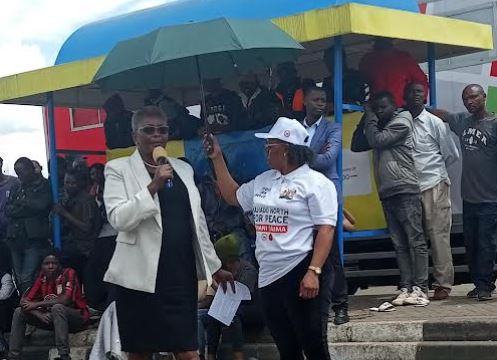
The National Authority for the Campaign Against Drug Abuse (NACADA) has called on liquor licensing bodies at both the national and county levels to enforce regulations set when issuing liquor licenses.
The vice-chairperson of the NACADA Board of Directors, Ann Mathu, on Monday specifically challenged the liquor licensing boards not to issue permits to liquor businesses that were near schools, churches and residences.
She noted that most licensing bodies were not adhering to the set regulations and were sometimes issuing licenses for many bars close to each other in an area, while there were also many unregulated outlets, noting that all these needed to be checked.
“You will find around 5 bars in a row, then in between, there is a wines and spirit outlet. This is one of the things that has seen many young people engage in consumption of alcohol as well as drugs,” she said.
Mathu, who was speaking in Ngong Town, Kajiado North Sub-County, during the commemoration of International Day of Peace, said there could be no peace when the young people are engaged in drugs and alcohol.
“There can be no genuine peace in communities plagued with alcohol and drug abuse. Substance use is a key driver to instability, eroding the fabric of our families and fueling poverty while at the same time destroying the potential of our youth, who are the future of this great country,” she said.
She mentioned that Kajiado County initially used to be a transit county but has now become a consumer with a lot of abuse of drugs, thus it was important that the county governments and security become involved.
“As NACADA, we are going to work with the DCC’s office and also the security departments to address the challenge of drug and substance abuse in the area,” she said.
Mathu further said that NACADA’s ambition is for a drug-free society and that they were ready and committed to lead through advocacy, education and support for those affected, though they could not do it alone.
“I call upon every community leader, every parent and every young person to take tangible action. Reject illicit brews, report drug peddlers, mentor a child and foster dialogue within your homes. These are the powerful grassroots actions that build resilience and peace,” Mathu said.
Mathu who is also a recovery coach, called upon county licensing committees to support the idea of direct revenue from the liquor licensing to fund alcohol and drug rehabilitation programmes.
She said that communities, through their representatives, could refuse to have bars put up in their areas as well as advocate for at least 15 percent of revenue collected through licensing to go to rehabilitation of those that needed help
“You can report unregulated outlets and drug dens through NACADA’s toll-free number 1192, and you can also get involved with your local resident’s association to lobby the county government for strict enforcement of liquor laws and reduced liquor outlets,” she explained.
Mathu’s sentiments came even as the Kajiado Sub County liquor licensing offices are in the process of receiving applications for bar licenses, an exercise that started on the 16th of this month and will end on October 3rd.
The process requires applicants to apply with the local committee and pay a prescribed fee for the bar to operate, with licenses specifying the sale hours and conditions that must be met.
Kajiado North OCPD Tom Achia asked the youth to be disciplined and stop engaging in drug and substance abuse.
“We will stop at nothing to ensure this area is safe, and we will not allow our young people to engage in theft, mugging and drugs,” he warned, calling on the youth to be good ambassadors of peace.
Member of the County Assembly of Ngong town Mbiriri Mwaura said due to the challenge of unemployment that somehow escalates drugs and substance abuse among the youth, they have been working with the Danish Embassy, a development partner, on a waste management programme that would see over 100 young people trained.
He added that he would also be approaching the government offices to assist in putting up a material recovery center to process mixed recyclable waste that in turn would be sold to manufacturers to be reprocessed into new products, saying this will create jobs for the young ones.
He acknowledged that politicians have been using the young people by giving them handouts to ignite chaos. “I want to urge young people not to be used by politicians through handouts to create chaos and in turn I want to challenge them to apply for identity cards as they await to register as voter with IEBC,” Mbiriri said
When it comes to legislation, Kajiado County is among those that through the Kajiado County Drinks and Alcohol Management Act, 2023, mandate that funds collected from liquor licensing be used for rehabilitation programmes.
Beyond just rehabilitation centres, the funds suggested could also support prevention, treatment, research and efforts to reintegrate recovered individuals back into the community through job opportunities and counseling.
The main law governing alcohol in Kenya is the Alcoholic Drinks Control Act, 2010, which addresses issues like illicit trade, underage drinking and misleading promotions and provides for licensing, education and rehabilitation programs.
By Wangari Ndirangu