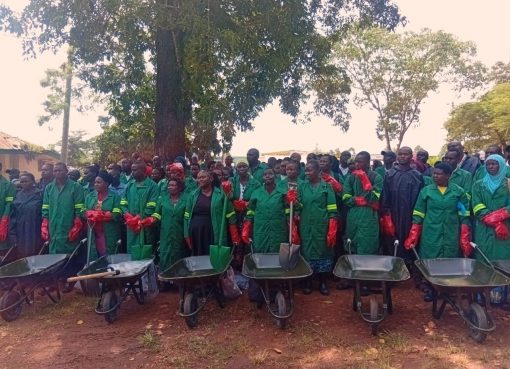
Equity Bank on Friday teamed up with residents of Dunga Beach, conservation groups, and government agencies in a large-scale clean-up drive aimed at restoring the Lake Victoria shoreline following recent reports of massive fish deaths linked to pollution and oxygen deficiency.
The exercise, held as part of this year’s Mazingira Day celebrations, brought together members of the Dunga Beach Management Unit (BMU) and the Kenya Marine and Fisheries Research Institute (KMFRI) alongside youth and women championing environmental conservation activities in the area.

The clean-up comes barely two weeks after cage fish farmers at Dunga Beach incurred losses estimated at over Sh10 million, after thousands of fish died in what experts attributed to increased pollution and low levels of dissolved oxygen in the lake.
Speaking during the event, Equity Bank Kisumu Mega Plaza Branch Manager Javan Odera said the initiative underscores the bank’s commitment to community welfare, environmental protection, and sustainable livelihoods.
“Today is one of the important days in our country, and as a bank, we saw it fit to join the community in restoring the cleanliness of Dunga Beach. The lake is visibly polluted, and we must all work together to make it habitable for both fish and people,” he said.
He added that Equity Bank has been actively participating in environmental conservation initiatives across the country as part of its Corporate Social Responsibility.
“Clean-up activities and protection of our natural environment are part and parcel of what we do as a bank. We are grateful to the Dunga Beach Management Unit for welcoming us to be part of this exercise that not only protects the lake but also sustains the community that depends on it,” he said.
Odera said the partnership seeks to create a long-term collaboration between financial institutions and local communities to address environmental challenges affecting livelihoods, especially in lakefront communities that rely on fishing.
Dunga Beach, a popular fish landing site and ecotourism hub on the shores of Lake Victoria, has in recent years struggled with rampant pollution, illegal waste disposal, and fish kills that threaten both aquatic life and local livelihoods.
Silas Awiti, Secretary General of the Dunga Beach Management Unit (BMU) and head of the Dunga Ecotourism and Environment Community-Based Organisation (CBO), said pollution from surrounding rivers continued to choke the lake’s ecosystem.
“In the past week, we have faced serious challenges such as fish kills caused by pollution flowing into the lake through nearby rivers. Today’s clean-up covers both the beach and the river mouth, and we hope to make it a continuous effort, not just a one-day event,” he said.
He lauded Equity Bank and other partners for supporting local conservation efforts and emphasised that environmental health directly affects the quality and safety of fish consumed in the region.
“It is vital that the fish we eat are fresh and healthy. As a beach management unit, we are doing everything possible to ensure that our waters remain safe, our fish are clean, and our customers continue to trust our products,” he said.
Environmental experts from the Kenya Marine and Fisheries Research Institute (KMFRI) also participated in the cleanup, underscoring the importance of combining community action with scientific research.
Patrick Otuo Wanguche, a Socio-economic Research Scientist at KMFRI’s Kisumu Station, said his team was supporting the exercise through a Volunteer Clean-up Programme, which mobilises students and volunteers to carry out clean-ups, waste segregation, and brand audits around major beaches.
“We are mandated to conduct research on all water bodies, but we also have a role in community sensitisation. Our programme brings together students and community members to ensure that waste, especially degradable waste, doesn’t reach the lake,” he said.
He added that preliminary field observations pointed to a combination of factors behind the recent fish deaths, including low oxygen levels and upwelling—an oceanographic phenomenon that brings low-oxygen water to the surface.
“It’s not the first time we are witnessing such an incident. Last year, around the same period, similar fish kills were recorded in Bukoba. It’s a mixture of several causes, and that’s why we need to combine science with civic responsibility to find lasting solutions,” he noted.
He said KMFRI’s scientific approach to clean-ups helped in identifying pollution sources through waste tracking and brand audits, ensuring accountability among industries and stakeholders responsible for pollution.
The event also drew the participation of young people and community leaders, who emphasised the need to integrate youth into environmental protection programmes.
Jimmy Magero, a youth representative, said the clean-up served as a reminder that protecting the environment is a shared duty.
“The environment is critical for our survival and for a healthy nation. We must make environmental conservation part of our culture and involve young people in such initiatives to keep them engaged and productive,” he said.
He observed that involving youth in conservation activities could also help reduce insecurity and crime linked to unemployment and idleness.
“When young people are meaningfully engaged in activities like the clean-ups, they become ambassadors of peace and development rather than perpetrators of crime,” he noted.
As the clean-up wound down, piles of plastic bottles, nets, and debris lay on the shore—a stark reminder of the scale of pollution threatening Lake Victoria. But amid the challenge, there was also optimism that collaboration between the government, private sector, local communities, and scientists could turn the tide.
By Chris Mahandara