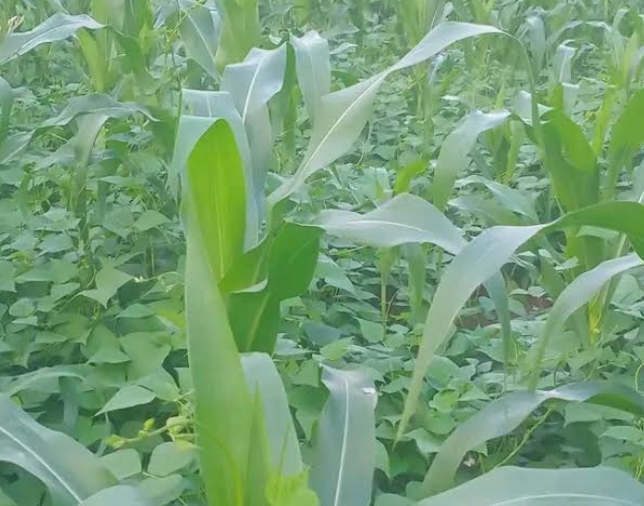
Farmers across Tindiret Sub-County are counting heavy losses after weeks of unpredictable weather resulted in widespread failure of short-season crops.
What should have been a reliable growing period has instead become one of the most disappointing seasons in recent years, with many households now worried about food supply and rising market prices.
A tour across several farms in the villages revealed fields dotted with stunted maize, dried bean stalks, and patchy pea crops—clear signs of crops that failed to withstand the unstable weather. For a region that depends heavily on short-season planting, the impact has been severe.
The Sub-County Agricultural Officer (SCAO) Ruth Chepkorir said the crisis is attributable to sudden and irregular changes in rainfall patterns. She explained that the rains came on time, enabling timely planting and germination. But midway the season, when the crops were in great need of water, a dry spell set in, causing a lot of stress to the crops and hence the crop failure.
Chepkorir urged farmers to begin adopting drought-tolerant seed varieties, improve soil conservation methods, and invest in small-scale water harvesting systems as the region increasingly experiences the effects of climate variability.
Local farmers echoed the officer’s concerns.
In Kapkerer, bean farmer Mercy Chepkirui said her field failed twice—first from lack of rain and later from a storm that uprooted newly sprouted plants. She said the officer had earlier warned of unpredictable weather, but she had hoped the season would stabilize.
In Chemalal village, veteran farmer Elijah Kiprop is facing one of his poorest maize harvests. His crop shows signs of moisture stress and nutrient loss caused by alternating hot, dry periods and sudden heavy rains. Kiprop said he now understands, from the officer’s explanation, that such instability may continue in future seasons.
Local markets are already feeling the strain as supplies of beans, maize, and peas drop sharply. Traders report reduced stock and expect prices to rise if the situation does not improve soon.
Despite the setbacks, the community is beginning to explore new farming strategies. Some farmers are shifting to more resilient crop varieties, while others are experimenting with simple water-capture techniques to supplement rainfall during dry spells.
As the area grapples with the changing climate, farmers and officials agree that adaptation will be key to securing future harvests. For now, the fields stand as a stark reminder of the season’s failure—and the new challenges that lie ahead.
By Sammy Mwibanda