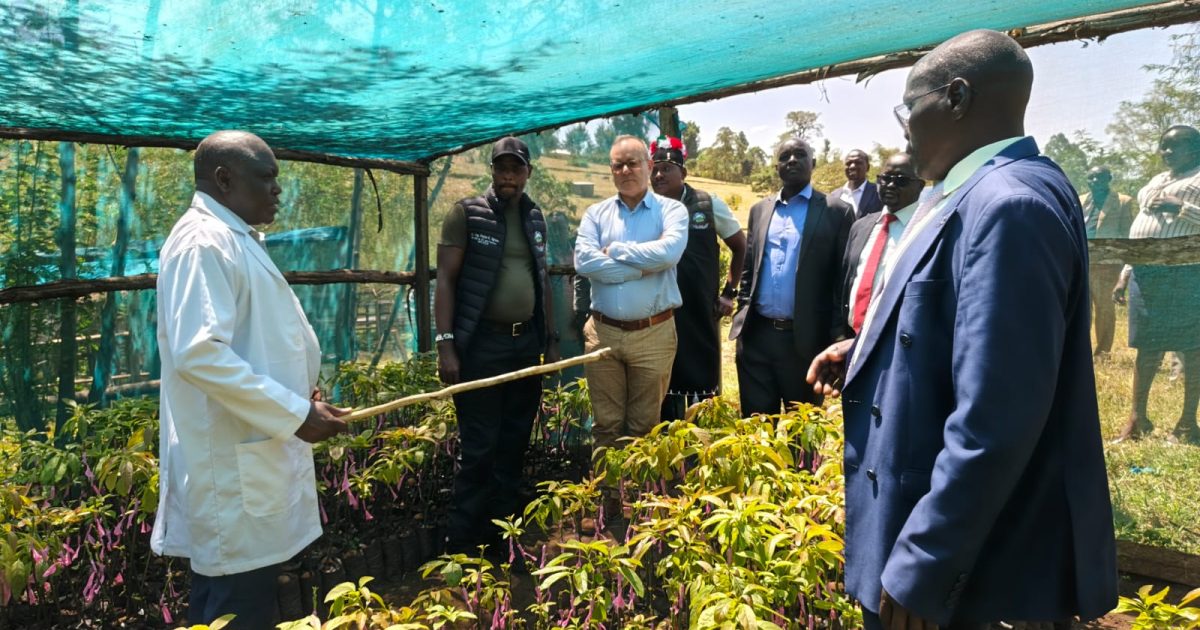
West Pokot governor Simon Kachapin on Thursday visited Aramaket fruit tree nursery to assess the progress the project has already achieved since its inception last year.
The project is under the larger Cherangany Forest Ecosystem Restoration Programme and is funded by the Italian Government through the Italian Agency for Development Cooperation (AICS), implemented by NETFUND, in partnership with County Governments of West Pokot and Elgeyo Marakwet, Kenya Forest Service (KFS), Nature Kenya and local communities.
Launched in early 2025, the four-year project targets degraded land through agroforestry and sustainable practices and is set to benefit over 270,000 families while boosting tree cover and strengthening rural livelihoods.
The governor was accompanied by the Italian Ambassador to Kenya Dr. Vincenzo Del Monaco, the Principal Secretary Ministry of Environment Dr. Eng. Festus K. Ng’eno and representatives from Netfund and other government institutions.
The primary objective is to restore approximately 92,000 hectares of the degraded Cherangany forest, rehabilitating critical ecosystems and strengthening climate resilience by enhancing water catchments, regulating local weather patterns, and supporting sustainable livelihoods for surrounding communities.
Registration and vetting for community participation in restoration and sustainable livelihoods is ongoing in Lelan, Siyoi, Weiwei, and Sekerr wards in West Pokot.
“The Ministry is open to such partnerships from development partners and county governments at the local levels to restore our degraded ecosystems to its original state caused by destruction and by the global climatic changes,” PS Ng’eno emphasized.
This also aligns with the presidential directive on tree-growing targets of planting about 15 billion trees by 2032.
The Italian ambassador lauded the collaboration between Kenya and Italy mentioning the consistency and coherence in working together to identify tangible problems affecting the communities and the positive impacts such projects have achieved.
Planting fruit trees creates jobs through seedling production in nurseries, ongoing farm management and maintenance, and harvesting providing both seasonal and long-term employment across the agricultural value chain.
The idea is intended to support sustainable agriculture to enhance food security within the community at the same time conserve the environment as the trees help maintain soil stability as the ecosystem in the region is mostly hilly and prone to landslides.
Ambassador Monaco lauded the collaboration between Kenya and Italy, mentioning the consistency and coherence in working together to identify tangible issues impacting the communities and the positive impacts such projects have achieved.
The fruit trees include mangoes and avocados together with cash crops such as coffee and macadamia which are grafted to ensure faster fruiting, consistent quality, improved disease resistance, better adaptability to local conditions, and controlled tree size for higher productivity.
Lilian Kosgey, a local farmer and project beneficiary, said the initiative has already transformed her livelihood by providing employment at the nursery and supplying her with tree seedlings, sustaining her income.
She noted that the trees are fast-growing and are of good quality as compared to the indigenous fruit trees and is counting on enjoying the fruits of her labor in a year’s time.
Farmers, especially the youth have been urged to turn up in large numbers to register and receive the tree seedlings for free by meeting the minimum requirements which are registration with the village representatives, securing the land by fencing, cultivating and finally digging the holes for planting the trees.
Farming and agribusiness are emerging as key pathways to sustainability, and with rising unemployment, young people are encouraged to embrace agriculture as a viable source of income and long-term economic stability.
By Parklea Ivor