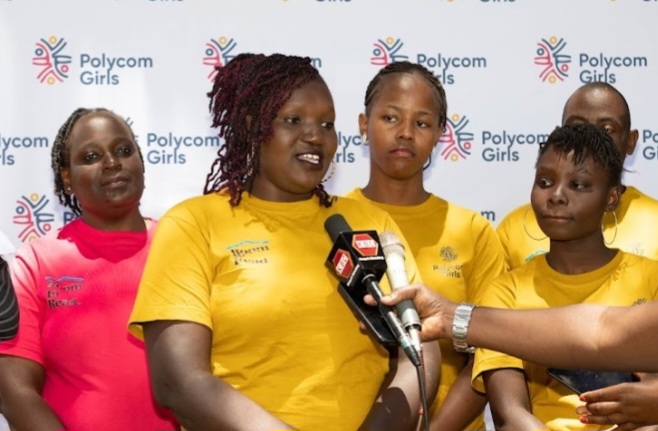
As the world marked the International Day of the Girl Child and also commemorated 30 years since the Beijing Declaration and Platform for Action, Polycom Girls, Nairobi, in partnership with Room to Read, joined the global community in celebrating the power, voice, and potential of every girl.
The celebration, themed “The Girl I Am, The Change I Lead”, called for renewed commitment to empower girls as agents of change and leaders in shaping a just and inclusive future.
This year’s event, held in Kibera, Nairobi, showcased Room to Read’s global “She Creates Change” project, a storytelling initiative that highlights the real-life journeys of girls who have overcome immense challenges to lead transformation in their communities.
In Kenya, Polycom Girls has localised this initiative across Kibera and Homa Bay County, combining storytelling, mentorship, and creativity to nurture leadership among adolescent girls.
Speaking during the event, Board Member at Polycom Girls, Brenda Kalekye, emphasised that the day amplifies the voices of young girls and celebrates their achievements despite adversity.
Kalekye said that by investing in education, leadership, and equality, we are not just shaping the future of individual girls; we are transforming societies, noting that during this International Day of the girl child, Polycom Girls and Room to Read reaffirm their commitment to empowering girls as change makers.
“Accessing Sexual and Reproductive Health Rights remains a challenge for many girls in informal settlements, but through Polycom Girls’ programmes, we’ve kept hundreds of girls in school by addressing issues around menstruation, education, and dignity,” she said.
Kalekye said the event featured film screenings, interactive sharing circles, and a Siri Ya Mwezi comic session on menstrual health and dignity, noting that ‘The girl I am, the change I lead’ is more than a theme, It is a movement, one that begins with a story, grows with mentorship, and blossoms into leadership.
Polycom Girls Mentor Lavenda Odhiambo noted that the initiative aligns with SDG 4 (Quality Education) and SDG 5 (Gender Equality) goals that are deeply intertwined in ensuring that girls gain knowledge, leadership skills, and confidence to change their communities.
“Through storytelling, we help girls relate, reflect, and rise. They begin to see themselves as leaders and decision-makers,” she added.
Polycom Girls’s menstrual Health Program Lead, Esther Musavi, highlighted the ongoing struggle to access hygiene products, particularly in informal settlements and rural areas, noting that they work with women who locally make disposable pads for girls.
“Many of the girls we support have faced FGM, teenage pregnancy, and early marriage. Through small grants and support, we help them return to school,” she explained.
Lydia Achieng, an adolescent mentor and member of the UNFPA Youth Advisory Panel, underscored the importance of mentorship and leadership development.
“For too long, girls have shied away from leadership. But through mentorship and multimedia programmes like She Creates Change, we’re seeing transformation. Girls are now taking initiative in schools, communities, and even national forums,” she said.
Kelvin Ouma, a male champion with Polycom Girls, added that gender equality requires partnership. “This is not a gender fight. Men and boys must collaborate with girls to create safe, equitable spaces for all,” he said.
Chris Musonya, a patron representing Polycom Girls in schools, reaffirmed their commitment to holistic support for girls.
“Through the Talking Boxes initiative, girls can confidentially report issues affecting them. Our quick response teams ensure they receive emotional and practical support to stay in school,” he explained.
According to UNICEF, globally, over 129 million girls are out of school, with Kenya facing persistent challenges that threaten girls’ education and wellbeing.
In Homa Bay County, about 33 per cent of girls aged 15–19 are either mothers or expectant, nearly twice the national average of 18 per cent. The teenage fertility rate stands at an alarming 178 births per 1,000 girls.
In Kibera, girls in informal settlements are more likely to drop out of school due to poverty, lack of menstrual products and social pressures such as early marriage or care responsibilities.
These realities make it clear that empowering girls is not a choice; it is a necessity. Programmes like She Creates Change play a vital role in bridging educational and gender gaps, fostering leadership, and ensuring that no girl is left behind.
As we mark three decades since the Beijing Declaration, the link between education (SDG 4) and gender equality (SDG 5) remains central to sustainable development.
Educated girls gain confidence, agency and economic independence, breaking cycles of poverty and inequality. When girls lead, entire communities thrive.
By Anita Omwenga