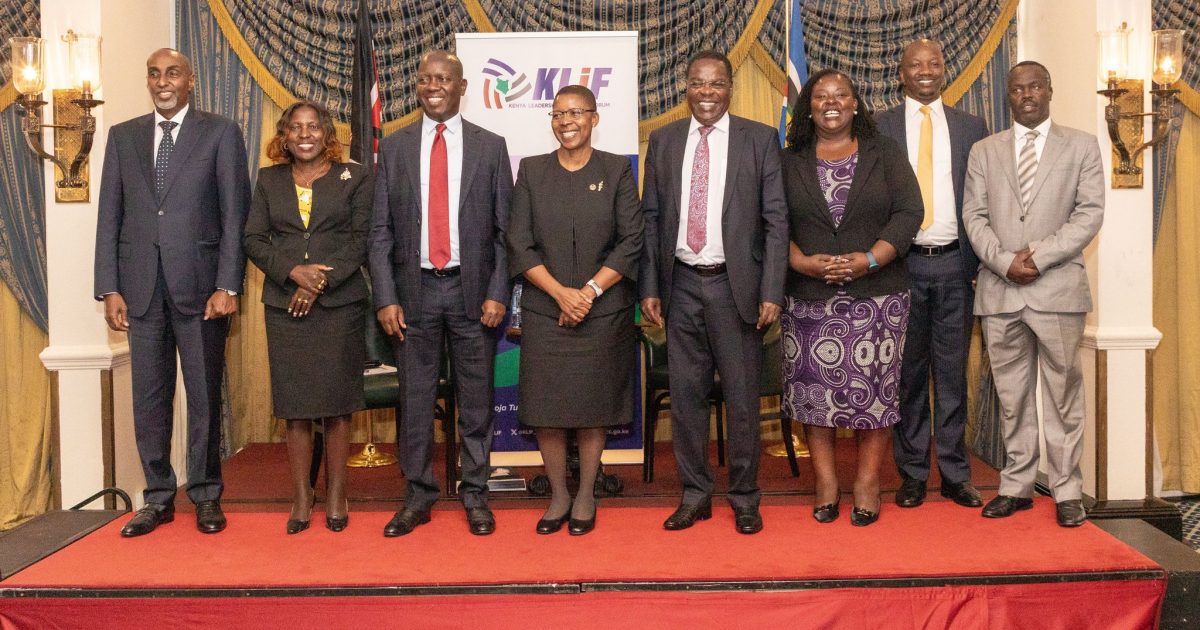
For Kenya to realize its potential and achieve greater prosperity, the Government and Private sector have partnered on Anti-Corruption under the umbrella of Kenya Leadership Integrity Forum (KLIF) to develop strategies to mitigate corruption.
As a follow up to the 56th National Coordinating Committee (NCC) meeting held in Nairobi on 14th May 2025 chaired by Attorney General Dorcas Oduor, The KLIF Sector Coordinating Committee unveiled a progressive report Friday June 6th 2025 following a workshop held in Machakos.
The report on the workshop for the Sector Coordinating Committee (SCC) held on 19th – 23rd May 2025 at Machakos University, Led by Head of KLIF Secretariat Ms. Joyce Munene recommended anchoring KLIF to law in line with the Kenya Integrity Plan (KIP 2023-2028).
This among other interventions will empower the platform to comprehensively harness the strengths of all stakeholders in combating corruption and unethical practices, while fostering ethics in society and institutions.
Currently, there are 20 sectors under KLIF which comprise Kenyan Citizens representing Watchdog Agencies, Media, Civil Society, Private Sector, Faith, Professional Bodies, Regional and Sub-Regional Bodies, Development Partners, Executive, Legislature, Judiciary, Transport, Education, Labour, County Government, Anti-Corruption Agencies, Constitutional Commissions, Regulatory Boards, Financial Services and Enforcement.
KLIF Patron President William Ruto launched the new Kenya Integrity Plan (KIP 2023-2028) on February 27, 2025 noting that effective coordination of its implementation was key to achieving the desired results through a unified and integrated approach in the promotion of ethics and integrity as envisioned by the Ethics and Anti-corruption Commission (EACC).
During the launch, President Ruto acknowledged the challenge posed by corruption in the attainment of socio-economic and political aspirations at both global and national levels and committed to remain steadfast and ready to fight it head-on.
The President called for collective efforts in tackling and preventing corruption noting that such a resolve embodies and speaks to what every Kenyan wants. President Ruto reiterated the government’s commitment to strengthen the anti-corruption legal and policy frameworks as a strategy to expediting economic development.
For this reason and indeed based on our commitment to the people of Kenya to promote transparency and accountability in service delivery, the Kenya Leadership Integrity Forum (KLIF), developed Kenya Integrity Plan to guide the country’s anti-corruption trajectory for the period 2023-2028.
Corruption keeps evolving making it even more complex and hence requires collective action both within and outside government. It is for this reason that KLIF was established as a multi-sectoral forum to promote a unified stakeholder approach in the fight against corruption.
The multi-sectoral forum that brings together both state and non-state actors, is a bold step in the fight against corruption. The Ethics and Anti-Corruption Commission (EACC) acts as the Secretariat of KLIF while the Executive, through the Office of the Attorney General, chairs the Forum.
All the 20 state and nonstate actors that make up KLIF are urged to continue partnering for a unified and integrated fight against corruption and unethical practices. The Plan provides a concise roadmap through which deliberate outcomes will be realized in the fight against corruption.
In line with that, the government will spare no effort in supporting all sector players to achieve the vision of the Plan of having an ethics and integrity-driven society.
Kenya has over the years had to grapple with the threat of corruption that threatens to permeate every fabric of the Kenyan society. Various interventions put in place to fight corruption ranging from setting up a dedicated anti-corruption body to enacting a host of legal and policy frameworks on corruption have so far yielded results.
Attorney General Dorcas Oduor noted that the unyielding menace of corruption even in the face of these interventions serves to strengthen the resolve to conceive additional strategies to combat corruption.
The AG observed that the new KIP will henceforth guide the multi-sectoral approach in promoting integrity and ethical practices in the society. Overall, the Plan focuses on the evolving nature of corruption and strengthening existing anti-corruption legal and policy framework and setting the stage for the enactment of new laws where there are legislative gaps.
Abdi Mohamud, Secretary/Chief Executive Officer, EACC, and Secretary National Coordinating Committee Kenya Leadership Integrity Forum added that Kenya Integrity Plan (KIP) 2023-2028 was a strategic blueprint aimed at fostering collective action and partnerships to enhance integrity and accountability in Kenya. Through the Kenya Leadership Integrity Forum (KLIF), the plan promotes a collaborative approach to ethics and integrity, leveraging the strengths of various stakeholders.
The key objectives of KLIF, said Mohamud, include mobilizing and empowering Kenyans to actively participate in the fight against corruption, developing mechanisms for evaluating the effectiveness of anti-corruption initiatives, mainstreaming anti-corruption policies and strategies across different sectors and mobilizing resources to support efforts against corruption and unethical conduct.
CEO Mohamed reaffirmed that the Commission remains committed to providing technical and coordination support, aiding in the implementation of the plan at various institutional levels.
The plan was developed by a dedicated team of technical officers representing the 20 sectors within KLIF, led by Mr. Godfrey Simiyu of the Kenya Revenue Authority.
By Joseph Kamolo Mutua