A joint initiative between the Government of Kenya and the World Bank (WB) has been hailed as a game changer in enhancing the uptake of Information and Communication Technology (ICT) skills in public learning institutions across the country.
The partnership, implemented through the Kenya Primary Education Equity in Learning Programme (KPEELP), has significantly improved education infrastructure, teacher training, and access to digital learning resources, particularly in underserved regions.
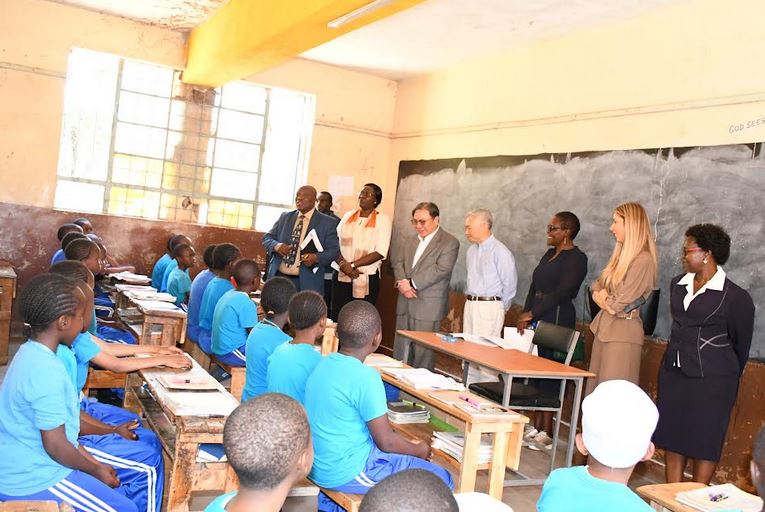
Speaking during a visit by a World Bank delegation to Nyamachaki Comprehensive School in Nyeri County, Central Region Director of Education Sabina Aroni said the collaboration has facilitated the construction of additional classrooms in schools and teachers training colleges, aimed at equipping learners with relevant skills needed in the modern workforce.
Nyamachaki Comprehensive School is among the institutions benefiting from the program, having received funding for the construction of four new classrooms through the World Bank under KPEELP. The bank has cumulatively invested Sh4 million in the project.
Aroni disclosed that President Dr. William Ruto personally injected Sh10 million towards the construction of eight classrooms at the school, with additional funding sourced from the World Bank through the KPEELP initiative. Four of the classrooms will accommodate Grade 8 learners, while the remaining four will host Grade 9 students.
The school currently has a population of 2,280 learners, and the additional infrastructure is expected to ease congestion and create a more conducive learning environment.
“Under the Competency-Based Curriculum (CBC), ICT skills are among the key competencies we want learners to acquire,” Aroni said. “Teacher training colleges have been well prepared, and we are confident that once these teachers get to the field, it will be easier and faster to pass ICT skills to learners across the country.”
She noted that the pace of ICT skills acquisition has previously been slow due to inadequate infrastructure and lack of equipment, particularly in public institutions. She therefore welcomed the World Bank’s intervention, saying it has come at a critical time to bridge existing gaps.
“We appreciate this support because lack of equipment and infrastructure has been a major hindrance. Supporting teacher training colleges is particularly important because these institutions prepare teachers who then go out to impart knowledge and skills to learners,” she added.
Aroni further observed that limited ICT infrastructure, such as computer laboratories and digital learning equipment, has been a persistent challenge in public schools for years. She said the government, in partnership with development partners like the World Bank, is now addressing these shortcomings through targeted investments.
Beyond infrastructure development, Aroni pointed out that the partnership has also been instrumental in supporting learners from disadvantaged backgrounds through scholarship programs.
“Through initiatives like the Elimu Scholarship, learners from low-income families who would otherwise be unable to afford boarding school education are supported,” she explained. “These interventions are helping address social and economic barriers that have hindered access to quality education.”
She acknowledged that overcrowding due to inadequate physical facilities remains a challenge in some schools but noted that the ongoing projects under KPEELP are helping to alleviate the problem.
On his part, Wencai Zhang, the World Bank Group Chief Administrative Officer, emphasized the need to encourage more girls to pursue Science, Technology, Engineering, and Mathematics (STEM) subjects, describing it as a key step toward breaking long-standing gender stereotypes in education.
Zhang said the time has come for deliberate efforts to increase female participation in science and technical fields in order to ensure fairness and inclusivity in future career opportunities.
“I would like to see more female teachers, particularly in junior and senior secondary schools, teaching mathematics and science subjects,” Zhang said. “Teachers are role models, and when girls see more women teaching STEM subjects, they are more likely to develop interest and confidence in these areas.”
He added that increasing female representation in STEM education is critical for building a balanced workforce capable of driving innovation and development.
World Bank Education Specialist Ruth Charo echoed Zhang’s sentiments, saying several measures are already being implemented to encourage girls to take up STEM subjects.
Charo noted that teacher training programs conducted through African Centers of Excellence are helping to equip educators with skills and strategies to motivate girls to pursue subjects such as chemistry and physics.
“These interventions are important for pipeline development at the secondary school level,” Charo said. “Unfortunately, many girls drop science subjects at Grade 10 and Grade 11, resulting in low uptake of STEM disciplines by the time they transition to tertiary education.”
She explained that while female enrollment is relatively high in teachers training colleges, gender imbalance becomes more pronounced in science-based programs at higher diploma colleges and universities.
“In science programs like chemistry, physics, and mathematics, male students tend to dominate, while females are more concentrated in biology,” Charo noted. “We want to change this trend by encouraging girls early and supporting them throughout their education journey.”
Earlier, the World Bank delegation paid a courtesy call to the Nyeri County Government, where they were received by Governor Dr. Mutahi Kahiga. Discussions focused on strengthening collaboration to enhance service delivery and development outcomes in the county.
Currently, the World Bank is overseeing the implementation of several major projects in Nyeri County, including the Kenya Informal Settlements Improvement Project (KISIP), Kenya Devolution Support Programme (KDSP), National Agricultural Value Chain Development Project (NAVCDP), and Financing Locally Led Climate Action (FLLoCA).
The government–World Bank partnership continues to play a critical role in advancing education reforms, improving infrastructure, promoting digital literacy, and ensuring equitable access to quality education for all learners
By Samuel Maina & Wangari Mwangi