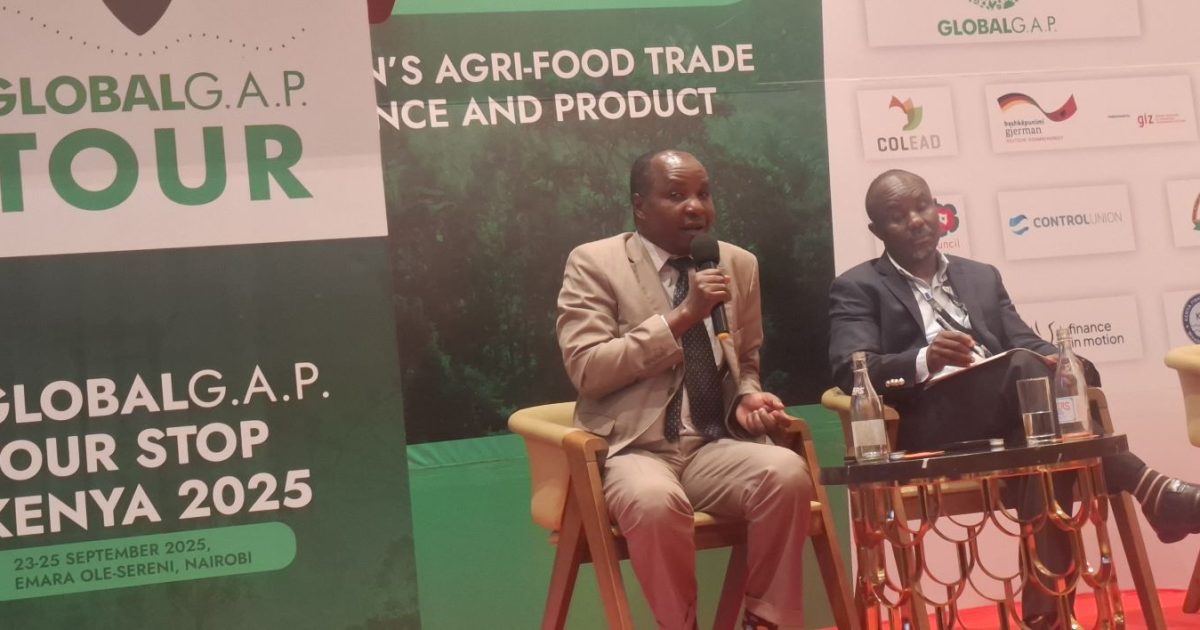
Safety, regulation, and responsible use of pesticides and pest control are topics that took center stage at the GLOBAL G.A.P. Tourstop 2025 meeting that brought together farmers, government representatives, and private sector players from the region.
The meeting held in Nairobi under the theme “Driving the Region’s Agri-food Trade Through Compliance and Product Diversification” discussed the concerns around pest control products.
Pest Control Products Board (PCPB), Chief Executive Officer (CEO), Fredrick Muchiri, spoke of the Maximum Residue Limits (MRL), which is the highest level of a pesticide residue that is legally tolerated in or on food or feed when pesticides are applied correctly.
“I want to clarify that MRL is not a measure of safety but is a market standard, and the fact that certain region has certain MRLs which are different from other regions does not mean that those who use the pesticides are actually poisoning themselves; that is not true,” he explained
Muchiri said governments have a responsibility to shield citizens from the dangers of pesticides and that for Kenya, products used as non-consumables are evaluated to ensure their safety to operators and also the environment.
He acknowledged the challenge of cross-border trade, particularly at the Kenya-Tanzania side, where pesticide shops on the Tanzanian side supply Kenyan farms but noted that they have increased surveillance, joint enforcement, and collaboration between agencies and land border police to reduce illegal inflows.
“Working with stakeholders, such as the Agro-Chemical Association of Kenya (AAK) and the Anti-Counterfeit Authority (ACA), we have reduced the problem by close to 70 percent,” he said
Muchiri, however, noted that interceptions of Kenyan produce in export markets usually occur when farmers do not adhere to good agricultural practices when it comes to the application of pesticides.
“We have introduced training programmes targeting extension officers to promote responsible pesticide use and once this is done, incidences of interception will come down,” he said
On counterfeit pesticides and illegal imports, Muchiri talked of ongoing risk assessment and enforcement mechanisms, saying Kenya is the only country in Africa that is undertaking risk assessment in regulatory decision-making processes.
When it comes to testing products, the CEO said Kenya has the capacity to analyze pesticide formulations and undertake analysis to determine the types of pest control products used on food commodities.
Eric Kimunguyi, Chief Executive Officer of AAK/GROW/Croplife, said that the evolution of pest control industry is evolving as agriculture evolves and the complexity surrounding the use of pest control, including withdrawals and restrictions of use, is also arising because of new science that is coming.
“One has to provide data that shows remnants applied to a crop remain in field and that the product is safe, can be utilized by the consumer”, he said and adding that MRL are largely about trade requirements
He noted that responsible companies are committed to phasing out highly hazardous pesticides (HHPs) and currently the country is almost at zero HHPs and due of developing sustainable business management frameworks.
Kimunguyi highlighted innovations aimed at reducing farmer exposure, including the use of drones of pesticide application and the deployment of trained service providers such as farmers who are trained, have the knowledge, have personal protective equipment and can apply on behalf of the farmers.
He, however, cautioned against the withdrawal of products by authority without clear alternatives, warning that this could drive farmers to source from the black market ending up in what he termed as “regrettable substitutions.
Both CEOs underscored on the need to harmonize pest control standards within the East African region to curb illegal trade and streamline standards from regional farmers.
“Differences in national regulation soften create loopholes and the EAC harmonization tool is going to address the gaps and although it is moving slowly, it will reach the level of standards use of regulations,” Kimunguyi said
The East African Community (EAC) harmonized tool is a Pesticides Management Guidelines that supports frameworks created to standardize the testing and registration of conventional pesticides and bio pesticides across the region, to improve farmer access to safe, effective, and affordable products
During the meeting, stakeholders agreed that pest control products remain critical to not only Kenya’s agricultural productivity and exports but also the region, and these require strict regulation, careful stewardship, and farmer education.
Regulatory and industry stakeholders also agreed that balancing food safety, environmental protection and market access will demand not only science-driven decisions but also closer collaboration across borders, value chains and regulatory systems.
By Wangari Ndirangu