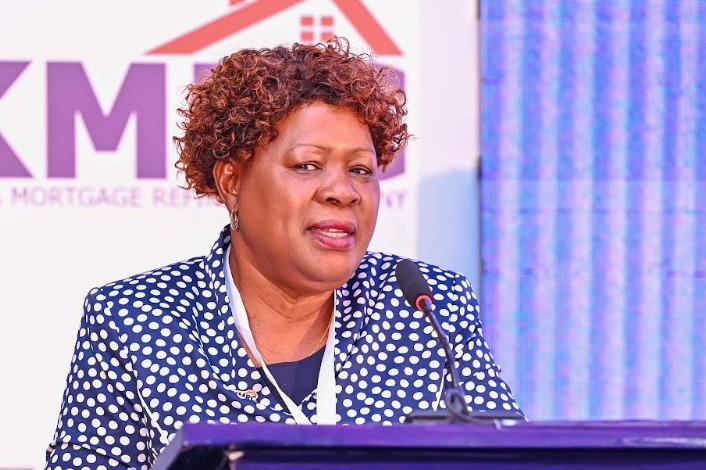
The government has called on private sector players to actively support Kenya’s Affordable Housing Programme, amid a massive Sh326 billion annual financing shortfall.
Lands, Housing and Urban Development Cabinet Secretary (CS) Alice Wahome made the appeal in Kisumu during the 4th Kenya Affordable Housing Conference (KAHC 2025), where she revealed that while the government needs Sh400 billion annually to meet its target of 200,000 affordable housing units per year, only Sh74 billion is currently being raised through the housing levy.
“This gap in financing is an opportunity. We expect the private sector to play an active role to help bridge the gap,” she said.
The CS announced that the government was exploring partnerships with commercial banks, retirement benefit schemes, mortgage schemes, SACCOs, development partners, and the wider business community to raise the required resources.

Wahome added that the ministry has developed affordable housing regulations which will give impetus to the drive to enforce the housing levy to net more resources from the informal sector.
“We are mainly collecting from the pay slip but the regulations allow us to look for funds from every Kenyan who has an income who will also be able to purchase the units,” she said.
This, the CS said, would secure additional funds for the project, affirming the government’s commitment to delivering one million affordable housing units by 2027.
She said so far, about 170,000 units were under construction nationwide, while other projects worth Sh600 billion are in the pipeline.
Her ministry, she added, has rolled out digitisation of land records through the Ardhisasa platform to accelerate mortgage processing and reduce fraud.
The platform, which is currently operational in Nairobi and Murang’a, she said, would be rolled out to 10 additional counties within the year.
“At the policy level, we are undertaking a comprehensive review to update and harmonise land laws. Our goal is to create a secure, transparent, and inclusive housing ecosystem that works for every Kenyan,” said Wahome.
Housing Secretary Said Athman said the government was on course with the implementation of the project, with over 3,000 units already handed over.
From January next year, he said, more units shall be handed over on a monthly basis, adding that all the contractors have been instructed to roll out night shifts to fast-track the project.
The housing programme, he added, was delivering not just units but also jobs. So far, he said, 300,000 jobs have been created, with projections to reach 900,000 by the end of the year as construction working times increase to two shifts per day.
The government, he said, has also advertised 4,000 internship opportunities for architects, engineers, plumbers, and other technical professionals.
“This initiative targets to mop up all our young people who have qualifications in the building industry as part of the government’s wider initiative to create jobs,” he said.
Athman noted some challenges, including scarcity of construction materials, limited local manufacturing capacity, and underutilisation of contractors.
“Kenya’s construction sector has never operated at such a large scale and that’s why we are experiencing these challenges,” he said.
The two-day conference, hosted by the Kenya Mortgage Refinance Company (KMRC), drew hundreds of stakeholders from government, finance, construction, academia, and the international community, with delegates from India, Malaysia, Pakistan, Tanzania, and Uganda attending.
KMRC Chief Executive Officer (CEO) Johnstone Oltetia said the institution had disbursed over Sh21.4 billion in low-interest, long-term funding to primary mortgage lenders, enabling 4,500 affordable home loans across 39 counties.
He stressed the importance of housing solutions that cater to the 80 per cent of Kenyans working in the informal sector.
“If our housing solutions aren’t designed to meet Kenyans where they are, we will never close the housing gap,” said Oltetia.
Kisumu Governor Prof. Anyang’ Nyong’o highlighted the role of counties as equal partners in delivering affordable housing, in line with the 2024 Affordable Housing Act.
“In Kisumu, we look at affordable housing not just as shelter but as a powerful instrument for equality, dignity, and economic development. We have embedded housing in our urban development strategy, streamlined approvals through digitisation, and provided serviced, titled land to catalyse investment,” said Nyong’o.
He cited several flagship projects underway in Kisumu: Makasembo (1,830 units), Anderson-Ofafa (1,200 units), Lumumba Estate (2,034 units), Kanyakwar (2,600 units) and the Kirembe project.
Nyong’o said effective coordination between county and national governments was critical to avoiding fragmented mandates and inefficiencies that can erode investor confidence. “We must act not as competing jurisdictions but as co-owners of a unified housing vision,” he said.
The conference continues Friday with panels on green housing, financing models, land digitisation, and global best practices.
By Chris Mahandara