The national government has intensified efforts to bring inclusive development closer to the people across counties, in line with the Bottom-Up Economic Transformation Agenda (BETA), aimed at improving livelihoods for all citizens.
The development model being spearheaded by the Kenya Kwanza government for the 2023-2027 period is structured around five core pillars, aimed at economic turnaround, inclusive growth and job creation across the country.
These pillars include Agriculture, Micro, Small and Medium Enterprises (MSMEs), Affordable housing and settlement, Affordable healthcare, as well as the Digital and creative economy.
Consequently, the impact of BETA projects and programmes is already evident through a number of the ongoing and completed development initiatives in Vihiga county .
For instance, in the agricultural sector, the National Agricultural Value Chain Development Project (NAVCDP) is supporting local farmers through improved access to farm inputs, value addition, and expanded market opportunities.
Infrastructural development has also taken centre stage, with major investments in road construction.
Towards this end, the Gisambai–Hamisi–Senende Road, a 13.5-kilometre stretch launched in 2020, has already been completed and upgraded to bitumen standards.
Similarly, the Ekwanda–Lwanda–Esirulo–Magada Road, spanning 27 kilometres, has also been completed, significantly improving connectivity and easing the movement of goods and people.
Several other road projects are currently underway, including the 33-kilometre Shamakhokho–Kaimosi–Mpaka–Mululu–Museno–Malinya Road, a major project designed to connect Vihiga and Kakamega counties.
The rehabilitation and upgrade to bitumen standards of the key road is being funded by the government of Kenya at a cost of Sh1.57 billion.
The project aims to reduce travel time, lower transportation costs, enhance safety, and boost trade and agriculture in the Western region.
The Mbale–Mbihi–Magada–Wemilabi–Luanda Road, a 20.8-kilometre stretch, is equally being upgraded to bitumen standards, the same as the Mago–Mululu–Wangulu Road and Lusuli–Vokoli Road, measuring approximately 20 kilometres.
Additionally, reconstruction and rehabilitation works on the Stendikisa–Luanda Road, a 24-kilometre stretch, are nearing completion.
In the trading sector, the government is constructing ten modern markets, each costing over Sh 300 million to support MSMEs and improve working conditions for traders.
Key among them are Chavakali and Mbale markets, which are currently under construction.
The government is also investing in sports, including the upcoming Sh 900 million 10,000 seater Kidundu modern stadium located in Vihiga sub-county that is expected to nurture local talent and promote youth empowerment.
Other key development projects for the region include the ongoing affordable housing projects like the VihigaTown/Majengo featuring 220 units and multiple 340 bed hostels for local technical institutions like Ebukanga Technical and Vocational College (TVC), Sabatia TVC and the Kaimosi Agricultural Training College, aimed at addressing accommodation needs and improving living standards.
At the same time, the government has embarked on the construction of the Kenya School of Government Vihiga campus at a cost of Sh1.1 billion, in a move aimed at strengthening public service training, research and capacity building, while at the same time stimulating the local economy.
And to strengthen public awareness, the government has rolled out intensive training programmes for National Government Administrative Officers (NGAO) countrywide and other implementing agencies, tasked with cascading the BETA message to the grassroots through public barazas and other community forums.
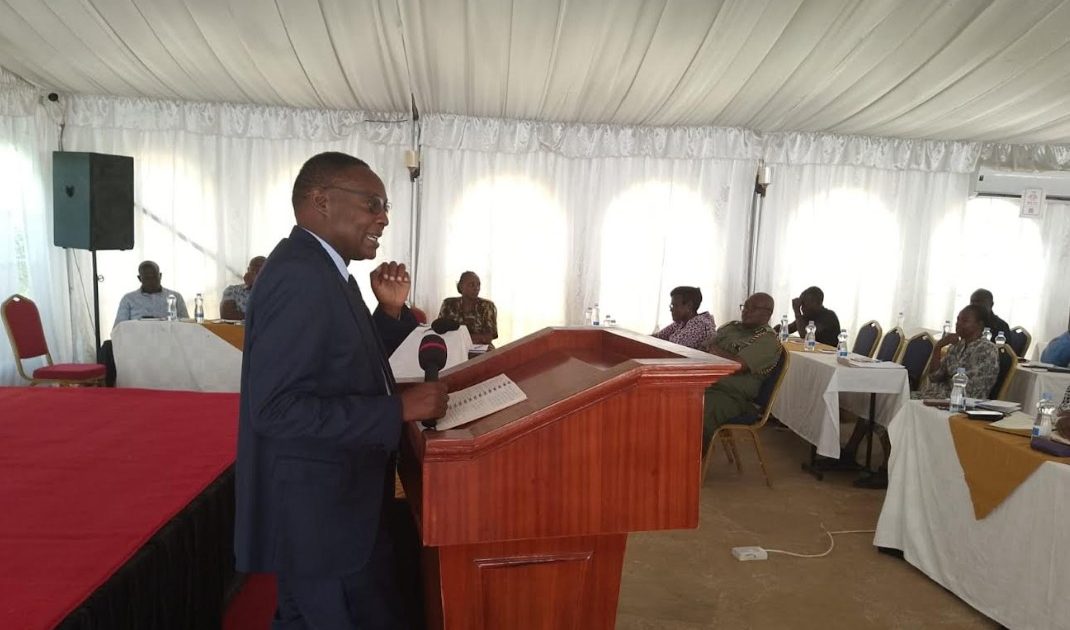
In the just concluded meeting with NGAO and other agencies in Vihiga county, County Commissioner Peter Maina emphasised the need for an informed public on the ongoing projects.
“These projects are more than just structures; they are the foundation for sustainable growth and community empowerment,” said Maina, adding, “When citizens understand and engage with these initiatives, they become active partners in development.”
In essence, the government wants BETA projects and programmes translated into tangible benefits, including improved infrastructure, enhanced access to markets, affordable housing, employment opportunities, digital skills development and support for creative talents.
They emphasise that an informed public is the foundation of national progress, noting that meaningful development can only be achieved when citizens understand government programmes and actively participate in their implementation.
Meanwhile, as the country moves forward, the Bottom-Up Economic Transformation Agenda remains a beacon of hope, promising inclusive growth and shared prosperity for all Kenyans.
By Rose Wasike